All species › Tubenoses › Petrels, shearwaters and diving petrels › Antarctic Prion
Antarctic Prion | Pachyptila desolata
Antarctische prion | Prión Antártico | Faigão-rola
The Antarctic Prion is a small, blue-grey petrel of the southern oceans and the most numerous of the prions. With its broad bill, which has fine, comb-like lamellae along the edges, it filters small plankton from the water. In the guide area it is a rare vagrant at sea off the coast of Peru.
Voice
Silent at sea. In the colonies cooing and purring calls from the burrows at night.
Recording: Émile Brisson-Curadeau — CC BY-NC-SA 4.0 · xeno-canto
Identification
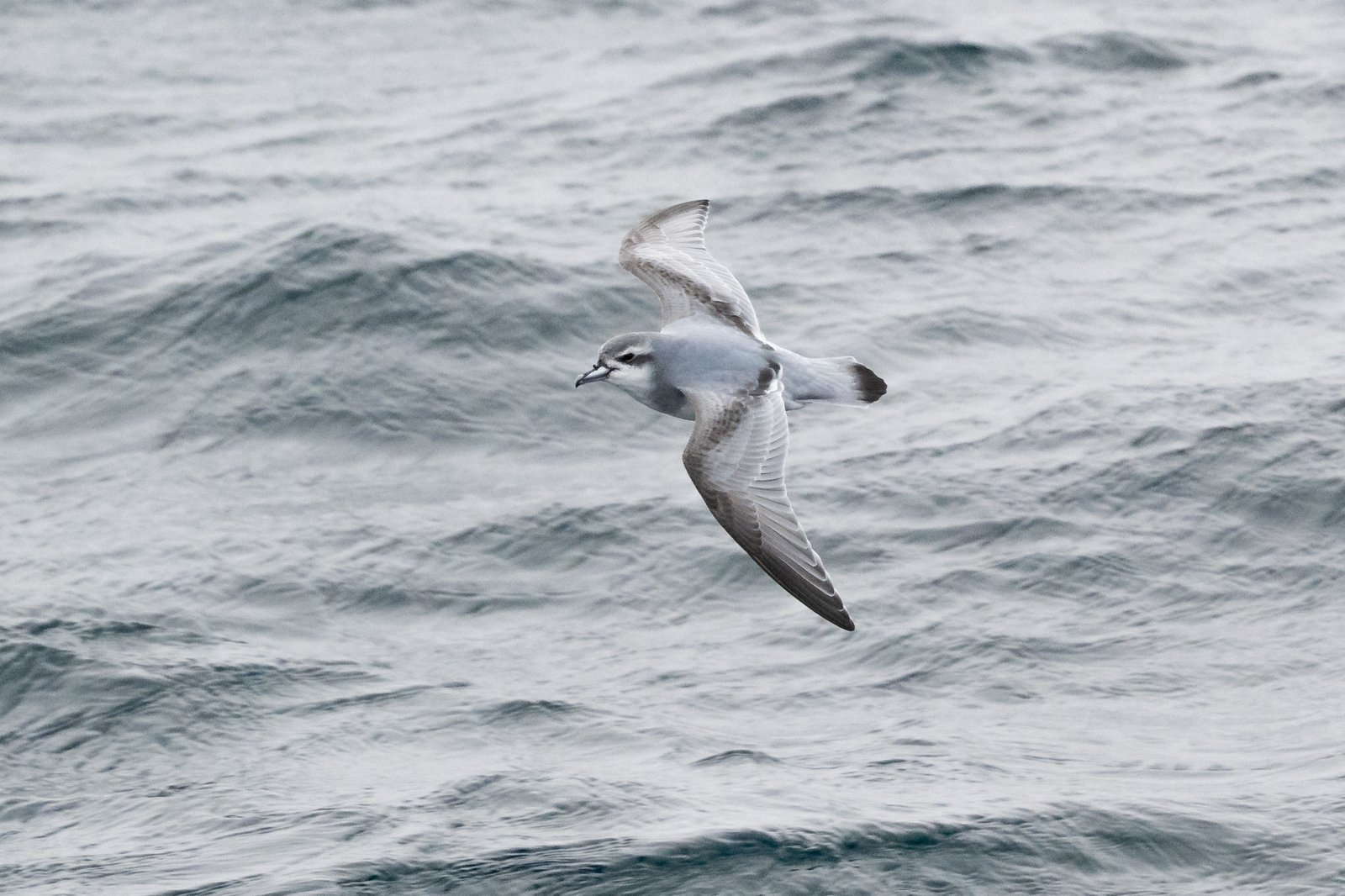
25–27 cm, a small, stocky petrel with a fairly large head and a broad, blue-grey bill with lamellae along the edges. The upperparts are blue-grey, with a broad blackish M across the wings and back and a broad dark terminal band on the wedge-shaped tail. The head shows a narrow white supercilium and a dark stripe through the eye; a grey half-collar marks the side of the breast. The underparts are white. It flies low and fast, banking and tilting over the waves. The sexes are alike.
Confusion species
Slender-billed Prion Pachyptila belcheri has a clearly narrower bill, a paler head with a broader white supercilium, a less sharp M and only a narrow dark tail tip; at sea the two species can often be separated only with good photographs of the bill. Pintado Petrel Daption capense is larger and chequered black and white. Southern Fulmar Fulmarus glacialoides is much larger, with a pink bill and no M.
Habitat
Open ocean and cool inshore waters, outside the breeding season often in flocks over cold, productive currents. It feeds mainly on krill, copepods and other small crustaceans, filtered from the surface while swimming or picked up with the head under water. It breeds in colonies in burrows and rock crevices on subantarctic islands and along the Antarctic Peninsula.
Where the bird is most at home, classified by the vegetation units of the Andes and the west coast.


Range and movements
Rare vagrant at sea off the coast of Peru, mainly in the austral winter; because of the similarity to Slender-billed Prion there are few confirmed records. Not known from Colombia, Ecuador, Bolivia or the Galápagos. Outside the guide area it breeds on islands around Antarctica, including South Georgia, the South Orkney Islands, Kerguelen and the Auckland Islands; outside the breeding season it ranges over the southern oceans.
How and when to look
On pelagic trips off southern Peru in the austral winter, check every prion and photograph the bill from above and from the side.
Conservation status
Least Concern. The world population numbers many millions of birds. Introduced rats and cats on breeding islands are local threats.
Scientific name
Pachyptila desolata | (Gmelin, 1789)
Gmelin described the species in 1789 as Procellaria desolata; because it was later moved to another genus, the author and year stand in brackets. The genus Pachyptila was introduced in 1811 by Illiger. The genus name comes from Greek pakhus, 'thick', and ptilon, 'feather', after the dense plumage. The species name is Latin desolatus, 'desolate', after Desolation Island, the old name of Kerguelen. The specimen the first description was based on came from Kerguelen Islands.