All species › Tubenoses › Petrels, shearwaters and diving petrels › Manx Shearwater
Manx Shearwater | Puffinus puffinus
Noordse pijlstormvogel | Pardela pichoneta | Bobo-pequeno
The Manx Shearwater is a medium-sized, crisply black-and-white shearwater that breeds in the North Atlantic and winters in the South Atlantic. In the guide area it has only been recorded as a very rare vagrant. Each year it travels tens of thousands of kilometres between its breeding and wintering areas.
Voice
Silent at sea. At the breeding colonies loud, crowing and hiccupping calls at night.
Recording: Anthony McGeehan — CC BY-NC-SA 4.0 · xeno-canto
Identification
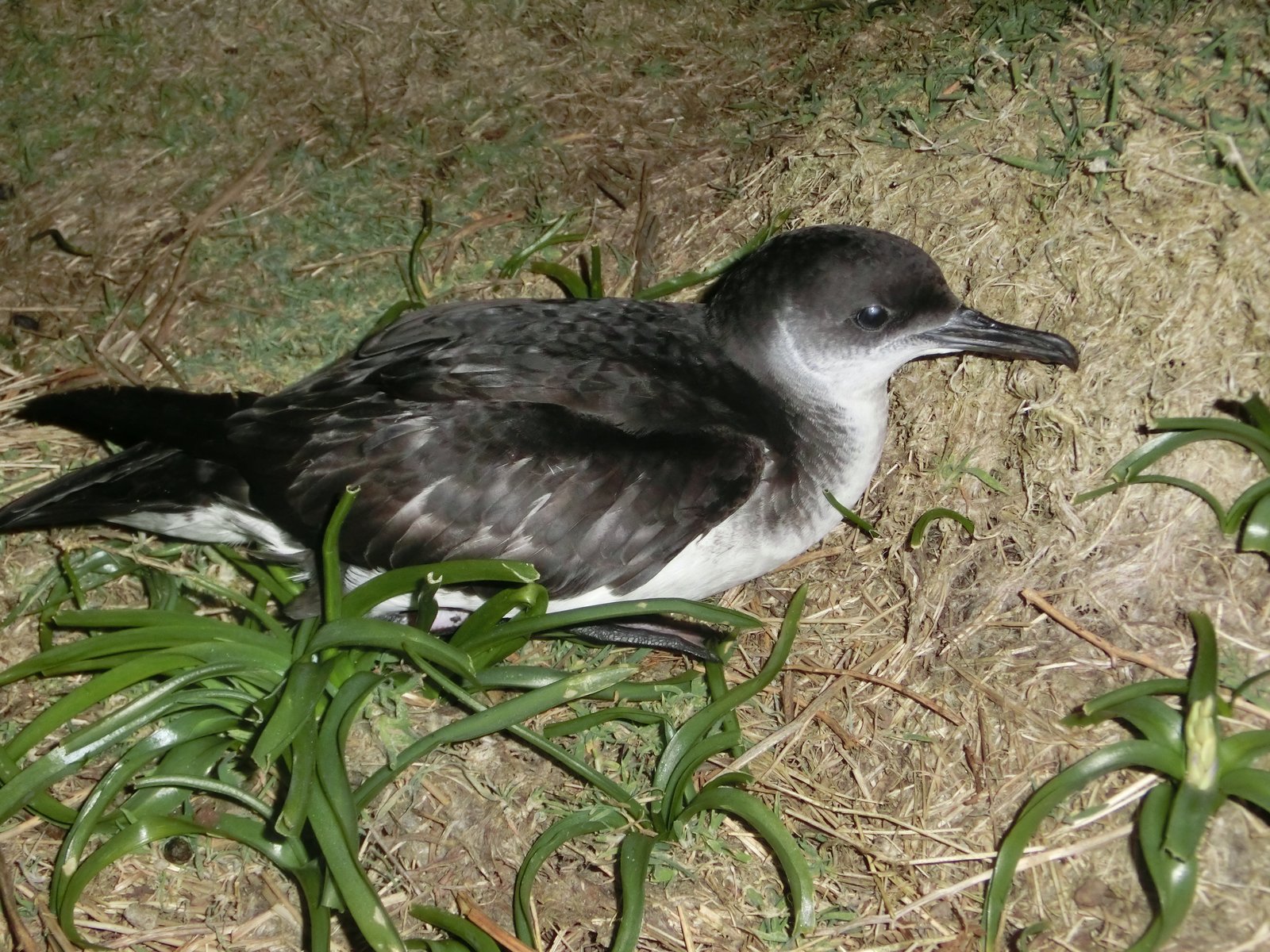
31–36 cm, a slender shearwater with long, straight wings, a short tail and a slender dark bill. The upperparts are blackish; the dark cap reaches below the eye and continues via a dark neck patch to the breast sides. The underparts are pure white, including the undertail coverts. The underwing is white with a narrow dark trailing edge and wing tip. The legs are pink. It flies with fast, stiff wingbeats and long, tilting glides, alternately showing the black upperside and the white underside. The sexes are alike.
Confusion species
Galapagos Shearwater Puffinus subalaris is smaller and browner, with dark undertail coverts, a mostly dark underwing and a fluttering flight. Sargasso Shearwater Puffinus lherminieri is smaller, with shorter wings, dark undertail coverts and faster, fluttering wingbeats. Buller's Shearwater Ardenna bulleri is larger, with pale grey upperparts and a black M. Pink-footed Shearwater Ardenna creatopus is much larger, with a pink bill and mottled flanks.
Habitat
Open sea, especially over the continental shelf and its edge. It feeds on small schooling fish and squid, which it pursues underwater in short dives. It breeds in colonies in burrows on grassy or boulder-strewn islands in the North Atlantic and comes ashore only at night.
Where the bird is most at home, classified by the vegetation units of the Andes and the west coast.


Range and movements
In the guide area only recorded as a very rare vagrant, with a few records at sea off the Pacific coast of Ecuador and northern Peru and in the Caribbean Sea off Colombia; there is no fixed place or time of occurrence. Absent from Bolivia and the Galápagos. It breeds mainly on islands of Britain and Ireland, also in Iceland, the Faroe Islands and north-eastern North America, and winters at sea off the east coast of South America, from Brazil to Argentina.
How and when to look
A vagrant may turn up on pelagic trips among other shearwaters. Look for the crisp black-and-white pattern, the white undertail coverts and the stiff, tilting flight.
Conservation status
Least Concern. The world population is large. Introduced rats on breeding islands, artificial light that disorients young birds and bycatch in fisheries are local threats.
Scientific name
Puffinus puffinus | (Brünnich, 1764)
Brünnich described the species in 1764 as Procellaria puffinus; because it was later moved to another genus, the author and year stand in brackets. The genus Puffinus was introduced in 1760 by Brisson. The genus name is a Neo-Latin form of English puffin, originally the name for the cured nestlings of the Manx shearwater. The species name repeats the genus name, the Neo-Latin form of English puffin, which originally referred to this very species. The specimen the first description was based on came from Faroe Islands and Norway.