All species › Tubenoses › Petrels, shearwaters and diving petrels › Southern Fulmar
Southern Fulmar | Fulmarus glacialoides
Grijze stormvogel | Fulmar Sureño | Pardelão-prateado
The Southern Fulmar is the southern counterpart of Northern Fulmar and breeds along the coasts of Antarctica. Outside the breeding season it follows cold currents north, in the Pacific to off Chile. In the guide area it is a rare vagrant off the coast of Peru.
Voice
Usually silent at sea; at food it gives cackling and croaking sounds.
No recording with a suitable Creative Commons licence is available for this species yet.
Identification
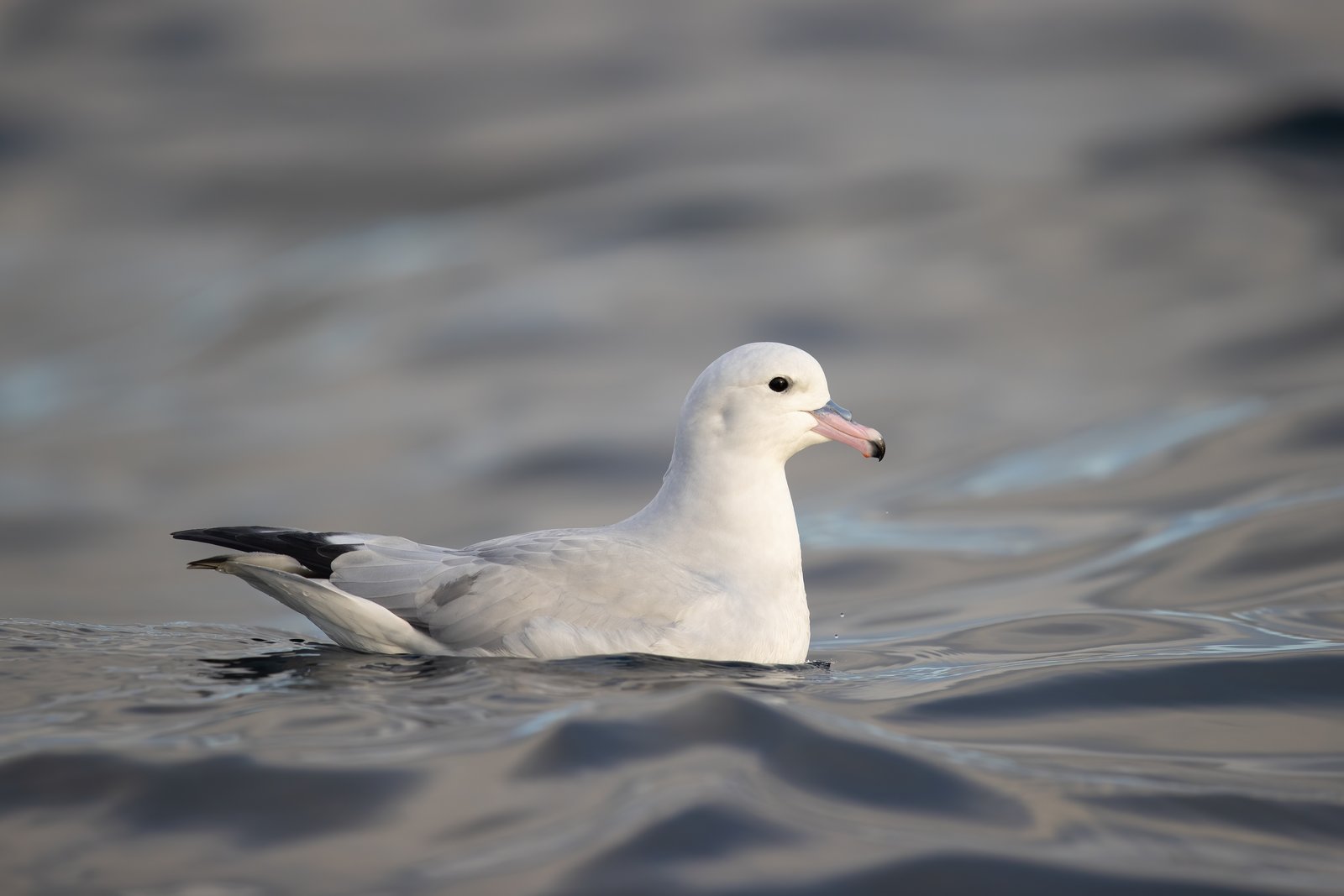
46–50 cm, a stocky, gull-like petrel with a thick neck and a short, stout pink bill with a blue-grey tubular nostril and a dark tip. The upperparts are silver-grey; the primaries are blackish with a large white patch at the base, forming a pale wing panel in flight. The head and underparts are white. It flies with short bursts of stiff wingbeats and long glides. The sexes are alike; juveniles resemble adults.
Confusion species
Pintado Petrel Daption capense has chequered black-and-white upperparts and a black head. Prions, such as Slender-billed Prion Pachyptila belcheri, are much smaller and blue-grey, with a dark M across the wings. Grey-mantled gulls have no tubular nostrils and fly with more flexible wingbeats.
Habitat
Cool, productive waters of the open ocean and inshore seas, in the breeding season often near pack ice and otherwise over cold currents. It feeds on krill, squid, fish and fish waste, often behind ships. It breeds in colonies on cliff ledges along the coast of Antarctica and on nearby islands.
Where the bird is most at home, classified by the vegetation units of the Andes and the west coast.


Range and movements
A rare vagrant at sea off the coast of Peru, mainly in the austral winter. Not known from Colombia, Ecuador, Bolivia or the Galápagos. Outside the guide area it breeds around Antarctica; outside the breeding season north to off Chile, Argentina and South Africa.
How and when to look
Look among the petrels attracted to waste at fishing boats off southern Peru, especially in cool years in the austral winter.
Conservation status
Least Concern. The world population is large; no serious threats are known, although changes in Antarctic sea ice may affect its food supply.
Scientific name
Fulmarus glacialoides | (Smith, 1840)
Smith described the species in 1840 as Procellaria glacialoides; because it was later moved to another genus, the author and year stand in brackets. The genus Fulmarus was introduced in 1826 by Stephens. The genus name comes from Old Norse fúll, 'foul', and már, 'gull', after the foul-smelling stomach oil the bird spits out. The species name combines glacialis (the Northern Fulmar, Fulmarus glacialis) with Greek -oidēs, 'resembling'. The specimen the first description was based on came from Seas off the Cape of Good Hope, South Africa.