All species › Tubenoses › Petrels, shearwaters and diving petrels › Northern Giant Petrel
Northern Giant Petrel | Macronectes halli
Noordelijke reuzenstormvogel | Abanto Marino Subantártico | Petrel-gigante-do-norte
The Northern Giant Petrel is the sister species of Southern Giant Petrel and breeds slightly further north, on subantarctic islands. Like that species it is both scavenger and predator. In the guide area it is only a rare vagrant at sea off the coast of Peru.
Voice
Usually silent at sea; at food it gives croaking and whinnying sounds.
Recording: Andrew Spencer — CC BY-NC-SA 4.0 · xeno-canto
Identification
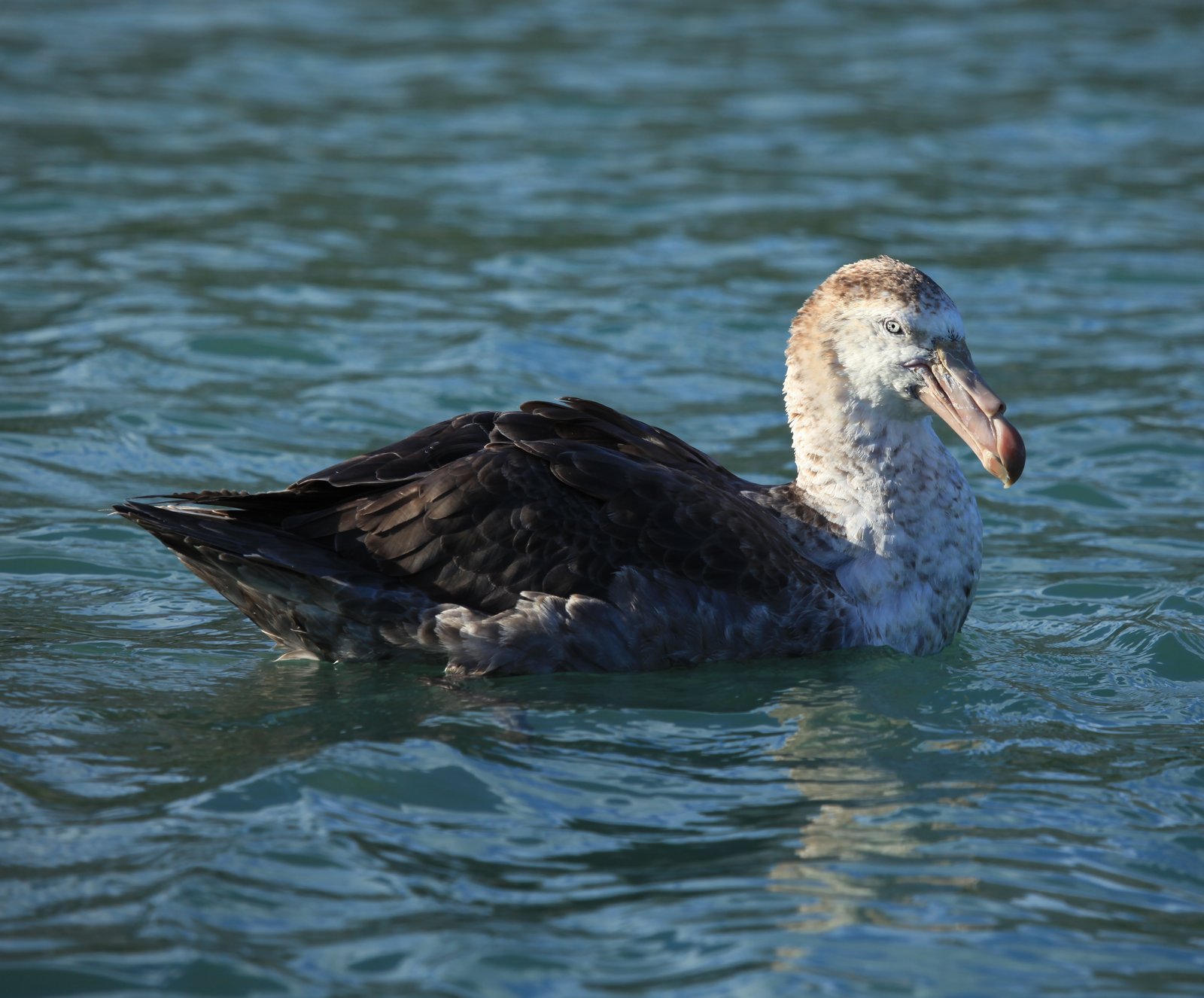
80–95 cm, built like Southern Giant Petrel, with a heavy, pale bill with a reddish-brown to pinkish-brown tip and a long tubular nostril. Adults are greyish brown, with a paler, speckled head, a darker crown and face and often a pale eye; there is no white morph. Juveniles are uniform blackish brown, with a dark eye. The flight is stiff, with short bursts of wingbeats. The sexes are alike, the male larger.
Confusion species
Southern Giant Petrel Macronectes giganteus has a greenish bill tip, and adults have a more uniformly white head without a dark face; juveniles can only be told apart by the bill tip, which is often hard to see at a distance. Albatrosses, such as Black-browed Albatross Thalassarche melanophris, have longer, narrower wings, a slimmer bill and a smoother gliding flight.
Habitat
Open ocean and cool inshore waters, also at fishing boats. It feeds on carrion of marine mammals and penguins, fish waste, squid and seabirds. It breeds scattered among vegetation on subantarctic islands, earlier in the year than Southern Giant Petrel.
Where the bird is most at home, classified by the vegetation units of the Andes and the west coast.


Range and movements
A very rare vagrant at sea off the coast of Peru, mainly in the austral winter; giant petrels at sea are not always identified to species. Not known from Colombia, Ecuador, Bolivia or the Galápagos. Outside the guide area it breeds on subantarctic islands in the Indian Ocean and the Pacific, around New Zealand and on South Georgia; outside the breeding season over the southern oceans, north to off Chile.
How and when to look
Check giant petrels at fishing boats and harbours in Peru for the colour of the bill tip; take close photographs.
Conservation status
Least Concern. The population is increasing. Bycatch in longline fisheries is the main threat.
Scientific name
Macronectes halli | Mathews, 1912
Mathews described the species in 1912 and placed it straight away in the genus where it still stands. The genus Macronectes was introduced in 1905 by Richmond. The genus name comes from Greek makros, 'large', and nēktēs, 'swimmer'. The species name honours Robert Hall (1867–1949), Australian ornithologist and collector who described the breeding birds of the Kerguelen Islands. The specimen the first description was based on came from Kerguelen Islands.