All species › Tubenoses › Petrels, shearwaters and diving petrels › Kermadec Petrel
Kermadec Petrel | Pterodroma neglecta
Kermadecstormvogel | Petrel de Kermadec | Grazina-de-kermadec
The Kermadec Petrel is a fairly large, short-tailed petrel of the subtropical Pacific, with a dark morph, a pale morph and intermediates. In all plumages the white shafts of the primaries form a pale flash on the wing. It breeds on remote islands, from the Kermadec Islands to the Juan Fernández Islands, and is rarely seen far offshore in the guide area.
Voice
Silent at sea. In the colonies high, cackling and moaning calls.
Recording: Johannes Fischer — CC BY-NC-SA 3.0 · xeno-canto
Identification
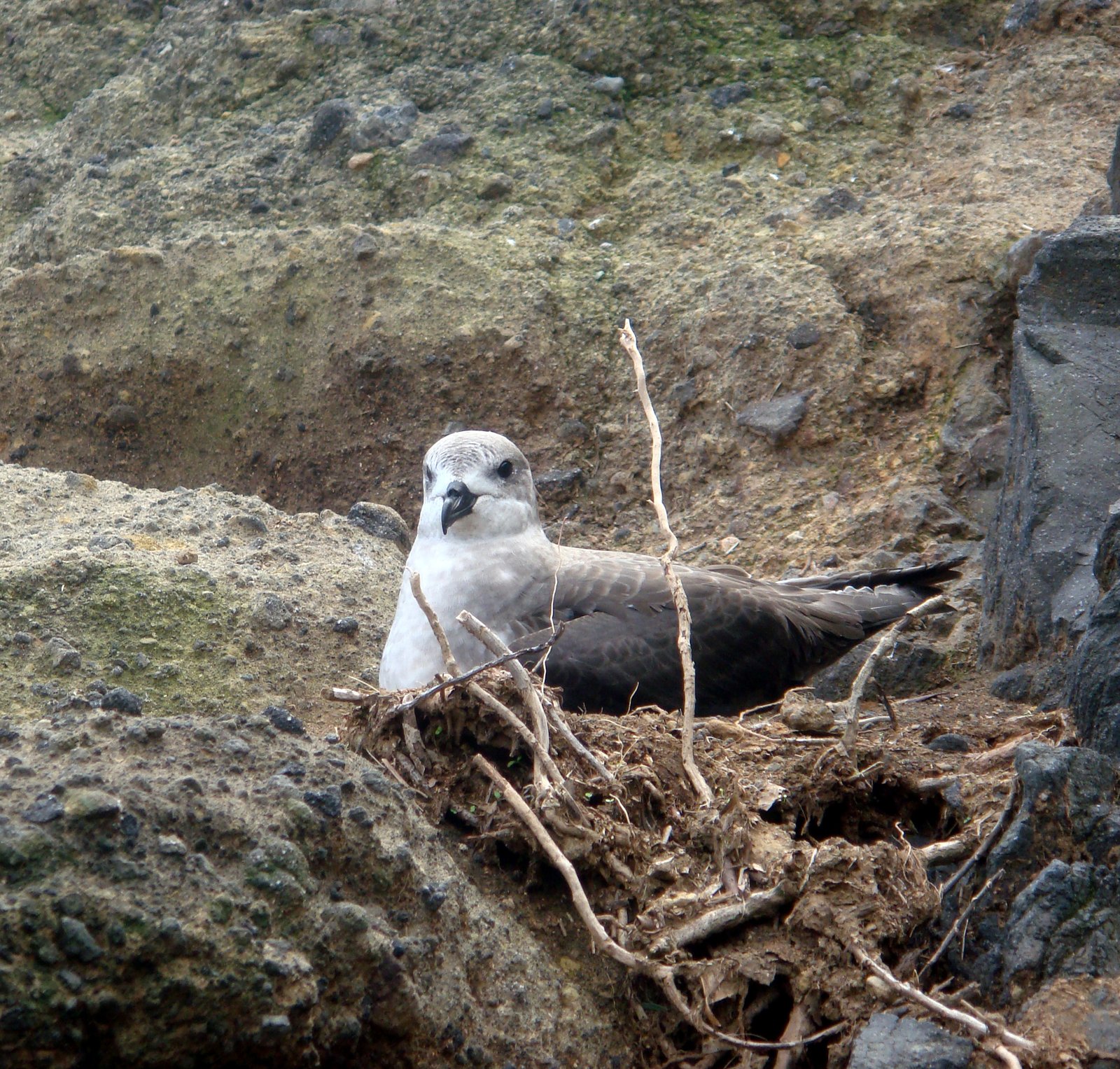
38 cm, a sturdy petrel with a round head, a heavy black bill, broad wings and a short, square tail. The dark morph is entirely dark grey-brown; the pale morph has a paler, grey-brown mottled head and white underparts, with intermediates. In all morphs the primary shafts are white, giving a narrow pale flash on the upperwing; on the underwing a distinct white patch lies at the base of the primaries. It flies in high arcs, sometimes with slow, deep wingbeats. The sexes are alike.
Confusion species
Dark birds may resemble Sooty Shearwater Ardenna grisea, which has a thin bill, a silvery underwing and fast, stiff wingbeats. Skuas and jaegers, such as Pomarine Jaeger Stercorarius pomarinus, also show a white wing flash, but have a hooked bill, a longer tail and a powerful, direct flight. Galapagos Petrel Pterodroma phaeopygia has a black cap and white underparts, without a white patch on the primaries.
Habitat
Open ocean of the subtropical and tropical Pacific, far offshore. It feeds mainly on squid, picked from the surface. It breeds in colonies on the ground, among vegetation or rocks, on remote oceanic islands.
Where the bird is most at home, classified by the vegetation units of the Andes and the west coast.

Range and movements
Rare and irregular far offshore in the guide area; there are few records. Not in Bolivia. It does not breed in the guide area. Outside the guide area it breeds on islands in the South Pacific, from Lord Howe and the Kermadec Islands through French Polynesia and the Pitcairn Islands to Salas y Gómez and the Juan Fernández Islands off Chile; outside the breeding season it ranges over the Pacific, also north of the equator.
How and when to look
On long pelagic trips far beyond the continental shelf; with every dark petrel, look for the white primary flash and the short tail.
Conservation status
Least Concern. The world population is large, but on several breeding islands introduced rats, cats and pigs have reduced or wiped out colonies; on some islands numbers are recovering after these animals were removed.
Scientific name
Pterodroma neglecta | (Schlegel, 1863)
Schlegel described the species in 1863 as Procellaria neglecta; because it was later moved to another genus, the author and year stand in brackets. The genus Pterodroma was introduced in 1856 by Bonaparte. The genus name comes from Greek pteron, 'wing', and dromos, 'runner', after the fast flight. The species name is Latin neglectus, 'overlooked'. The specimen the first description was based on came from Kermadec Islands, New Zealand.