All species › Tubenoses › Petrels, shearwaters and diving petrels › Galapagos Petrel
Galapagos Petrel | Pterodroma phaeopygia
Galápagosstormvogel | Petrel de Galápagos | Grazina-de-galápagos
The Galapagos Petrel is a large petrel that breeds only in the Galápagos, in burrows in the humid highlands of some of the largest islands. By day it forages far out at sea; after sunset it returns to the colonies. The species is critically threatened by introduced predators and loss of breeding habitat, but breeding success has recovered locally through rat control.
Voice
Silent at sea. In the colonies, mainly after sunset, drawn-out, moaning and squealing calls.
Recording: Jacob Guachisaca Salínas — CC BY-NC-SA 4.0 · xeno-canto
Identification
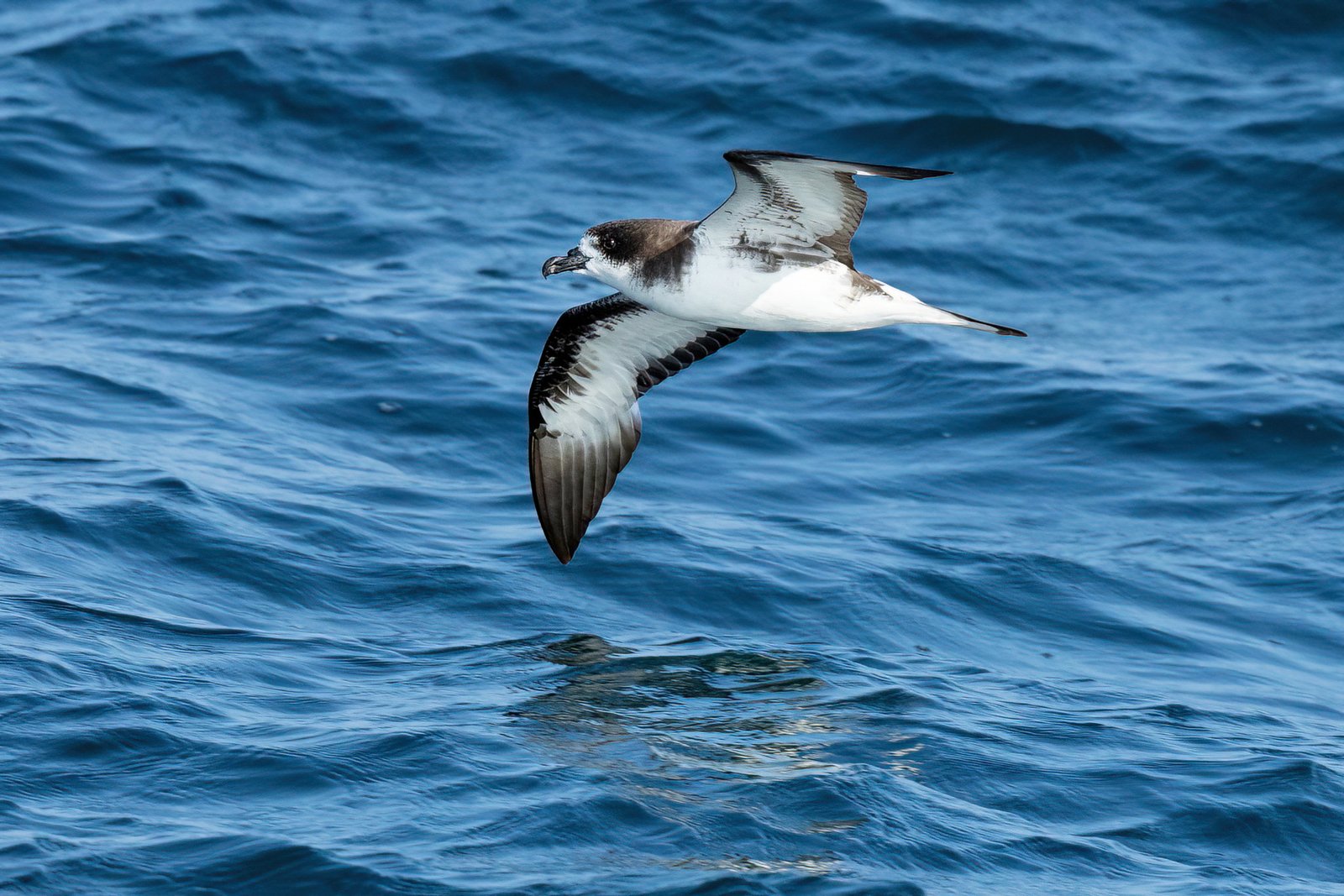
43 cm, a large petrel with long, narrow wings, a wedge-shaped tail and a heavy black bill. The crown, hindneck and sides of the head are blackish, sharply demarcated from the white forehead. The upperparts are dark grey-brown to blackish, with a faint dark M. The underparts are white, with a dark half-collar on the side of the breast. The underwing is white, with a black leading edge that runs inwards from the carpal as a diagonal bar, a black wingtip and a narrow dark trailing edge. It flies in high arcs and fast turns over the water. The sexes are alike.
Confusion species
Juan Fernandez Petrel Pterodroma externa is paler grey above, with a less sharply demarcated cap and less black on the underwing. Galapagos Shearwater Puffinus subalaris is smaller and browner, with a thin bill, and flies low with rapid wingbeats. Wedge-tailed Shearwater Ardenna pacifica has a thin, pale bill, a longer tail and browner upperparts.
Habitat
It forages over open ocean around the Galápagos and far beyond, often over areas of cold upwelling. It feeds on squid, fish and crustaceans, picked from the surface, often together with tuna or dolphins. It breeds in burrows in the humid highlands, roughly between 300 and 900 m, on steep slopes and crater walls, among ferns, moss and shrubs and in the pampa zone.
Where the bird is most at home, classified by the vegetation units of the Andes and the west coast.


Range and movements
Breeds only in the Galápagos, on Santa Cruz, San Cristóbal, Floreana, Santiago and Isabela, and is present year-round in the surrounding waters. At sea it forages far east and north of the archipelago, also off the coast of Ecuador and Colombia and rarely off northern Peru. Not in Bolivia. Outside the guide area at sea north to off Central America.
- Resident
- dark = core range, pale = thinly spread
How and when to look
On boat trips between the islands, especially in the early morning and towards evening; at dusk birds fly to the breeding colonies in the highlands of Santa Cruz and San Cristóbal.
Conservation status
Critically Endangered. Introduced rats, cats, pigs and dogs kill eggs, chicks and adults, and grazing goats, agriculture and invasive plants degrade the breeding areas. Rat control and protection of colonies have improved breeding success locally.
Scientific name
Pterodroma phaeopygia | (Salvin, 1876)
Salvin described the species in 1876 as Oestrelata phaeopygia; because it was later moved to another genus, the author and year stand in brackets. The genus Pterodroma was introduced in 1856 by Bonaparte. The genus name comes from Greek pteron, 'wing', and dromos, 'runner', after the fast flight. The species name comes from Greek phaios, 'dusky', and pugē, 'rump'. The specimen the first description was based on came from San Cristóbal Island, Galápagos.