All species › Parrots › African and New World parrots › Red-masked Parakeet
Red-masked Parakeet | Psittacara erythrogenys
Guayaquilaratinga | Aratinga de Guayaquil | Aratinga-de-guayaquil
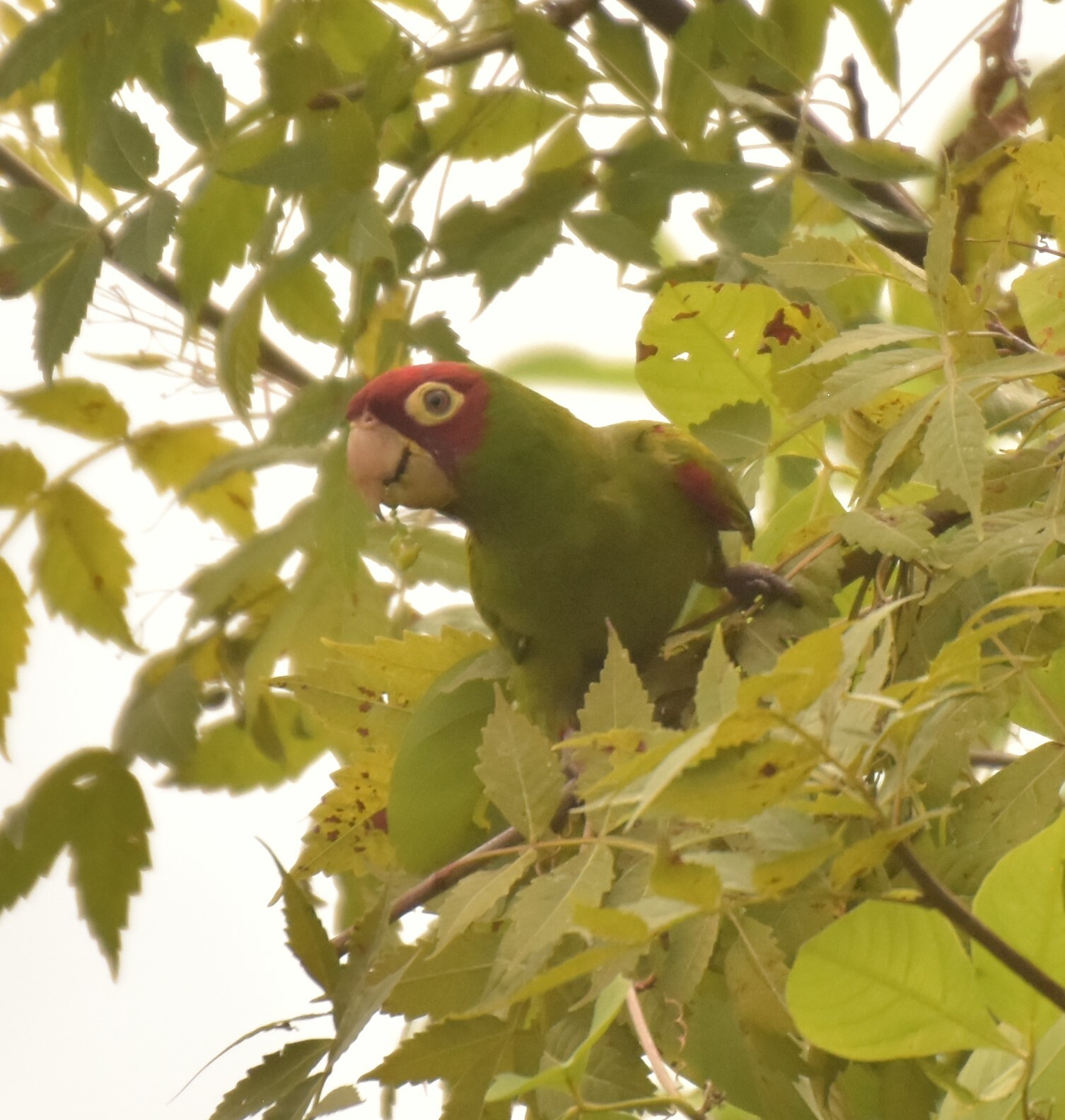
The Red-masked Parakeet is a green parakeet with an entirely red head, native only to western Ecuador and north-western Peru. It is a characteristic bird of Tumbesian dry forest. Because of the cage-bird trade, feral flocks also live far outside the native range, including in Lima.
Voice
Shrill, harsh screeches, such as a repeated kree-kree or kreeh, mainly in flight; flocks are noisy at roosts.
Recording: Leonardo Ordóñez-Delgado — CC BY-NC-SA 4.0 · xeno-canto
Identification
33 cm, with a long, pointed tail and a pale horn-coloured bill. The plumage is green, with an entirely red head: forehead, crown, cheeks and throat. The thighs, the bend of the wing and the lesser underwing coverts are also red; the greater underwing coverts are yellow. A bare, whitish ring surrounds the eye. The sexes are alike. Juveniles have a green head and acquire the red gradually over the first years.
Confusion species
Scarlet-fronted Parakeet Psittacara wagleri is larger, with only the forehead red, and usually lives higher in the Andes. El Oro Parakeet Pyrrhura orcesi is smaller, with red only on the forehead and a maroon tail, and lives in humid forest. Green-headed juveniles resemble other green parakeets; check for the red bend of the wing and the red and yellow underwing.
Habitat
Dry deciduous forest, thorn scrub, semi-humid forest and the edges of more humid forest, also farmland with trees and, in Lima, parks and gardens, from sea level to about 2500 m. It feeds on seeds, fruit and flowers. It nests in tree cavities and in holes in cliffs.
Where the bird is most at home, classified by the vegetation units of the Andes and the west coast.


Range and movements
In Ecuador in the west, from Manabí south through Guayas, El Oro and Loja. In Peru in the north-west (Tumbes, Piura, Lambayeque, Cajamarca), with feral flocks in and around Lima. Absent from Colombia, Bolivia and the Galápagos. The native range lies entirely within the guide area; feral flocks also live elsewhere, including in Spain and the United States.
- Resident
- dark = core range, pale = thinly spread
How and when to look
In the dry forest of Cerro Blanco near Guayaquil, at Jorupe and Zapotillo in southern Ecuador and in the dry forests of Tumbes in Peru. In Lima in parks and along tree-lined streets.
Conservation status
Near Threatened. The population has declined sharply through trapping for the cage-bird trade and clearance of Tumbesian dry forest. The species persists in protected areas and locally in farmland.
Scientific name
Psittacara erythrogenys | Lesson, 1844 (GBIF: Aratinga erythrogenys)
Lesson described the species in 1844 and placed it straight away in the genus where it still stands. The genus Psittacara was introduced in 1825 by Vigors. The genus name combines Latin psittacus, 'parrot', with ara, 'macaw', a name of Tupi origin. Greek eruthros, 'red', and genus, 'cheek': 'red-cheeked'. The specimen the first description was based on came from Guayaquil, Ecuador.