All species › Parrots › African and New World parrots › Mitred Parakeet
Mitred Parakeet | Psittacara mitratus
Roodmaskeraratinga | Aratinga mitrada | Periquitão-mitrado
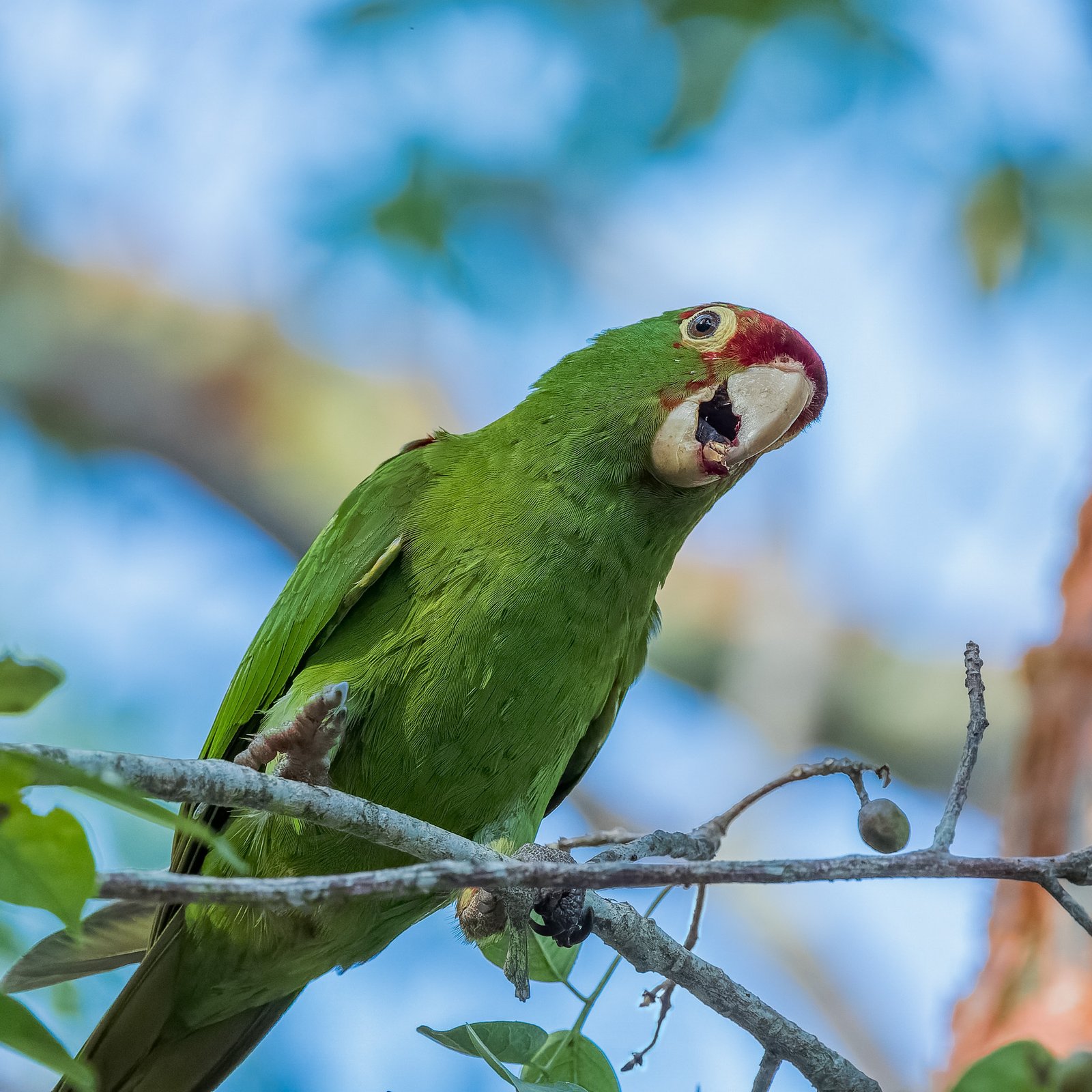
The Mitred Parakeet is a large, heavy parakeet of the eastern Andes from Peru to Argentina, with a red face that varies greatly from bird to bird. It lives in montane forest and dry Andean valleys and breeds and roosts on cliffs. In the valleys of Bolivia it is a familiar sight over fields and villages.
Voice
Loud, harsh screeches, such as a repeated kreeh or chee-ak, mainly in flight; flocks are constantly noisy.
Recording: Jorge Leitão — CC BY-NC-SA 4.0 · xeno-canto
Identification
34–38 cm, with a long, pointed tail and a heavy, pale horn-coloured bill. The plumage is green. The forehead, lores and part of the cheeks are red, often with scattered red feathers around the eye and throat; the edge of the red is irregular. A bare, whitish ring surrounds the eye. The bend of the wing is green, without red. The underwing is green with olive-yellow flight feathers. The sexes are alike; juveniles have less red on the head.
Confusion species
Scarlet-fronted Parakeet Psittacara wagleri has a sharply defined red forehead, often red at the bend of the wing, and lives on the western slope of the Andes. Blue-crowned Parakeet Thectocercus acuticaudatus has a blue crown and no red on the head. White-eyed Parakeet Psittacara leucophthalmus is smaller, with a red and yellow underwing, and lives in the lowlands. Military Macaw Ara militaris is much larger, with a red forehead and bare pink facial skin.
Habitat
Yungas montane forest, dry woodland and scrub in Andean valleys, gorges and farmland with trees, mostly between 1000 and 3400 m. It feeds on seeds, fruit and flowers and visits maize fields. It breeds and roosts in groups in holes in cliffs and gorges.
Where the bird is most at home, classified by the vegetation units of the Andes and the west coast.


Range and movements
In Peru along the eastern slope of the Andes and in the Andean valleys, from the centre of the country southward. In Bolivia in the Andes and Yungas and in the dry valleys of the eastern slope (La Paz, Cochabamba, Santa Cruz, Chuquisaca, Tarija). Absent from Colombia, Ecuador and the Galápagos. Outside the guide area in north-western Argentina.
- Resident
- dark = core range, pale = thinly spread
How and when to look
In the dry Andean valleys of Bolivia, for example around Cochabamba and Samaipata, where flocks roost on cliffs and fly to the fields in the morning; in Peru in the valleys around Cusco.
Conservation status
Least Concern. The species is trapped locally for the cage-bird trade and persecuted as a maize pest, but it tolerates farmland and is common over much of its range.
Scientific name
Psittacara mitratus | (Tschudi, 1844) (GBIF: Aratinga mitrata)
Tschudi described the species in 1844 as Conurus mitratus; because it was later moved to another genus, the author and year stand in brackets. The genus Psittacara was introduced in 1825 by Vigors. The genus name combines Latin psittacus, 'parrot', with ara, 'macaw', a name of Tupi origin. Latin mitratus, 'wearing a mitre', after the red forehead and head. The specimen the first description was based on came from Peru.