All species › Parrots › African and New World parrots › Scarlet-fronted Parakeet
Scarlet-fronted Parakeet | Psittacara wagleri
Roodvoorhoofdparkiet | Aratinga frentirroja | Periquitão-de-testa-vermelha
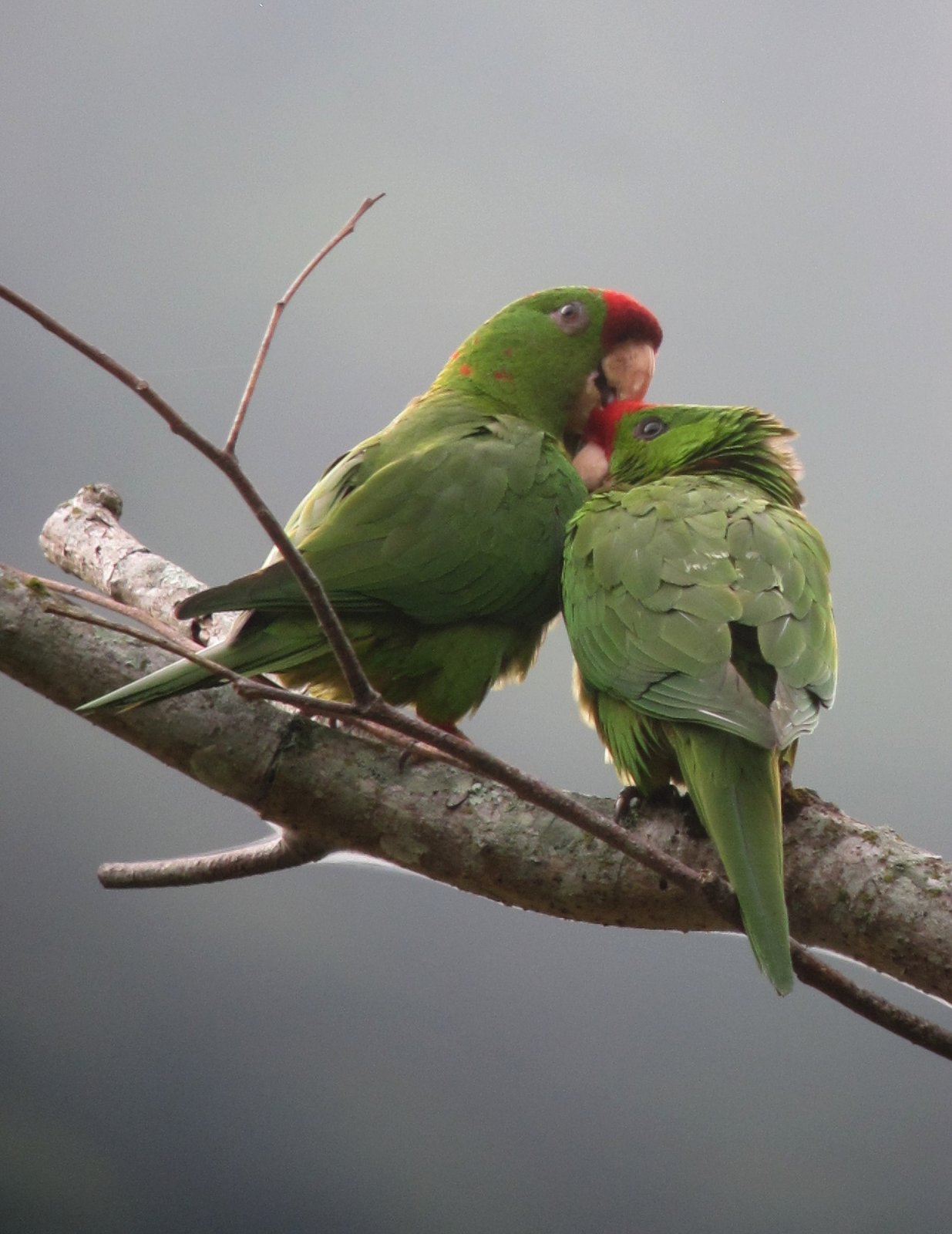
The Scarlet-fronted Parakeet is a large, green parakeet with a red forehead that lives in the Andes from Colombia to Peru. It breeds and roosts in colonies in holes in steep cliffs and flies from there in noisy flocks to forest and fields. Northern birds (Colombia) and southern birds (Ecuador and Peru) differ in size and in the red on the wing, and are sometimes treated as two species.
Voice
Loud, harsh and grating screeches, such as a repeated kreeh-kreeh, mainly in flight; a constant din at the colonies.
Recording: Mauricio Cuellar Ramirez (@Birding.travel) — CC BY-NC-SA 4.0 · xeno-canto
Identification
36–40 cm, with a long, pointed tail and a pale horn-coloured bill. The plumage is green, with a red forehead and forecrown. A bare, whitish ring surrounds the eye. The thighs are often red. In the larger southern birds of Ecuador and Peru the leading edge of the wing at the bend is also red; in northern birds this is almost absent. The underwing is green with olive-yellow flight feathers. The sexes are alike; juveniles have little or no red on the forehead.
Confusion species
Mitred Parakeet Psittacara mitratus has red more irregularly spread over the forehead and cheeks and lives on the eastern slope of Peru and in Bolivia. Red-masked Parakeet Psittacara erythrogenys has an entirely red head and lives mainly in the dry lowlands. White-eyed Parakeet Psittacara leucophthalmus has scattered red feathers on the head and a red and yellow underwing, and lives in the lowlands. Golden-plumed Parakeet Leptosittaca branickii has no red and a yellow plume beside the eye.
Habitat
Humid and dry montane forest, dry valleys, gorges and farmland with forest remnants, mostly between 500 and 2800 m, in western Peru also lower. It feeds on seeds, fruit and flowers and visits maize fields. It breeds in colonies in holes in steep cliffs and gorges, where the birds also roost together.
Where the bird is most at home, classified by the vegetation units of the Andes and the west coast.


Range and movements
In Colombia in all three Andean ranges, in the Sierra Nevada de Santa Marta and the Serranía de Perijá. In Ecuador on the western slope and in the dry Andean valleys of the south (Loja, El Oro). In Peru on the western slope and in the western Andean valleys, south to the south of the country, and locally in the upper Marañón. Absent from Bolivia and the Galápagos. Outside the guide area in northern Venezuela.
- Resident
- dark = core range, pale = thinly spread
How and when to look
At cliffs and gorges with breeding colonies, for example in the dry valleys of Loja in Ecuador or in the valleys of the western slope in Peru; flocks leave early in the morning and return late in the afternoon.
Conservation status
Near Threatened. The population has declined through trapping for the cage-bird trade and clearance of montane forest; persecution as a maize pest also plays a part locally. Where the colonies are left undisturbed, the species persists in farmland.
Scientific name
Psittacara wagleri | (Gray, 1845) (GBIF: Aratinga wagleri)
Gray described the species in 1845 as Conurus Wagleri; because it was later moved to another genus, the author and year stand in brackets. The genus Psittacara was introduced in 1825 by Vigors. The genus name combines Latin psittacus, 'parrot', with ara, 'macaw', a name of Tupi origin. Named after Johann Georg Wagler (1800–1832), German zoologist who published on parrots and reptiles. The specimen the first description was based on came from Bogotá, Colombia.