All species › Tinamous › Tinamous › Red-winged Tinamou
Red-winged Tinamou | Rhynchotus rufescens
Pampahoen | Tinamú alirrojo | Perdiz
The Red-winged Tinamou is a large, rufous-winged tinamou of open grassland and savanna in eastern and central South America. In the guide area it lives in the lowland savannas of Bolivia and very locally in south-eastern Peru. Its whistled song, mainly at dusk, is a regular sound of the savanna.
Voice
A melodious series of a few clear whistles, the first one drawn out, mainly heard in the early morning and evening. When flushed a loud whirr of wings.
Recording: Robson Silva e Silva — CC BY-NC-SA 4.0 · xeno-canto
Identification
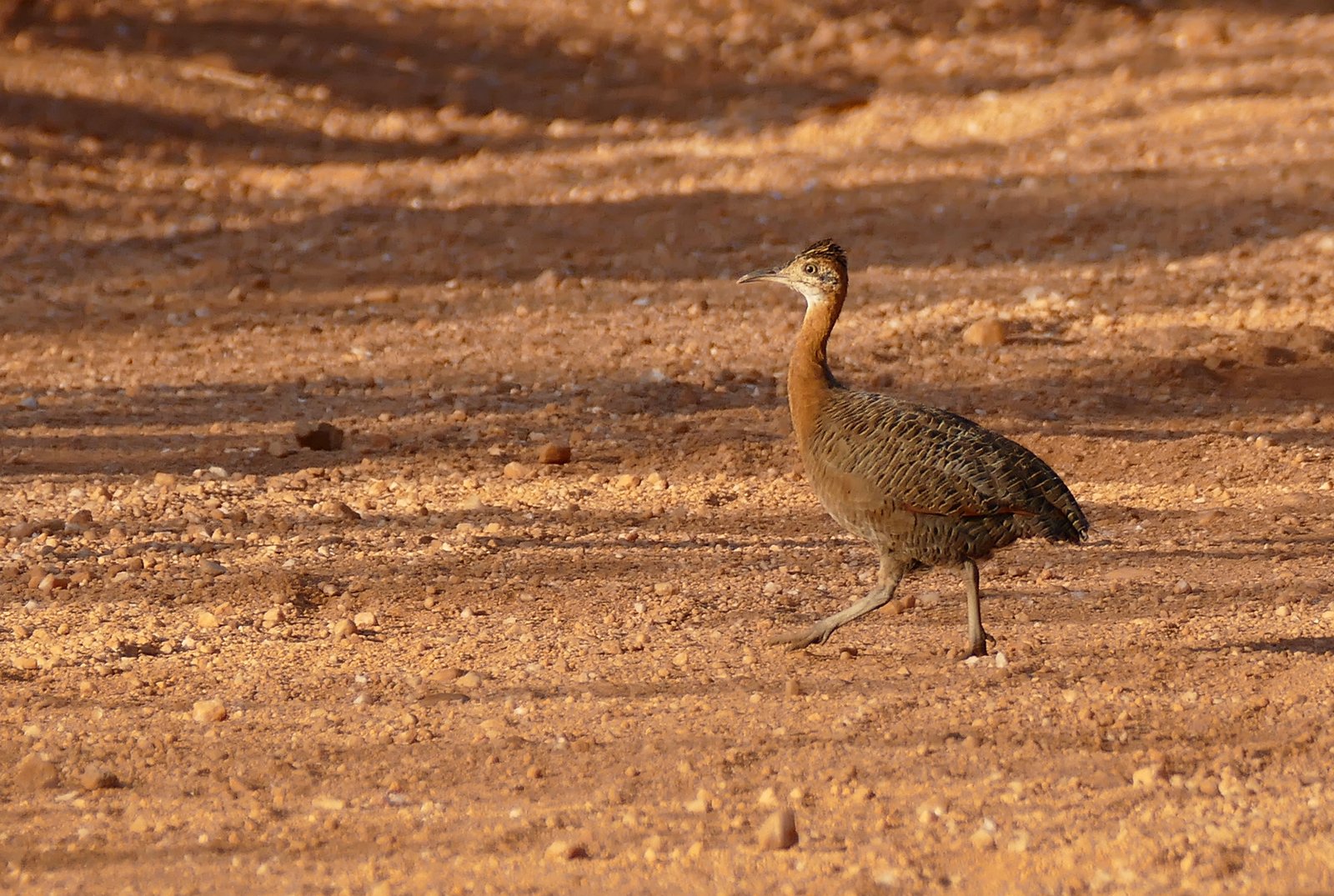
37–42 cm, with a long neck, a long, slightly decurved bill and almost no tail. The crown is black with pale streaks. The neck and upper breast are plain rufous to cinnamon, and the throat is pale. The rest of the underparts are buff, darkly barred on the flanks. The upperparts are buff to greyish brown with black barring and pale edges. The primaries are rufous and clearly visible in flight. The legs are greyish. The female is on average slightly larger.
Confusion species
Huayco Tinamou Rhynchotus maculicollis lives on the mountain slopes of the Andes and has a densely black-spotted neck. White-bellied Nothura Nothura boraquira is much smaller, with a short bill, a white belly and no rufous primaries. Small-billed Tinamou Crypturellus parvirostris is much smaller and unstreaked, with a red bill. Quebracho Crested Tinamou Eudromia formosa has a long crest and lives in dry Chaco forest.
Habitat
Open grassland, savanna, cerrado with scattered shrubs, wet grassland at the edges of marshes, and pasture and fields, in the lowlands. It walks on the ground, feeding on seeds, tubers, fruit and insects. The nest is on the ground, hidden in a grass tussock; the male incubates.
Where the bird is most at home, classified by the vegetation units of the Andes and the west coast.


Range and movements
In Bolivia in the lowland savannas, from the Beni savanna to the Chiquitania and the south-east. In Peru only in the Pampas del Heath in the far south-east. Absent from Colombia, Ecuador and the Galápagos. Outside the guide area in eastern and southern Brazil, Paraguay, Uruguay and northern and central Argentina.
- Resident
- dark = core range, pale = thinly spread
How and when to look
In the early morning and evening, listen for the whistled song along savannas and pastures in the Beni or the Chiquitania. Birds sometimes walk across open spots and sandy tracks; when they flush, the rufous primaries show.
Conservation status
Least Concern. The species tolerates pasture and fields, but is heavily hunted; locally its numbers decline through hunting, fires and the conversion of grassland to cropland.
Scientific name
Rhynchotus rufescens | (Temminck, 1815)
Temminck described the species in 1815 as Tinamus rufescens; because it was later moved to another genus, the author and year stand in brackets. The genus Rhynchotus was introduced in 1825 by Spix. The genus name comes from Greek rhunkhos, 'bill', with the suffix -ōtēs, 'featuring'; the original description calls the bill long and slightly arched. Latin rufescens means 'reddish', after the rufous primaries. The specimen the first description was based on came from São Paulo, Brazil.