All species › Tinamous › Tinamous › Huayco Tinamou
Huayco Tinamou | Rhynchotus maculicollis
Huaycotinamoe | Tinamú huayco | Perdiz-huayco
The Huayco Tinamou is a large, rufous-winged tinamou of grassy mountain slopes and dry valleys on the eastern slope of the Andes in Bolivia and north-western Argentina. It was long regarded as a subspecies of Red-winged Tinamou Rhynchotus rufescens, but differs in plumage and voice and is tied to mountain slopes. The name huayco goes back to the Quechua word for a ravine or mountain valley.
Voice
A series of clear, whistled notes, mainly heard from grassy slopes in the early morning and towards evening. When flushed a loud whirr of wings.
Recording: Rosendo Fraga — CC BY-NC-SA 4.0 · xeno-canto
Identification
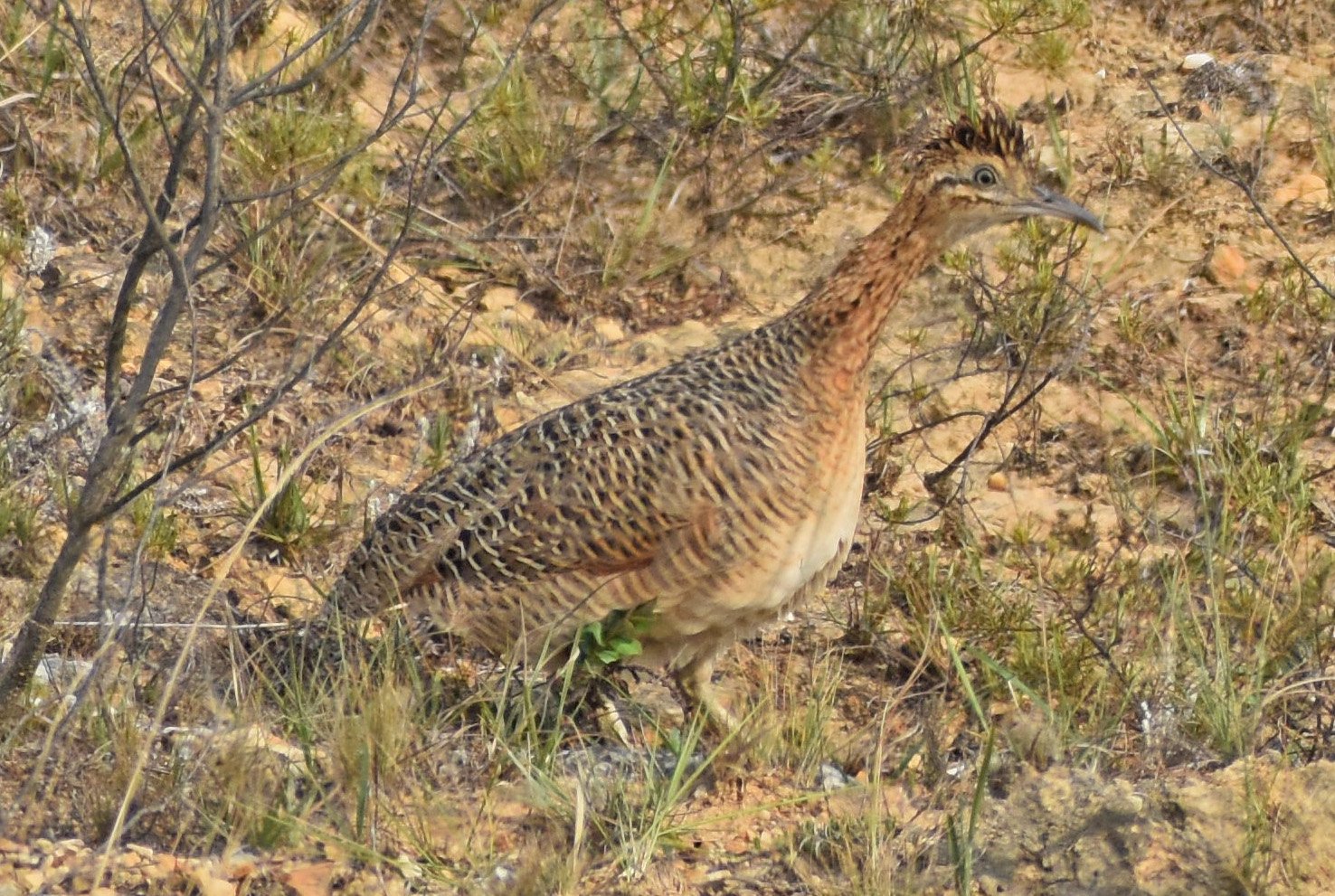
38–42 cm, with a long neck, a long, slightly decurved bill and almost no tail. The crown is blackish. The neck and breast are buff to rufous, densely spotted and streaked with black. The belly is paler buff and the flanks are darkly barred. The upperparts are greyish brown with black barring and pale edges. The primaries are rufous and visible in flight. The legs are greyish. The sexes are nearly alike.
Confusion species
Red-winged Tinamou Rhynchotus rufescens lives in the lowlands and has a plainer rufous neck, without dense black spotting; its whistles are different. Andean Tinamou Nothoprocta pentlandii is much smaller and greyer, without rufous primaries. Ornate Tinamou Nothoprocta ornata lives higher, on the puna, and has a whitish, black-spotted head. Darwin's Nothura Nothura darwinii is much smaller, with a short bill.
Habitat
Grassy mountain slopes, grassland with scattered shrubs and trees, clearings in and above montane forest and the edges of fields and pastures in the dry valleys, mainly between 1000 and 3000 m. It walks on the ground, feeding on seeds, tubers, shoots and insects. The nest is on the ground, hidden in tall grass or under a shrub.
Where the bird is most at home, classified by the vegetation units of the Andes and the west coast.


Range and movements
In Bolivia on the eastern slope of the Andes and in the dry valleys, from La Paz south through Cochabamba, Chuquisaca and Santa Cruz to Tarija. Absent from Colombia, Ecuador, Peru and the Galápagos. Outside the guide area in north-western Argentina.
- Resident
- dark = core range, pale = thinly spread
How and when to look
Search grassy slopes with scattered shrubs in the dry valleys around Cochabamba and Samaipata. Birds are first heard in the early morning; later they sometimes walk across clearings and tracks.
Conservation status
Least Concern. The species is hunted and tolerates grazed land and small-scale farming, but may decline locally where hunting is heavy.
Scientific name
Rhynchotus maculicollis | Gray, 1867
Gray described the species in 1867 and placed it straight away in the genus where it still stands. The genus Rhynchotus was introduced in 1825 by Spix. The genus name comes from Greek rhunkhos, 'bill', with the suffix -ōtēs, 'featuring'; the original description calls the bill long and slightly arched. Latin macula, 'spot', and collum, 'neck': 'spot-necked'. The specimen the first description was based on came from Bolivia.