All species › Tinamous › Tinamous › White-throated Tinamou
White-throated Tinamou | Tinamus guttatus
Witkeeltinamoe | Tinamú goliblanco | Inhambu-galinha
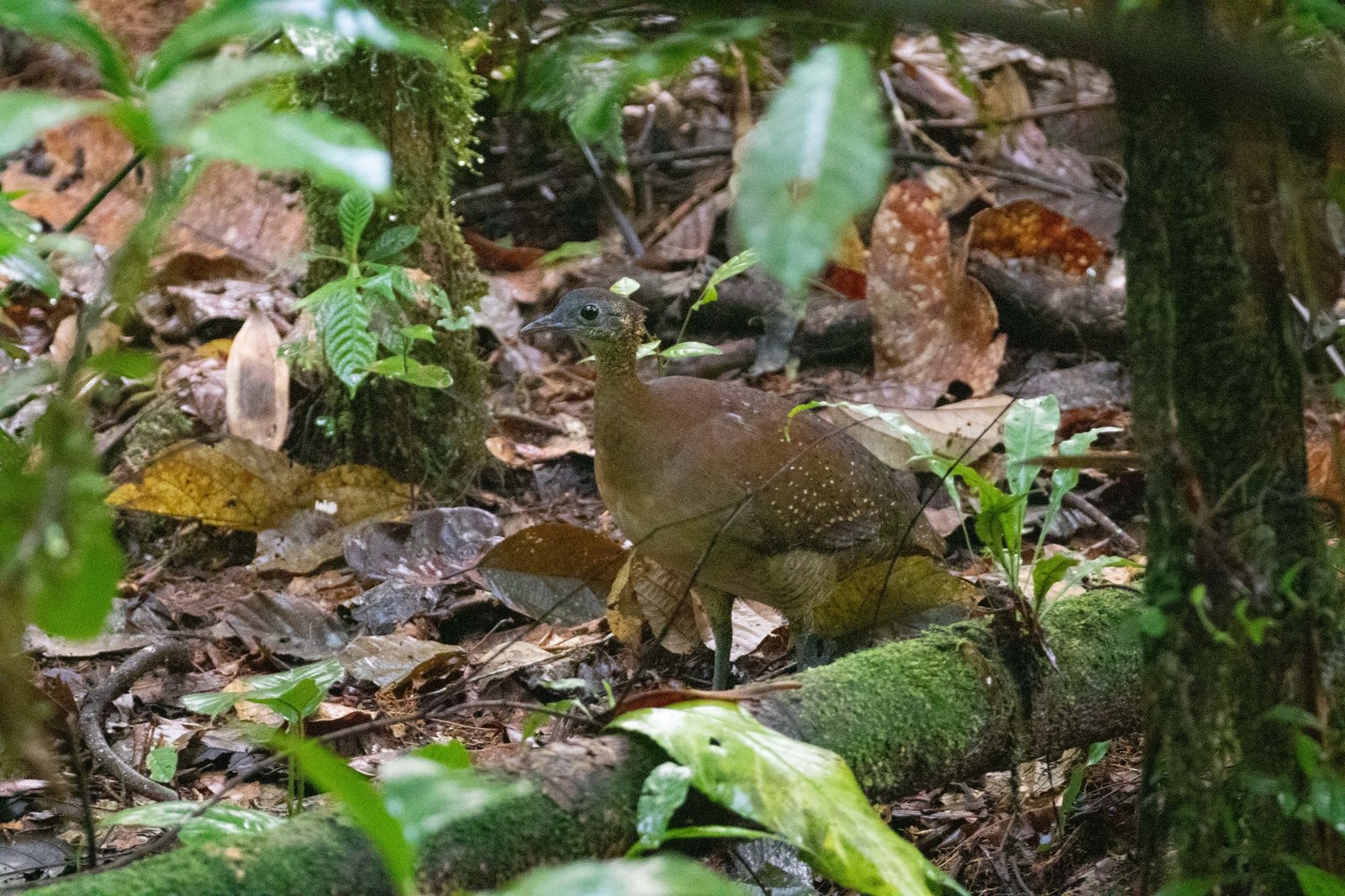
The White-throated Tinamou is a medium-sized Tinamus of tall terra firme forest in the Amazonian lowlands. It is smaller than Great Tinamou and has pale spots on the back and wings and a white throat. Its deep, plaintive whistle carries far through the forest at dusk.
Voice
A deep, hollow, plaintive whistle in two parts, the second slightly longer and first rising then falling, repeated at long intervals. Heard mainly at dawn and dusk.
Recording: JAYRSON ARAUJO DE OLIVEIRA — CC BY-NC-SA 4.0 · xeno-canto
Identification
32–36 cm, with a small head, a thin neck and a rounded, almost tailless body. The upperparts are dark olive-brown with fine black barring and small yellowish-white spots on the wing coverts and lower back. The head and neck are grey-brown, and the throat is clearly white. The underparts are warm cinnamon-brown, barred dark on the flanks and undertail coverts. The legs are greyish green. The sexes are alike.
Confusion species
Great Tinamou Tinamus major is larger, without pale spots on the wings, with greyer-brown underparts and often a rufous crown. Grey Tinamou Tinamus tao is larger and greyer, with white speckling on the sides of the neck, and lives more on slopes. Variegated Tinamou Crypturellus variegatus is smaller, with a black crown, a rufous neck and a boldly black-and-buff barred back. Cinereous Tinamou Crypturellus cinereus is smaller and uniform dark grey-brown, without a white throat.
Habitat
The floor of tall, humid terra firme forest in the Amazonian lowlands, locally also in the lower foothills; mostly below 500 m, sometimes up to about 1000 m. It avoids seasonally flooded forest more than Great Tinamou. It walks over the forest floor searching for fallen fruit, seeds and invertebrates. The nest is on the ground between the roots of a tree.
Where the bird is most at home, classified by the vegetation units of the Andes and the west coast.


Range and movements
In Colombia in the eastern lowlands east of the Andes. In Ecuador in the Amazonian lowlands. In Peru in the Amazonian lowlands throughout the east of the country. In Bolivia in the north, in Pando, Beni and northern La Paz. Absent west of the Andes and from the Galápagos. Outside the guide area in southern Venezuela, the Guianas and Brazilian Amazonia.
- Resident
- dark = core range, pale = thinly spread
How and when to look
Listen at dawn and dusk in large, quiet terra firme forest, such as around lodges along the Napo in Ecuador and in Manu and Tambopata in Peru. Walk trails slowly in the early morning; birds often walk ahead of the observer before flushing.
Conservation status
Near Threatened. The species disappears where hunting is heavy and suffers from clearance of Amazonian forest; in large, undisturbed forests it is still regularly found.
Scientific name
Tinamus guttatus | Pelzeln, 1863
Pelzeln described the species in 1863 and placed it straight away in the genus where it still stands. The genus Tinamus was introduced in 1783 by Hermann. The genus name goes back to tinamú, the word for these birds in the Carib language of French Guiana, via Buffon's 'Les Tinamous'. Latin guttatus means 'spotted'. The specimen the first description was based on came from Borba, Amazonas, Brazil.