All species › Tinamous › Tinamous › Great Tinamou
Great Tinamou | Tinamus major
Grote tinamoe | Tinamú mayor | Inhambu-de-cabeça-vermelha
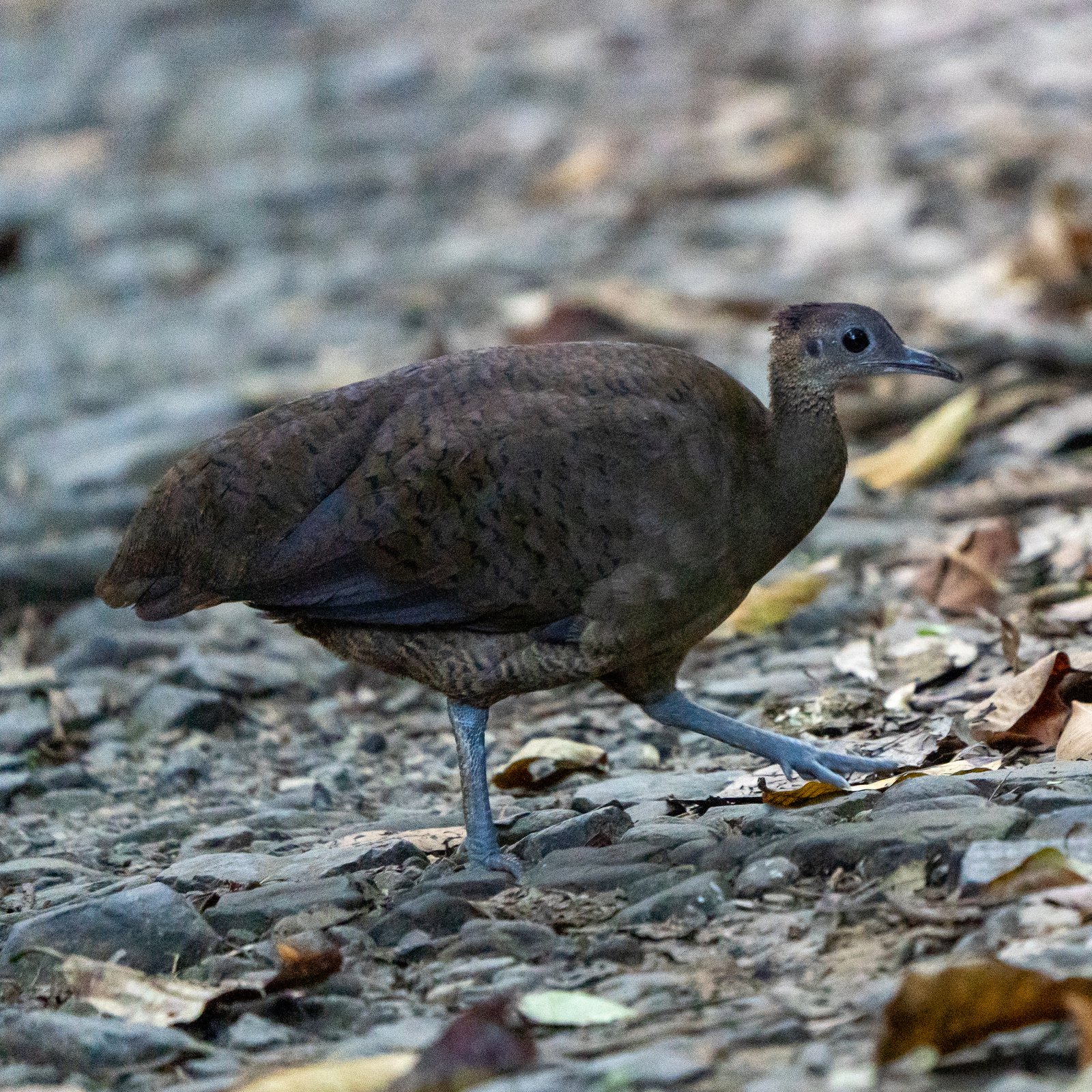
The Great Tinamou is a stocky, olive-brown ground bird of humid lowland forest on both sides of the Andes. It is far more often heard than seen: at dusk its tremulous, plaintive whistles ring through the forest, a characteristic sound of the rainforest.
Voice
A series of deep, tremulous, somewhat plaintive whistles, often in pairs and falling in pitch, heard mainly at dawn and dusk and sometimes at night. A loud clatter of wings when flushed.
Recording: Jacob Wijpkema — CC BY-NC-SA 4.0 · xeno-canto
Identification
38–46 cm, with a small head, a thin neck, a rounded, almost tailless body and sturdy grey legs. The upperparts are olive-brown with fine black barring, the underparts grey-brown to buff, barred dark on the flanks and undertail coverts. The throat is whitish. The crown is rufous in Amazonian birds and more olive-brown in western birds; in some forms the crown feathers form a short crest. The sexes are alike.
Confusion species
Grey Tinamou Tinamus tao is larger and greyer, with white speckling on the sides of the neck, and usually lives higher on the slopes. White-throated Tinamou Tinamus guttatus is smaller, with pale spots on the back and wings and a more clearly white throat. Black Tinamou Tinamus osgoodi is much darker, slate grey to blackish, and lives in foothill forest. Crypturellus tinamous such as Cinereous Tinamou Crypturellus cinereus are smaller and have different whistles.
Habitat
The floor of humid, tall lowland and foothill forest, also seasonally flooded forest and older secondary forest; mainly below about 1000 m, locally higher. It walks quietly over the forest floor searching for fallen fruit, seeds and small animals. It roosts on a low branch. The nest is on the ground between the roots of a tree; the glossy, blue-green eggs are incubated by the male.
Where the bird is most at home, classified by the vegetation units of the Andes and the west coast.


Range and movements
In Colombia on the Pacific side, in the north and in the eastern lowlands. In Ecuador in the western lowlands and in the Amazonian lowlands. In Peru in the Amazonian lowlands and foothill forest. In Bolivia in the northern lowlands. Outside the guide area from southern Mexico through Central America to Panama, and in Venezuela, the Guianas and Brazilian Amazonia.
- Resident
- dark = core range, pale = thinly spread
How and when to look
Listen at dusk along forest trails for the tremulous whistles. It is seen mainly on quiet trails in little-hunted forest, where birds sometimes walk slowly across the trail just in front of the observer.
Conservation status
Disappears quickly where heavily hunted and suffers from clearance of lowland forest; still fairly common in large, little-hunted forests.
Scientific name
Tinamus major | (Gmelin, 1789)
Gmelin described the species in 1789 as Tetrao major; because it was later moved to another genus, the author and year stand in brackets. The genus Tinamus was introduced in 1783 by Hermann. The genus name goes back to tinamú, the word for these birds in the Carib language of French Guiana, via Buffon's 'Les Tinamous'. Latin major means 'larger'. The specimen the first description was based on came from Cayenne, French Guiana.