All species › Tinamous › Tinamous › Black Tinamou
Black Tinamou | Tinamus osgoodi
Zwarte tinamoe | Tinamú negro | Inhambu-negro
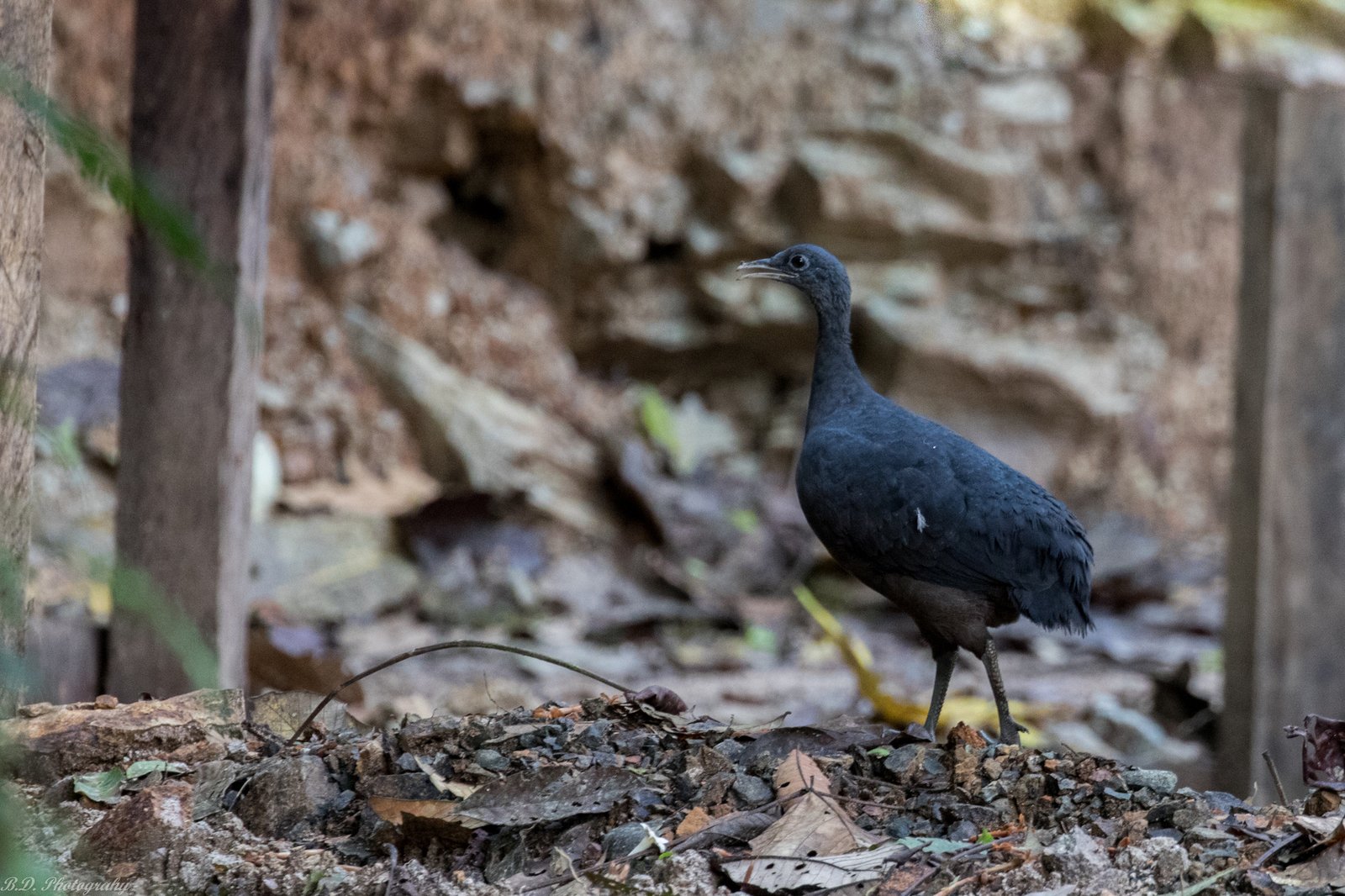
The Black Tinamou is a large, very dark tinamou of foothill and lower montane forest on the eastern slope of the Andes. It is known from only a few widely separated areas: a northern group in Colombia and Ecuador and a southern one in south-eastern Peru and adjacent Bolivia. Little has been recorded of its life history.
Voice
A long, slightly tremulous whistle that falls at the end, repeated at intervals, mainly at dusk. The call resembles that of other Tinamus species; recordings from the guide area are few.
Recording: Edilson Rosero — CC BY-NC-SA 4.0 · xeno-canto
Identification
40–46 cm, with a small head, a thin neck and a rounded, almost tailless body. The whole plumage is uniform dark slate grey to blackish brown, without obvious pattern on the upperparts; the belly and undertail coverts are slightly browner, with fine rufous fringes. The throat is barely paler. The legs are grey. The sexes are alike.
Confusion species
Great Tinamou Tinamus major is olive-brown with fine black barring and a whitish throat, and usually lives lower. Grey Tinamou Tinamus tao is paler grey, with white speckling on the sides of the neck and clear barring. Hooded Tinamou Nothocercus nigrocapillus is smaller, rufous-brown with a blackish head, and lives higher in cloud forest. Brown Tinamou Crypturellus obsoletus is much smaller and warm brown.
Habitat
The floor of tall, humid foothill and lower montane forest on the eastern slope of the Andes, roughly between 900 and 2100 m, often on steep slopes and in ravines. It walks over the forest floor searching for fallen fruit, seeds and small animals. The nest is on the ground at the foot of a tree.
Where the bird is most at home, classified by the vegetation units of the Andes and the west coast.


Range and movements
In Colombia very local: at the head of the Magdalena valley in Huila, on the eastern slope of the Eastern Cordillera in Caquetá, and with sight records in Antioquia. In Ecuador only recently discovered, at a few sites on the eastern slope in Sucumbíos and Napo. In Peru on the eastern slope in the south-east, in Cusco and Puno. Sight records have been reported from north-western Bolivia (La Paz), but are not yet documented. Absent from the Galápagos. Does not occur outside the guide area.
- Resident
- dark = core range, pale = thinly spread
How and when to look
Listen at dusk for whistles in foothill forest on the eastern slope, such as along the Manu road in south-eastern Peru and at the Cordillera de Huacamayos in Ecuador. Birds walk off quietly over the forest floor; camera traps provide most records.
Conservation status
Vulnerable. The small, fragmented population suffers from clearance of foothill forest and from hunting.
Scientific name
Tinamus osgoodi | Conover, 1949
Conover described the species in 1949 and placed it straight away in the genus where it still stands. The genus Tinamus was introduced in 1783 by Hermann. The genus name goes back to tinamú, the word for these birds in the Carib language of French Guiana, via Buffon's 'Les Tinamous'. Named after Wilfred Hudson Osgood (1875–1947), American zoologist at the Field Museum in Chicago. The specimen the first description was based on came from Hacienda Cadena, Marcapata, Cuzco, Peru.