All species › Tinamous › Tinamous › Grey Tinamou
Grey Tinamou | Tinamus tao
Grijze tinamoe | Tinamú gris | Azulona
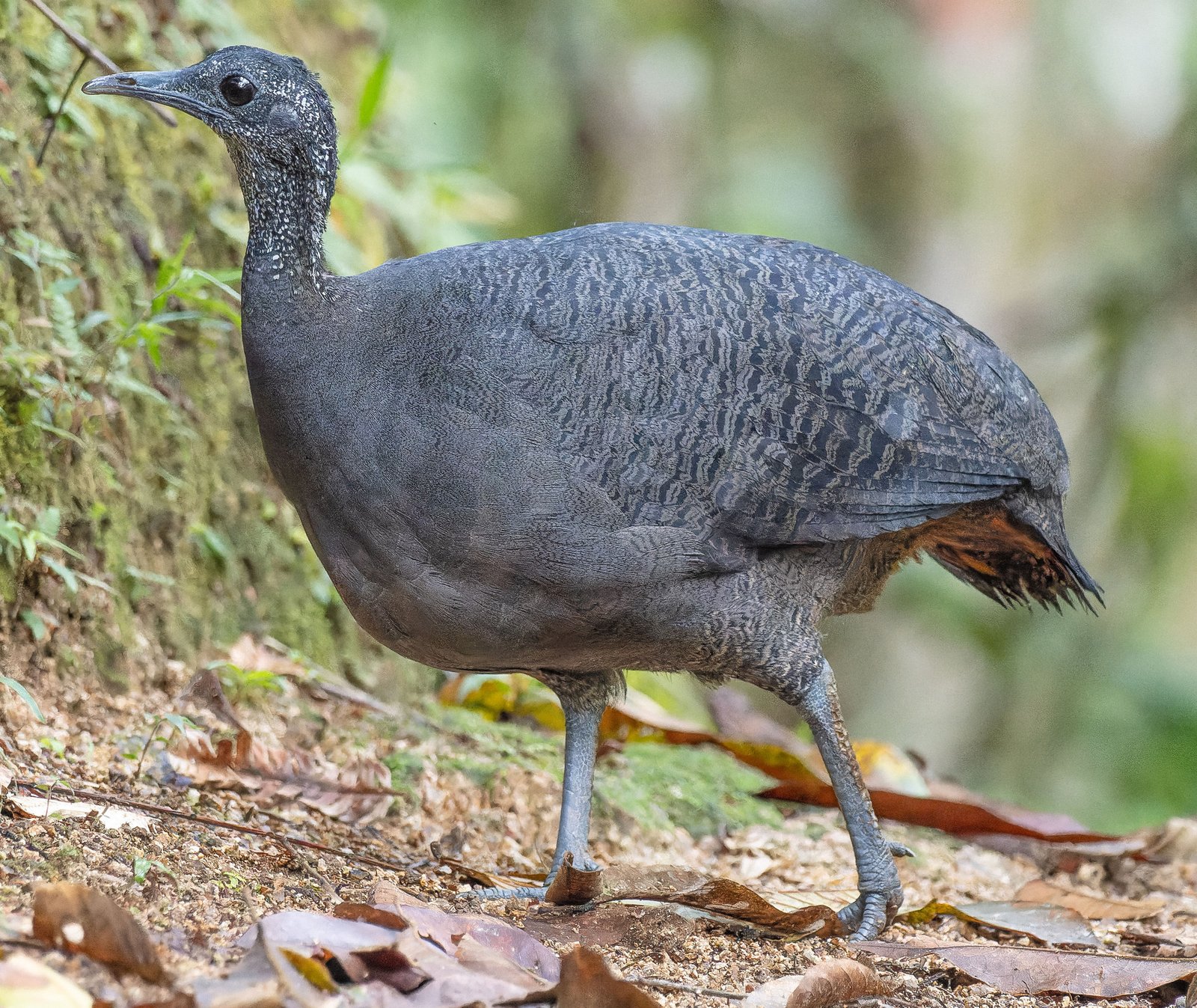
The Grey Tinamou is the largest tinamou of the guide area, a heavy, grey ground bird of foothill forest and lower montane forest along the Andes. It is far more often heard than seen: its deep, hollow call carries mainly at dusk. Because of hunting and deforestation it is globally Vulnerable.
Voice
A single deep, hollow whistle, repeated at long intervals, mainly at dawn and dusk. A loud clatter of wings when flushed.
Recording: Fabrice Schmitt — CC BY-NC-SA 4.0 · xeno-canto
Identification
41–49 cm, with a small head, a thin neck and a heavy, almost tailless body. The plumage is grey to olive-grey, finely barred black on the upperparts. The head and sides of the neck are speckled black and white, and the throat is whitish. The underparts are grey, buff and barred dark on the lower belly and undertail coverts. The legs are grey. The sexes are alike.
Confusion species
Great Tinamou Tinamus major is smaller and browner, without white speckling on the sides of the neck, and usually lives lower. Black Tinamou Tinamus osgoodi is darker, slate grey to blackish, without speckling, with a rufous undertail. White-throated Tinamou Tinamus guttatus is smaller and browner, with pale spots on the back. The highland tinamous of the genus Nothocercus are smaller and more rufous.
Habitat
The floor of humid foothill and lower montane forest, locally also tall lowland forest, roughly between 300 and 1800 m. It walks quietly over the forest floor searching for fallen fruit, seeds and small animals. The nest is on the ground between the roots of a tree; the male incubates the eggs.
Where the bird is most at home, classified by the vegetation units of the Andes and the west coast.


Range and movements
In Colombia locally in the foothills and lower slopes of the Andes and in the Serranía de Perijá. In Ecuador on the eastern slope. In Peru on the eastern slope and in the adjacent lowlands. In Bolivia in the foothills and the lower Yungas. Outside the guide area in Venezuela and in southern Brazilian Amazonia.
- Resident
- dark = core range, pale = thinly spread
How and when to look
Listen at dawn and dusk on quiet trails in little-hunted foothill forest, especially in large protected areas on the eastern slope. Birds sometimes walk slowly across the trail.
Conservation status
Vulnerable. The species is declining because of hunting and clearance of foothill forest; in large, little-hunted forests it is still locally common.
Scientific name
Tinamus tao | Temminck, 1815
Temminck described the species in 1815 and placed it straight away in the genus where it still stands. The genus Tinamus was introduced in 1783 by Hermann. The genus name goes back to tinamú, the word for these birds in the Carib language of French Guiana, via Buffon's 'Les Tinamous'. The species name goes back to 'Ynambu tao', a name Temminck (1815) recorded from the Brazilian province of Pará; compare Greek taōs, 'peacock'. The specimen the first description was based on came from Pará, Brazil.