All species › Tinamous › Tinamous › Quebracho Crested Tinamou
Quebracho Crested Tinamou | Eudromia formosa
Quebrachotinamoe | Martineta chaqueña | Perdiz-de-topete-do-chaco
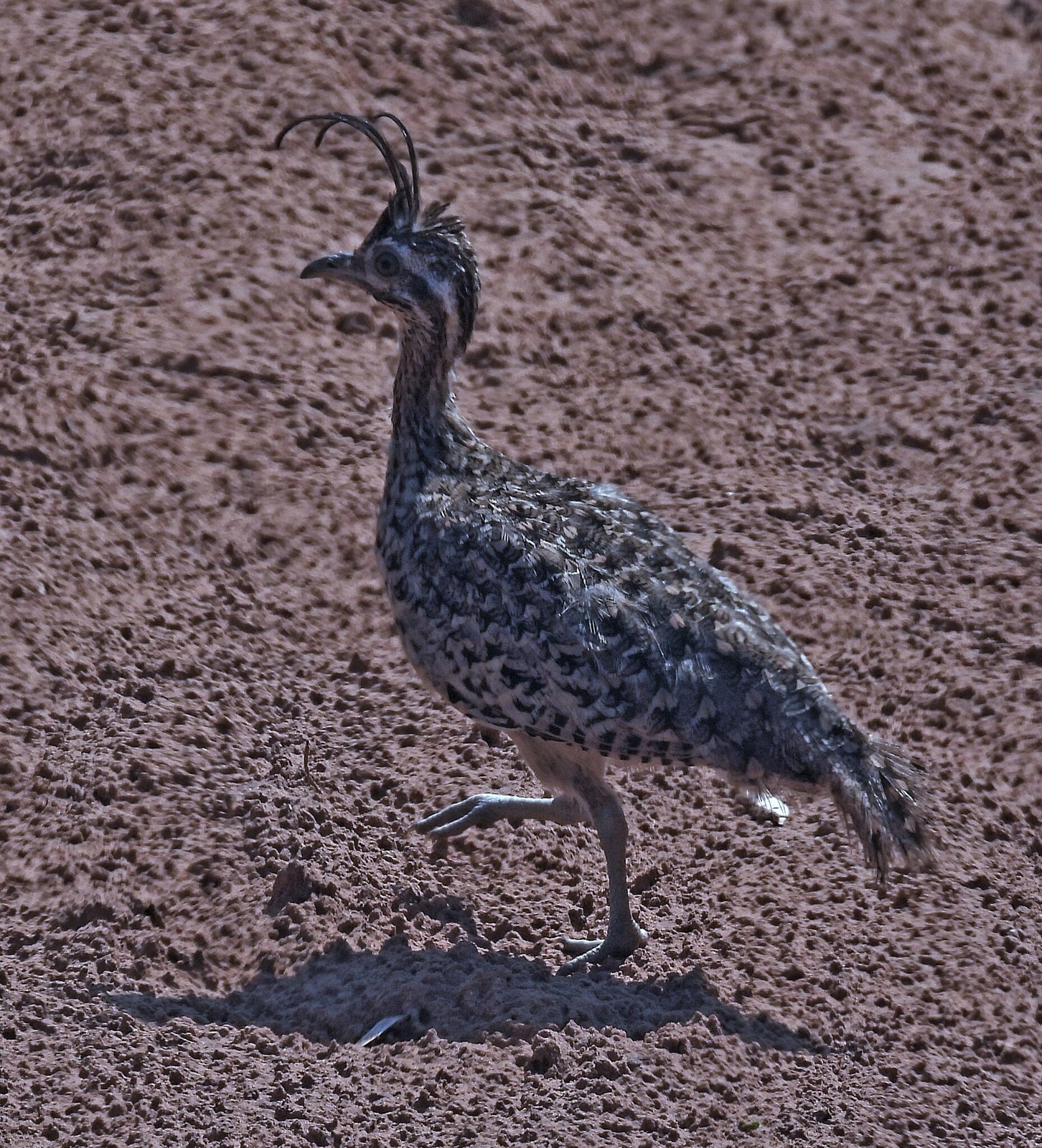
The Quebracho Crested Tinamou is a large tinamou with a long, thin crest that lives in the dry Chaco forest of Paraguay, Argentina and south-eastern Bolivia. It is named after the quebracho trees that characterise this forest. In the guide area it is a rare species at the far eastern edge, with only a few records known.
Voice
A series of clear, plaintive whistles, mainly heard at dusk. The voice is poorly documented; when flushed it gives a loud whirr of wings.
Recording: Eduardo Quintanilla — CC BY-NC-SA 4.0 · xeno-canto
Identification
38–41 cm, with a small head, a long, thin, forward-curving crest that is usually held erect, a thin, slightly decurved bill and almost no tail. The head has a white supercilium and a white stripe from the gape down the neck, separated by a dark band. The upperparts are greyish brown, densely covered with pale spots and fine dark barring. The underparts are paler buff with dark spots and bars on the breast and flanks. The legs are grey, without a hind toe. The sexes are alike.
Confusion species
The crest separates it from all other tinamous in the guide area. Red-winged Tinamou Rhynchotus rufescens is of similar size but lacks a crest, has rufous primaries and a rufous neck, and lives in open grassland. White-bellied Nothura Nothura boraquira is much smaller, without a crest, and has a white belly. Outside the guide area Elegant Crested Tinamou Eudromia elegans is very similar; it is on average paler and lives in drier, more open country further south and west.
Habitat
Dry Chaco forest with quebracho and other thorny trees, with an open understorey of shrubs, cacti and bromeliads, and the edges of this forest, in the lowlands. It walks on the ground, alone or in pairs and small groups, feeding on seeds, fruit, shoots and insects. The nest is on the ground, hidden under shrubs.
Where the bird is most at home, classified by the vegetation units of the Andes and the west coast.

Range and movements
In Bolivia only in the Chaco of the south-east, where only a few records are known. Absent from Colombia, Ecuador, Peru and the Galápagos. Outside the guide area in western Paraguay and northern Argentina.
- Resident
- dark = core range, pale = thinly spread
How and when to look
Search undisturbed Chaco forest in south-eastern Bolivia, along quiet sandy tracks in the early morning and late afternoon, when birds come out into open spots. At dusk, listen for the whistles.
Conservation status
Least Concern, but the Chaco forest is being cleared rapidly for cattle ranching and agriculture, and the species is hunted; its numbers are therefore expected to decline.
Scientific name
Eudromia formosa | (Lillo, 1905)
Lillo described the species in 1905 as Calopezus formosus; because it was later moved to another genus, the author and year stand in brackets. The genus Eudromia was introduced in 1832 by Geoffroy Saint-Hilaire. The genus name comes from Greek eu, 'well', and dromos, 'running'; the birds escape predators by running. Latin formosus means 'shapely'. The specimen the first description was based on came from Tucumán, Argentina.