All species › Rheas › Rheas › Greater Rhea
Greater Rhea | Rhea americana
Nandoe | Ñandú común | Ema
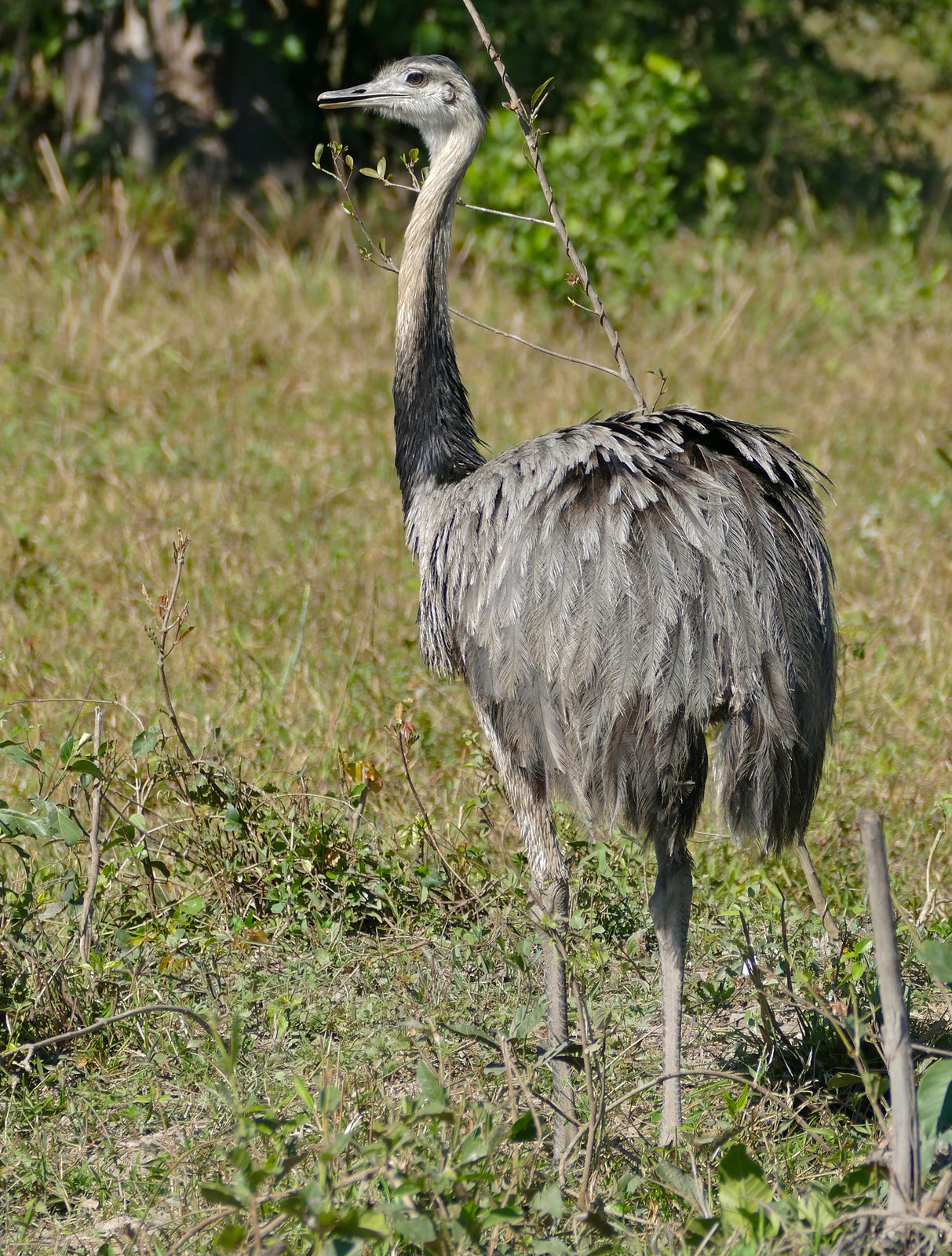
The Greater Rhea is the largest bird of South America, a flightless ratite of open grassland and savanna. In the guide area it lives only in the lowlands of eastern Bolivia. Outside the breeding season it roams in groups, often together with deer or cattle. Its Spanish and Portuguese name imitates the call of the male.
Voice
Usually silent. In the breeding season the male gives a deep, booming nan-doo. When threatened both sexes hiss; the chicks give whistles.
Recording: Dante Buzzetti — CC BY-NC-SA 4.0 · xeno-canto
Identification
127–140 cm; standing up to about 1.5 m tall. Long neck, long, bare three-toed lower legs and a rounded, tailless body under loose, soft plumage. The plumage is plain grey to greyish brown, without white spots. The male has black on the crown, nape and the front of the lower neck and breast, more extensive in the breeding season; the female is paler with less black. The large wings are spread when running. Young birds are greyer, with dark longitudinal stripes. White, leucistic birds occur.
Confusion species
Unmistakable within its habitat. Lesser Rhea Rhea pennata is smaller and browner, with small white spots on the back and wings and feathered upper legs, and lives only on the altiplano of western Bolivia and southern Peru, far from the lowlands.
Habitat
Open grassland, savanna, cerrado and open Chaco scrub, also pastures and fields with scattered groves, in the lowlands. It eats leaves, seeds and fruit, and also insects and small vertebrates. The male makes a nest on the ground, in which several females lay their eggs; he incubates alone and cares for the chicks, which he defends vigorously.
Where the bird is most at home, classified by the vegetation units of the Andes and the west coast.


Range and movements
In Bolivia in the eastern lowlands: the savannas of the Beni, the open country of Santa Cruz and the Chaco in the south-east. Absent from Colombia, Ecuador, Peru and the Galápagos. Outside the guide area in eastern and central Brazil, Paraguay, Uruguay and northern and central Argentina.
- Resident
- dark = core range, pale = thinly spread
How and when to look
In the savannas of the Beni, for example around Trinidad, and on large cattle ranches in eastern Bolivia, where groups can be seen from afar in the open grassland. Approach carefully: they run off quickly when disturbed.
Conservation status
Near Threatened. The population is declining through the conversion of grassland and savanna to arable farming, hunting and egg collecting. On large cattle ranches and in protected savannas the species holds its own.
Scientific name
Rhea americana | (Linnaeus, 1758)
Linnaeus described the species in 1758 as Struthio americanus; because it was later moved to another genus, the author and year stand in brackets. The genus Rhea was introduced in 1760 by Brisson. The genus name refers to Rhea, in Greek mythology a Titaness and the mother of Zeus. The species name is Latin americana, 'American', for the continent where the species lives. The specimen the first description was based on came from Sergipe and Rio Grande do Norte, Brazil.