All species › Rheas › Rheas › Lesser Rhea
Lesser Rhea | Rhea pennata
Darwins nandoe | Ñandú petiso | Ema-de-darwin
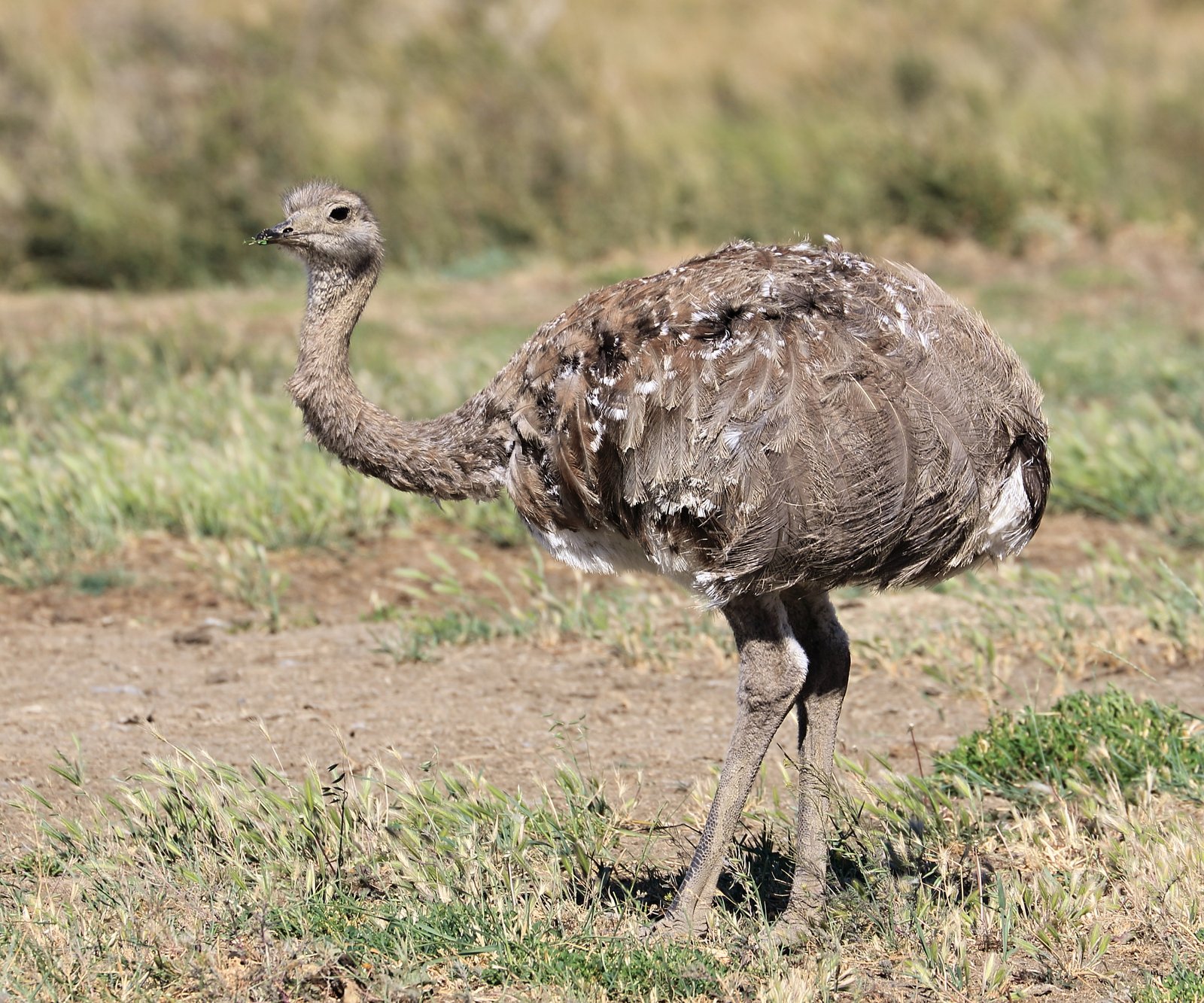
The Lesser Rhea is the smaller of the two rheas, a large, flightless ratite. In the guide area only the highland form occurs, inhabiting the dry plateaus of the altiplano well above 3000 m. There, small groups walk over the sparse grassland among llamas, alpacas and vicuñas. This form is sometimes treated as a separate species, the Puna Rhea.
Voice
Usually silent. In the breeding season the male gives a low booming or hissing sound.
Recording: Elisa M. Huanca Plata - Universidad Técnica de Oruro — CC BY-NC-SA 4.0 · xeno-canto
Identification
90–100 cm tall, with a long neck, long, strong three-toed legs and a rounded, tailless body under a thick plumage. The plumage is greyish brown, with small white spots on the back and wings; the underparts are paler. The wings are fairly large for a ratite, but the bird cannot fly; when running it spreads them to change direction quickly. The upper part of the legs is feathered. The sexes are alike; young birds are greyer and striped.
Confusion species
In the guide area it is unmistakable. Greater Rhea Rhea americana is larger and greyer, without white spots, with bare lower legs, and lives only in the lowlands of eastern Bolivia, far from the altiplano.
Habitat
Dry puna and altiplano with sparse bunch grass and low shrubs, also the edges of bofedales and salt flats, at roughly 3500 to 4500 m. It eats mainly leaves, shoots and seeds of low plants, and also insects. A male makes a nest on the ground, in which several females lay their eggs; the male incubates alone and cares for the chicks.
Where the bird is most at home, classified by the vegetation units of the Andes and the west coast.


Range and movements
In Peru only in the far south, in the highlands of Puno, Moquegua and Tacna, where it is rare. In Bolivia on the altiplano in the west and south-west of the country. Absent from Colombia, Ecuador and the Galápagos. Outside the guide area in northern Chile and north-western Argentina; the lowland form lives in Patagonia in southern Argentina and Chile.
- Resident
- dark = core range, pale = thinly spread
How and when to look
On the vast plateaus of south-western Bolivia and in the area around Sajama, where groups can be seen from afar. Approach carefully: they run off quickly when disturbed.
Conservation status
Least Concern, but the highland form is much scarcer than the lowland form and is declining through hunting, egg collecting and competition with livestock; in Peru it has become very rare.
Scientific name
Rhea pennata | d'Orbigny, ACVMD, 1834
D'Orbigny, ACVMD described the species in 1834 and placed it straight away in the genus where it still stands. The genus Rhea was introduced in 1760 by Brisson. The genus name refers to Rhea, in Greek mythology a Titaness and the mother of Zeus. The species name is Latin pennatus, 'feathered, winged'. The specimen the first description was based on came from Patagonia.