All species › Tubenoses › Northern storm petrels › Ringed Storm-Petrel
Ringed Storm-Petrel | Hydrobates hornbyi
Gekraagd stormvogeltje | Paíño de Hornby | Painho-de-colar
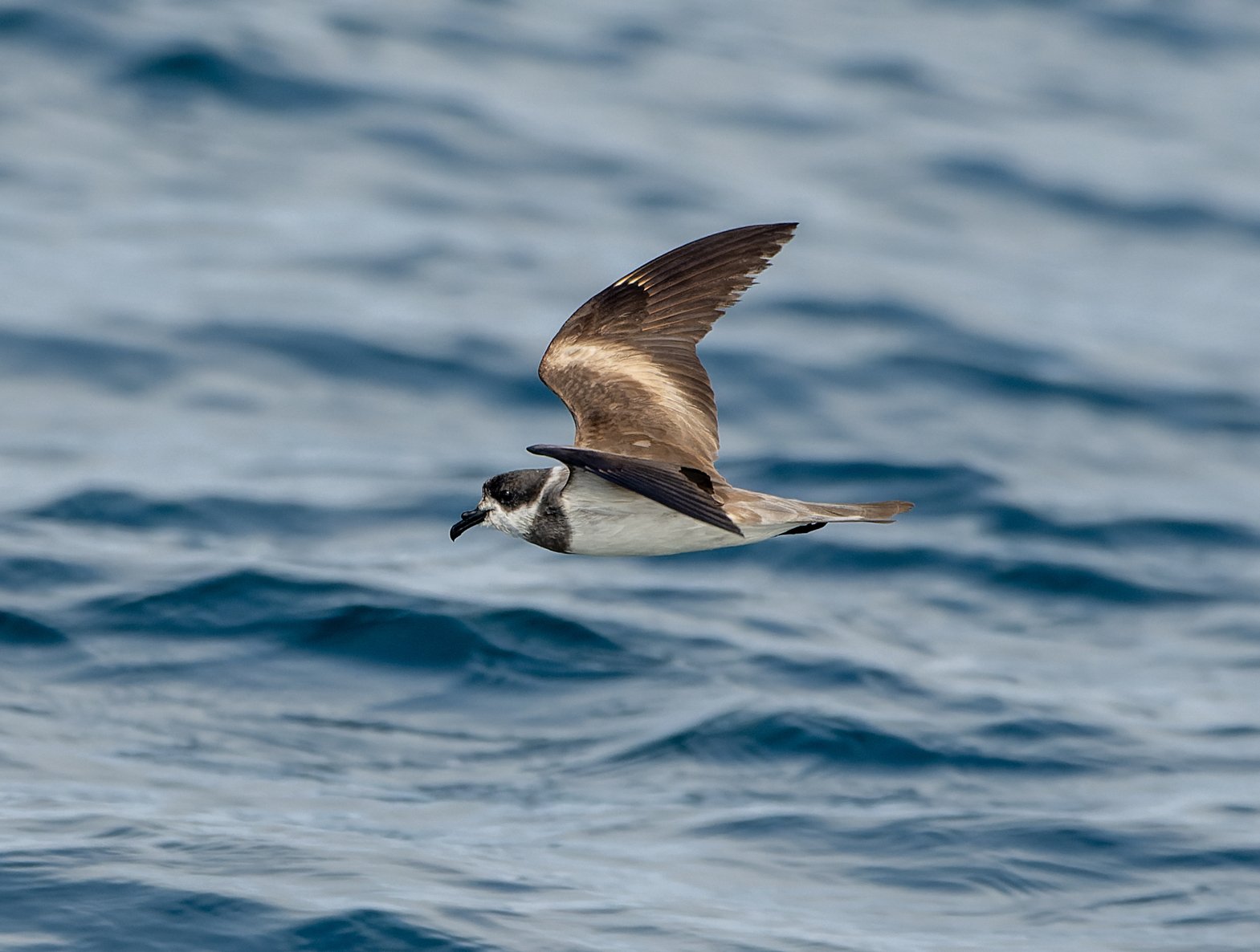
The Ringed Storm-Petrel is a grey-and-white storm petrel with a dark cap and a dark breast band, found only in the Humboldt Current. For a long time its breeding grounds were unknown. The first colonies were found only in 2017, in cavities in salt crusts deep in the Atacama Desert of northern Chile.
Voice
Silent at sea. Little is known about the calls at the colonies.
Recording: Cristian Pinto — CC BY-NC-SA 4.0 · xeno-canto
Identification
21–22 cm, a medium-sized storm petrel with long wings and a deeply forked tail. Forehead, throat and a broad collar around the neck are white and sharply set off against a blackish-brown cap. The back is grey, the wings darker greyish brown with a pale bar across the upperwing. The underparts are white with a broad greyish-brown breast band. Flight is fast and swerving, with short glides. The sexes are alike.
Confusion species
White-faced Storm-Petrel Pelagodroma marina has a white supercilium and a dark eye patch instead of a cap, and no breast band. White-bellied Storm Petrel Fregetta grallaria is blackish above with a white rump and lacks a white collar. Elliot's Storm-Petrel Oceanites gracilis is smaller and dark, with a white rump and some white on the belly.
Habitat
At sea over the Humboldt Current, mainly far offshore over deep water and less often over the continental shelf. It picks small fish, squid and crustaceans from the surface in flight. It breeds in cavities in the salt crust of dry flats deep in the desert, tens of kilometres from the sea; birds come ashore only at night.
Where the bird is most at home, classified by the vegetation units of the Andes and the west coast.


Range and movements
At sea along the coast of Peru, most numerous off central and southern Peru; scarce north to waters off Ecuador. Breeding in the desert of southern Peru is suspected but not confirmed. There are at most a few records from Colombia and the waters around the Galápagos; absent from Bolivia. Outside the guide area it breeds in northern Chile and occurs at sea off the Chilean coast.
- Resident
- Summer visitor (c. Apr–Sep)
- Winter visitor (c. Oct–Mar)
- Passage (Mar–Apr, Oct–Nov)
- dark = core range, pale = thinly spread
How and when to look
The species is seen most often on pelagic trips farther offshore from Lima and southern Peru, usually singly or in small numbers among other storm petrels.
Conservation status
Near Threatened. As with Markham's Storm Petrel, artificial light from towns, mines and roads disorients fledging young birds, which come down on land. Mining, road building and other developments in the desert also threaten the colonies.
Scientific name
Hydrobates hornbyi | (Gray, 1854) (GBIF: Oceanodroma hornbyi)
Gray described the species in 1854 as Thalassidroma Hornbyi; because it was later moved to another genus, the author and year stand in brackets. The genus Hydrobates was introduced in 1822 by Boie. The genus name comes from Greek hudro-, 'water-', and batēs, 'walker', for the pattering over the water surface while feeding. The species name honours Admiral Sir Phipps Hornby (1785–1867), a British naval officer who obtained the type specimen. The specimen the first description was based on came from (per the description).