All species › Tubenoses › Northern storm petrels › Wedge-rumped Storm Petrel
Wedge-rumped Storm Petrel | Hydrobates tethys
Galapagosstormvogeltje | Paíño danzarín | Painho-de-galápagos
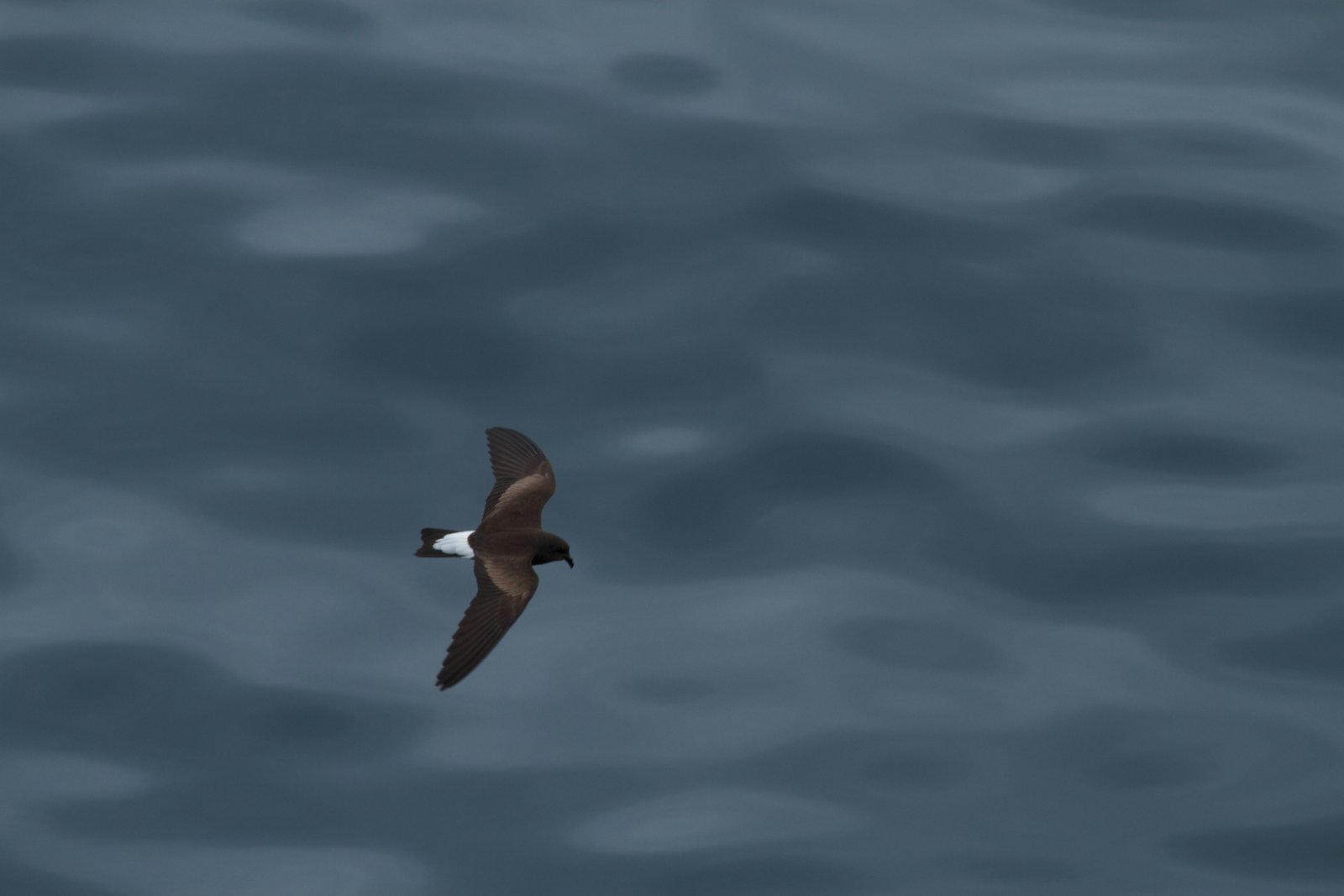
The Wedge-rumped Storm Petrel is a small, dark storm petrel with a strikingly large white rump, living in the tropical eastern Pacific. It is the commonest storm petrel around the Galápagos and, unlike most storm petrels, can be seen at its breeding colonies by day. At sea it feeds mainly at night.
Voice
Usually silent at sea. At the breeding colonies birds give scratchy and chattering calls.
Recording: Fabrice Schmitt — CC BY-NC-SA 4.0 · xeno-canto
Identification
18–20 cm, a small storm petrel with fairly long, pointed wings. The plumage is uniformly sooty black to dark blackish brown, with a pale diagonal bar across the upperwing. The white rump is large and triangular and extends far over the base of the tail at the sides, so that from above the short tail looks largely white with only a dark terminal band. The feet do not project beyond the tail. Flight is fast and erratic, low over the water. The sexes are alike.
Confusion species
Band-rumped Storm Petrel Hydrobates castro is larger, with a narrower, straight white rump band and a calmer, shearing flight. Leach's Storm-Petrel Hydrobates leucorhous is larger, with a forked tail and a rump patch that is often divided in the centre. Wilson's Storm Petrel Oceanites oceanicus and Elliot's Storm-Petrel Oceanites gracilis have rounder wings and feet that project beyond the tail; Elliot's Storm-Petrel also shows white on the belly. Least Storm Petrel Hydrobates microsoma is all dark, without a white rump.
Habitat
Open ocean and the warmer inshore waters, often far offshore; less numerous over the cold Humboldt Current. It picks small fish, squid and crustaceans from the surface in flight, mainly at night. It breeds in colonies in crevices and cavities in lava rock and on rocky islands.
Where the bird is most at home, classified by the vegetation units of the Andes and the west coast.


Range and movements
Breeds on the Galápagos, where it occurs on several islands, and as a smaller subspecies on a few islands off the coast of Peru. At sea throughout the waters between the Galápagos and the mainland and along the coasts of Colombia, Ecuador and Peru. Absent from Bolivia. Outside the guide area it disperses north to waters off Central America and Mexico and south to waters off Chile.
- Resident
- Summer visitor (c. Apr–Sep)
- Winter visitor (c. Oct–Mar)
- Passage (Mar–Apr, Oct–Nov)
- dark = core range, pale = thinly spread
How and when to look
On Genovesa in the Galápagos large numbers fly by day over the lava fields where they breed, together with Band-rumped Storm Petrels; Short-eared Owl Asio flammeus hunts storm petrels there. At sea the species is regularly seen from boats between the islands.
Conservation status
Least Concern. Introduced rats and cats are a threat to breeding colonies; on the Galápagos the main colonies are protected.
Scientific name
Hydrobates tethys | (Bonaparte, 1852) (GBIF: Oceanodroma tethys)
Bonaparte described the species in 1852 as Thalassidroma Tethys; because it was later moved to another genus, the author and year stand in brackets. The genus Hydrobates was introduced in 1822 by Boie. The genus name comes from Greek hudro-, 'water-', and batēs, 'walker', for the pattering over the water surface while feeding. The species name refers to Tethys, a sea goddess in Greek mythology, daughter of Uranus and Gaia and wife of Oceanus. The specimen the first description was based on came from Galápagos Islands, Ecuador.