All species › Tubenoses › Northern storm petrels › Leach's Storm-Petrel
Leach's Storm-Petrel | Hydrobates leucorhous
Vaal stormvogeltje | Paíño boreal | Painho-de-cauda-furcada
Leach's Storm-Petrel breeds in the northern Atlantic and Pacific and is one of the most widespread storm petrels in the world. Outside the breeding season birds from the Pacific colonies move to the tropical eastern Pacific, as far as the waters around the Galápagos and off Ecuador. There they mostly stay far offshore and rarely come within sight of land.
Voice
Silent at sea. At the colonies a rattling, cackling call is given at night, and a long purring sound comes from the burrows.
Recording: Doug Hynes — CC BY-SA 4.0 · xeno-canto
Identification
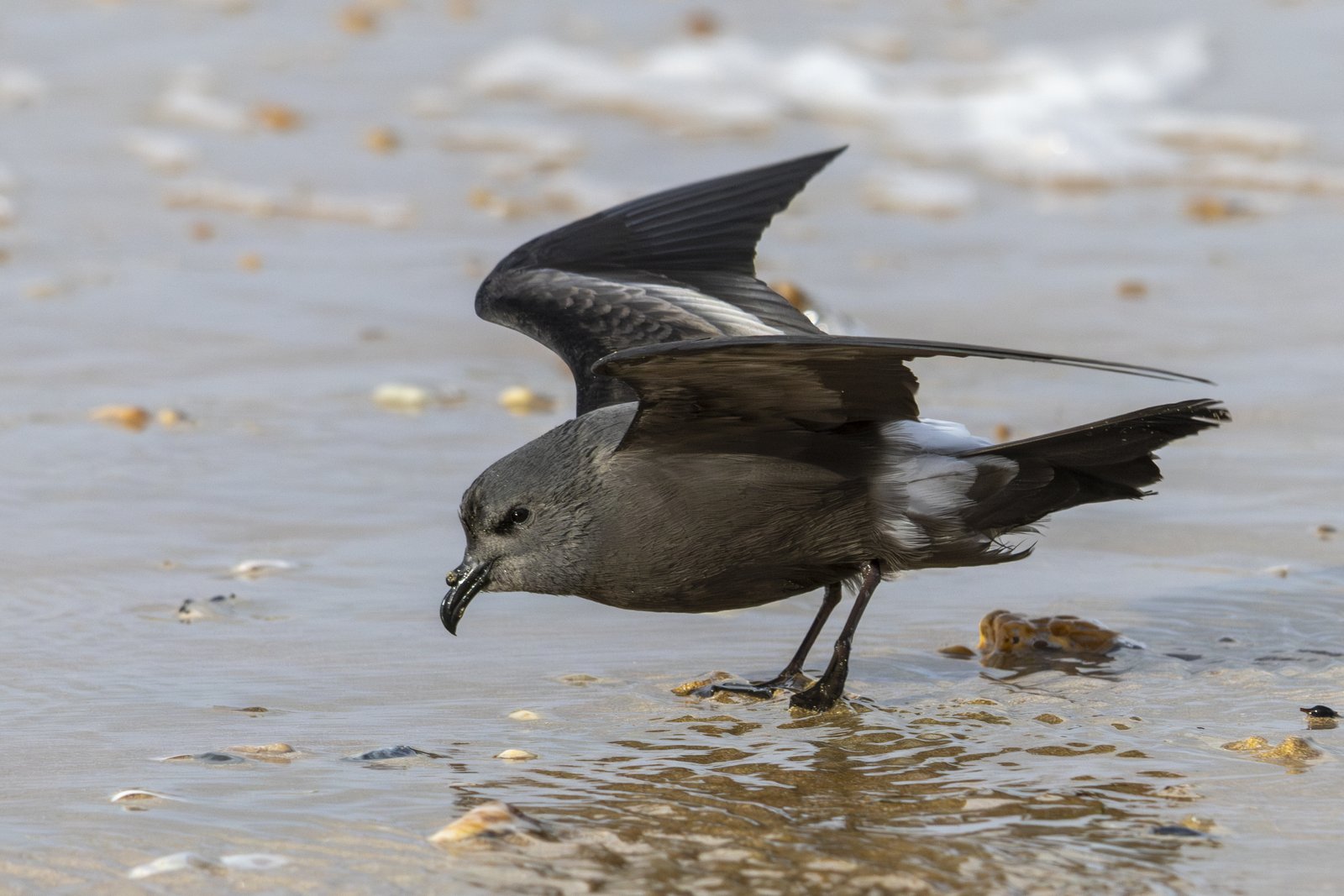
19–22 cm, a medium-sized storm petrel with long, angular wings and a clearly forked tail. The plumage is dark brownish black, with a broad pale bar across the upperwing reaching almost to the leading edge. Most birds have a white rump often divided by a grey central line; birds from colonies off Baja California have a dark or nearly dark rump. Flight is bounding and erratic, with sudden changes of direction, recalling a nightjar. The sexes are alike.
Confusion species
Band-rumped Storm Petrel Hydrobates castro has a narrower, straight and undivided rump band, a less forked tail and a calmer, shearing flight. Wedge-rumped Storm Petrel Hydrobates tethys is smaller, with a large, triangular white rump. Dark-rumped birds resemble Black Storm Petrel Hydrobates melania and Markham's Storm Petrel Hydrobates markhami, which are larger, with a longer tail and a calmer wingbeat.
Habitat
Open ocean far offshore, especially over deep water and along boundaries between water masses; scarce over the continental shelf. It picks small fish, crustaceans and other plankton from the surface in flight, mainly at night. It breeds in self-dug burrows in the ground on islands outside the guide area.
Where the bird is most at home, classified by the vegetation units of the Andes and the west coast.

Range and movements
In the northern winter at sea around the Galápagos and well off the coasts of Ecuador and Colombia; scarce off Peru, mainly far offshore. Rare along the Caribbean coast of Colombia. Absent from Bolivia. Outside the guide area it breeds in the northern Pacific, from Japan via Alaska to Baja California, and in the northern Atlantic.
How and when to look
The species is rarely seen from shore. On long boat trips to and between the Galápagos and on pelagic trips far off Ecuador, birds appear now and then among other storm petrels; note the forked tail, the long wing bar and the bounding flight.
Conservation status
Vulnerable. The largest colonies, in the Atlantic and especially in Canada, have declined sharply in recent decades through predation by gulls and mammals, artificial light on oil platforms and in towns, and changes in food supply at sea.
Scientific name
Hydrobates leucorhous | (Vieillot, 1818) (GBIF: Oceanodroma leucorhoa)
Vieillot described the species in 1818 as Procellaria leucorhoa; because it was later moved to another genus, the author and year stand in brackets. The genus Hydrobates was introduced in 1822 by Boie. The genus name comes from Greek hudro-, 'water-', and batēs, 'walker', for the pattering over the water surface while feeding. The species name comes from Greek leukos, 'white', and orrhos, 'rump', for the white rump. The specimen the first description was based on came from Coast of Picardy, France.