All species › Tubenoses › Petrels, shearwaters and diving petrels › Pintado Petrel
Pintado Petrel | Daption capense
Kaapse stormvogel | Petrel Pintado | Pomba-do-cabo
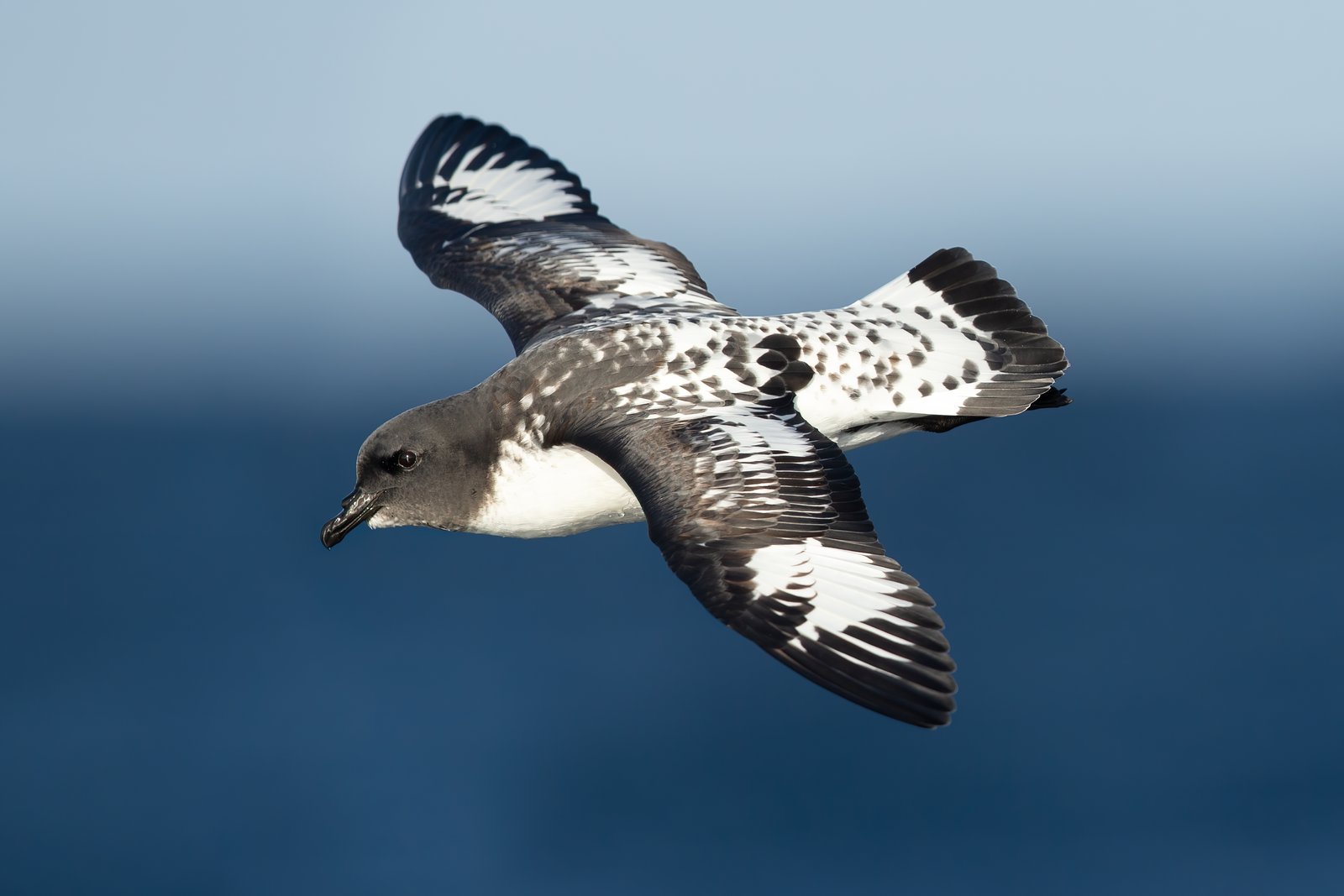
The Pintado Petrel is a medium-sized petrel of the southern oceans with chequered black-and-white upperparts unlike those of any other seabird. It breeds around Antarctica and on subantarctic islands and moves north with the cold Humboldt Current in the austral winter. It follows ships and gathers in flocks at fish waste.
Voice
Usually silent at sea. When feeding at ships it gives cackling and rattling calls, often from many birds at once.
Recording: Mike Bell/Dave Boyle — CC BY-NC-SA 4.0 · xeno-canto
Identification
35–40 cm, a stocky petrel with a round head, a short, thick black bill with tubular nostrils and a short, rounded tail. The head, neck and front of the mantle are blackish. The back, rump and upperwing are white with a dense pattern of black spots; the upperwing shows two large white patches, one at the base of the primaries and one on the inner wing. The tail is white with a broad black terminal band. The underparts are white, the underwing white with a dark border. It flies with fast, stiff wingbeats alternating with glides. The sexes are alike; juveniles resemble adults.
Confusion species
The chequered black-and-white pattern makes the species almost unmistakable in the guide area. Southern Fulmar Fulmarus glacialoides is larger and silver-grey, with a pink, dark-tipped bill and only a white patch on the primaries. Prions, such as Slender-billed Prion Pachyptila belcheri, are smaller and blue-grey, with a dark M across the wings and unspotted white underparts.
Habitat
Cool inshore waters and open ocean, especially over the Humboldt Current, also close inshore and in harbours. It feeds on krill and other crustaceans, small fish and squid, picked from the surface while swimming, and follows fishing boats for waste. It breeds in colonies on ledges and in niches of cliffs along the coast of Antarctica and on subantarctic islands; the nest is a scrape lined with small stones.
Where the bird is most at home, classified by the vegetation units of the Andes and the west coast.


Range and movements
In Peru at sea in the austral winter, mainly off the south and centre, moving further north in cool years. In Ecuador rare, off the south coast. Not known from Colombia, Bolivia or the Galápagos. It does not breed in the guide area. Outside the guide area around Antarctica and on islands in the southern oceans; outside the breeding season north to the Humboldt Current off Chile and Peru and in the Atlantic to off Brazil.
- Passage (Mar–Apr, Oct–Nov)
- dark = core range, pale = thinly spread
How and when to look
On pelagic trips from harbours in southern and central Peru between June and October; birds come to fish waste and often sit in small groups near fishing boats.
Conservation status
Least Concern. The world population is large. Bycatch in fisheries and rats and other introduced predators on breeding islands are local threats.
Scientific name
Daption capense | (Linnaeus, 1758)
Linnaeus described the species in 1758 as Procellaria capensis; because it was later moved to another genus, the author and year stand in brackets. The genus Daption was introduced in 1826 by Stephens. The genus name is an anagram of pintado, Portuguese for 'painted', the old sailors' name for this bird. The species name refers to the Cape of Good Hope, South Africa. The specimen the first description was based on came from Cape of Good Hope, South Africa.