All species › Tubenoses › Petrels, shearwaters and diving petrels › Southern Giant Petrel
Southern Giant Petrel | Macronectes giganteus
Zuidelijke reuzenstormvogel | Abanto Marino Antártico | Petrel-gigante
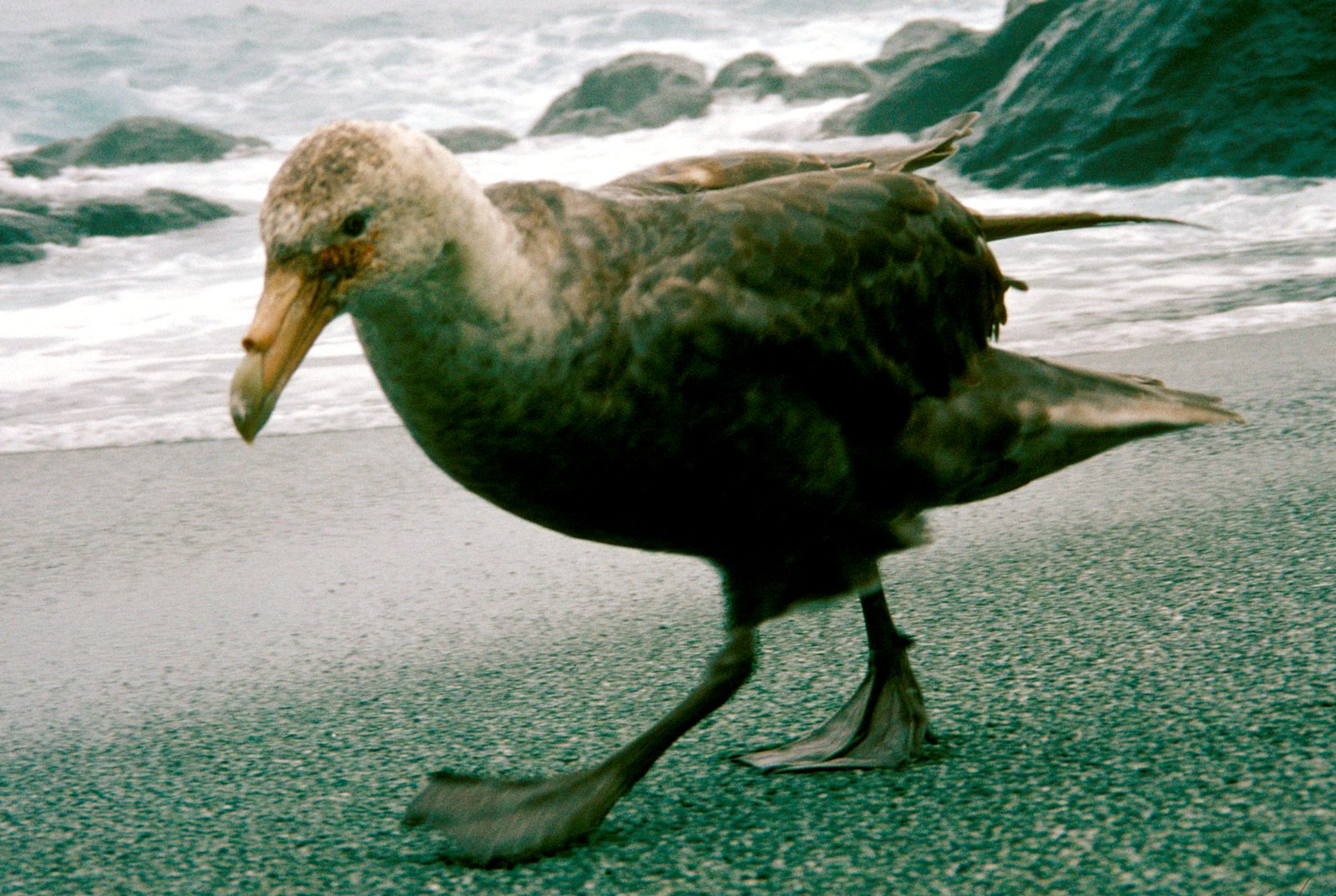
The Southern Giant Petrel is, together with Northern Giant Petrel, the largest petrel, as big as a small albatross, with a massive pale bill. It is both scavenger and predator: it feeds on carcasses of seals and penguins and also kills seabirds. After fledging, young birds wander over much of the southern oceans, north into the Humboldt Current.
Voice
Usually silent at sea. At carcasses and food it gives croaking, whinnying and cackling sounds, with threat displays with spread wings and raised tail.
No recording with a suitable Creative Commons licence is available for this species yet.
Identification
85–100 cm, a massive petrel with a heavy, pale horn-coloured bill with a greenish tip and a long tubular nostril, a thick neck and long, rather narrow wings. Most birds are dark greyish brown, with a paler head and neck that become whiter with age; adults are mottled greyish brown with a whitish head and neck. A rare white morph is entirely white with a few dark feathers. Juveniles are uniform glossy blackish brown. The flight is stiff, with short bursts of wingbeats and a hunched posture; on land and on the water it moves heavily. The sexes are alike, the male larger.
Confusion species
Northern Giant Petrel Macronectes halli has a reddish-brown rather than greenish bill tip, and adults have a darker face and often a pale eye; juveniles of the two species can only be told apart by the bill tip. Albatrosses, such as Black-browed Albatross Thalassarche melanophris, have longer, narrower wings, a slimmer bill without a long tube on top and a smoother gliding flight. White-chinned Petrel Procellaria aequinoctialis is much smaller and slimmer, with a smaller pale bill.
Habitat
Inshore waters and open ocean, often close to the coast, at harbours, fishing boats and sea lion colonies. It feeds on carrion of marine mammals and birds, fish waste, squid and crustaceans, and also kills seabirds. It breeds in loose colonies on open, flat ground on Antarctic and subantarctic islands and along the coast of Patagonia; the nest is a mound of grass, moss and small stones.
Where the bird is most at home, classified by the vegetation units of the Andes and the west coast.


Range and movements
In Peru at sea and along the coast, mainly in the south and centre in the austral winter; scarcer to the north. In Ecuador rare, off the south coast. No confirmed records from Colombia, Bolivia or the Galápagos. It does not breed in the guide area. Outside the guide area it breeds around Antarctica, on subantarctic islands and in Argentina; young birds wander over all the southern oceans.
- Resident
- Summer visitor (c. Apr–Sep)
- Passage (Mar–Apr, Oct–Nov)
- dark = core range, pale = thinly spread
How and when to look
Check harbours and fishing boats in southern and central Peru, such as around Lima and Paracas, and on pelagic trips between May and October. The size and the heavy pale bill are diagnostic at a distance.
Conservation status
Least Concern. After an earlier decline the population is stable to increasing. Bycatch in longline fisheries and disturbance at breeding colonies are the main threats.
Scientific name
Macronectes giganteus | (Gmelin, 1789)
Gmelin described the species in 1789 as Procellaria gigantea; because it was later moved to another genus, the author and year stand in brackets. The genus Macronectes was introduced in 1905 by Richmond. The genus name comes from Greek makros, 'large', and nēktēs, 'swimmer'. The species name is Latin giganteus, 'gigantic'. The specimen the first description was based on came from Isla de los Estados (Staten Island), Argentina.