All species › Passerines › Tyrant flycatchers and allies › Rough-legged Tyrannulet
Rough-legged Tyrannulet | Acrochordopus burmeisteri
Ruwpoottiranneke | Mosqueta pico curvo | Piolhinho-chiador
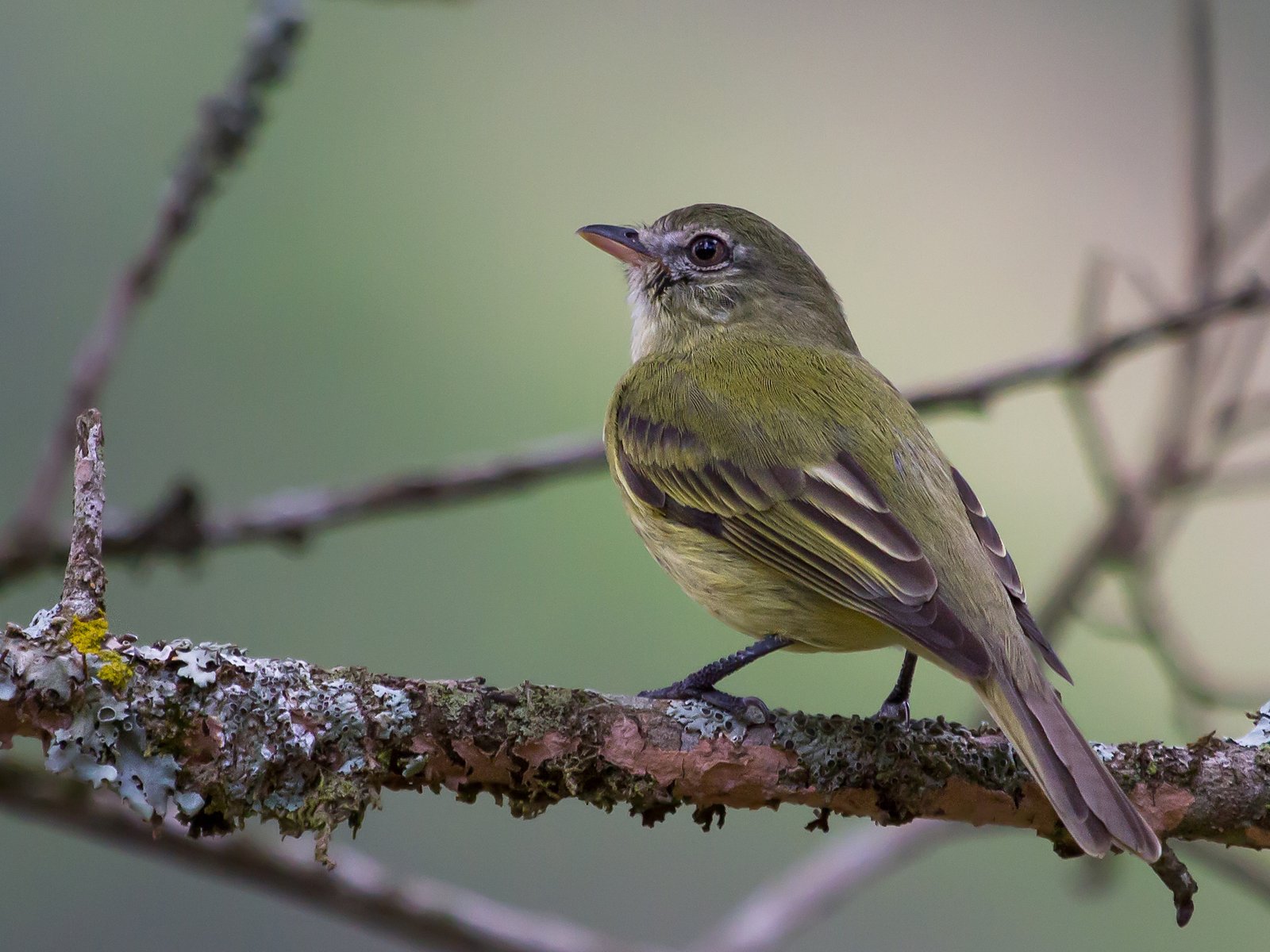
The Rough-legged Tyrannulet is a small, olive-green tyrannulet of the canopy of humid foothill and montane forest. The name refers to the rough, granular scales on the tarsi, a feature visible only in the hand. In the field the pale lower mandible is the most obvious feature. Some lists treat the northern forms as a separate species, Acrochordopus zeledoni.
Voice
High, sharp calls and a short series of thin, slightly descending notes.
No recording with a suitable Creative Commons licence is available for this species yet.
Identification
11.5 cm, with a short bill whose lower mandible is pale orange or pinkish. The crown is greyish, in birds from Colombia to Peru with a whitish forehead and white lores. The upperparts are olive-green. The wings are dark, with two yellowish wing bars and yellow edges to the flight feathers. The throat is greyish white, the breast and belly pale yellow, the breast with an olive wash. The sexes are alike.
Confusion species
Sclater's Tyrannulet Phyllomyias sclateri of the Yungas has a grey crown with a white eyebrow and an all-dark bill. Golden-faced Tyrannulet Zimmerius chrysops has a yellow face and wing feathers with yellow edges, but no true wing bars. Yellow-crowned Tyrannulet Tyrannulus elatus of the lowlands is smaller, with a short, black bill and a grey face.
Habitat
The canopy and edges of humid foothill and lower montane forest, roughly between 600 and 2000 m. It searches for insects and small fruits among leaves and on branches in the treetops, often in mixed flocks. The nest has been little described.
Where the bird is most at home, classified by the vegetation units of the Andes and the west coast.


Range and movements
Bolivia: in the south, along the east slope of the Andes (form burmeisteri). Colombia, Ecuador and Peru: locally on the slopes of the Andes (form leucogonys, if included in this species). Absent from the Galápagos. Outside the guide area in north-western Argentina, Paraguay and south-eastern Brazil, and with related forms in Costa Rica, Panama and Venezuela.
How and when to look
Search the canopy along roads through humid foothill and montane forest, often in mixed flocks with tanagers, and look for the pale lower mandible.
Conservation status
Least Concern. The species is locally scarce but has a large range.
Scientific name
Acrochordopus burmeisteri | (Cabanis & Heine, 1860)
Cabanis & Heine described the species in 1860 as P[hyllomyias] Burmeisteri; because it was later moved to another genus, the author and year stand in brackets. The genus Acrochordopus was introduced in 1905 by Berlepsch & Hellmayr. The genus name comes from Greek akrokhordōn, 'wart', and pous, 'foot', referring to the rough, warty legs. The species name honours Hermann Burmeister (1807–1892), German-Argentine zoologist and director of the natural history museum in Buenos Aires. The specimen the first description was based on came from Rio de Janeiro, Brazil.