All species › Passerines › Tyrant flycatchers and allies › Cock-tailed Tyrant
Cock-tailed Tyrant | Alectrurus tricolor
Hanenstaarttiran | Yetapá chico | Galito
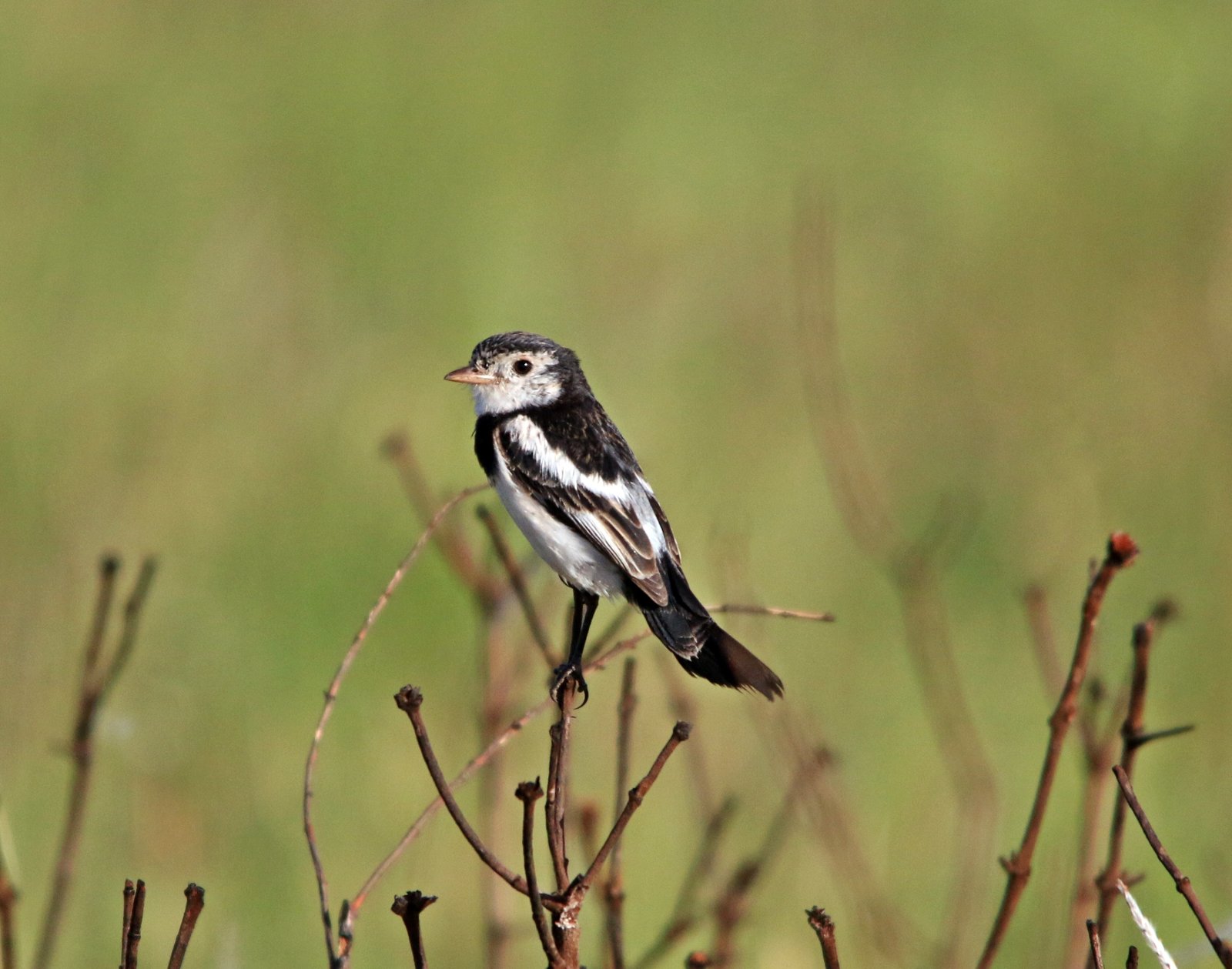
The Cock-tailed Tyrant is a small tyrant of wet grassland and open savanna in the south-east of the Amazon basin and the cerrado. The male has a tail with two broad, upright central feathers, which vaguely recall the tail of a cockerel. In the guide area it occurs only in eastern Bolivia. The species has declined in many places as its grassland disappears.
Voice
Usually silent. During the display flight the male gives soft ticking sounds and a rustle of the wings.
Recording: Jacob Wijpkema — CC BY-NC-SA 4.0 · xeno-canto
Identification
12–18 cm; the male including the elongated tail, the female about 12 cm. The male is black and white: crown, upperparts and wings black, with a white patch on the shoulder, and white underparts with a black patch on each side of the breast. The bill is strikingly pale, pinkish to yellowish. The tail has two broad central feathers held upright. The female is brown above with paler feather edges, whitish below with brown breast sides, and has a normal, short tail. Young birds resemble the female.
Confusion species
Streamer-tailed Tyrant Gubernetes yetapa is much larger, grey with a rufous throat band and a very long, deeply forked tail. Spectacled Tyrant Hymenops perspicillatus has an all-black male with white primaries and a yellow fleshy ring around the eye; the female is streaked with rufous wings. Sharp-tailed Grass Tyrant Culicivora caudacuta is smaller, streaked on the back, with a thin, pointed tail, and lives in the same grassland. Females can be confused with female seedeaters, but have a thin tyrant bill.
Habitat
Tall, damp to seasonally flooded grassland, savanna with scattered shrubs and grassy marsh edges in the lowlands, up to about 1000 m. It perches low on grass stems or small shrubs and catches insects in short flights or from the ground. In display the male rises steeply and glides back with the tail raised. The nest is an open cup low in the grass.
Where the bird is most at home, classified by the vegetation units of the Andes and the west coast.


Range and movements
In the guide area only in eastern Bolivia, in the savannas of Beni and Santa Cruz. Absent from Colombia, Ecuador, Peru and the Galápagos. Outside the guide area in central and southern Brazil and in Paraguay; in north-eastern Argentina almost or entirely gone.
- Resident
- dark = core range, pale = thinly spread
How and when to look
In the wet season, search tall grassland in Beni and eastern Santa Cruz for a male perched on a grass stem or making short display flights above the grass.
Conservation status
Vulnerable. The open grassland on which the species depends is converted to farmland and plantations, heavily grazed and often burned.
Scientific name
Alectrurus tricolor | (Vieillot, 1816)
Vieillot described the species in 1816 as Gallita tricolor; because it was later moved to another genus, the author and year stand in brackets. The genus Alectrurus was introduced in 1816 by Vieillot. The genus name comes from Greek alektōr, 'cock', and oura, 'tail', referring to the male's striking tail. The species name comes from Latin tricolor, 'three-coloured'. The specimen the first description was based on came from Paraguay.