All species › Passerines › Tyrant flycatchers and allies › Cattle Tyrant
Cattle Tyrant | Machetornis rixosa
Veetiran | Picabuey | Suiriri-cavaleiro
The Cattle Tyrant is a largely terrestrial tyrant: it walks and runs on long legs through short grass and often rides on the backs of cattle, horses and capybaras. From there it catches the insects the animals flush. In the guide area it occurs in two separate regions: northern Colombia and the lowlands of Bolivia.
Voice
High, thin, squeaky notes and twittering, such as tsee-tsee-tsee, often in duet; at dusk a repeated, sibilant song.
Recording: Fabrício Grigolin — CC BY-NC-SA 4.0 · xeno-canto
Identification
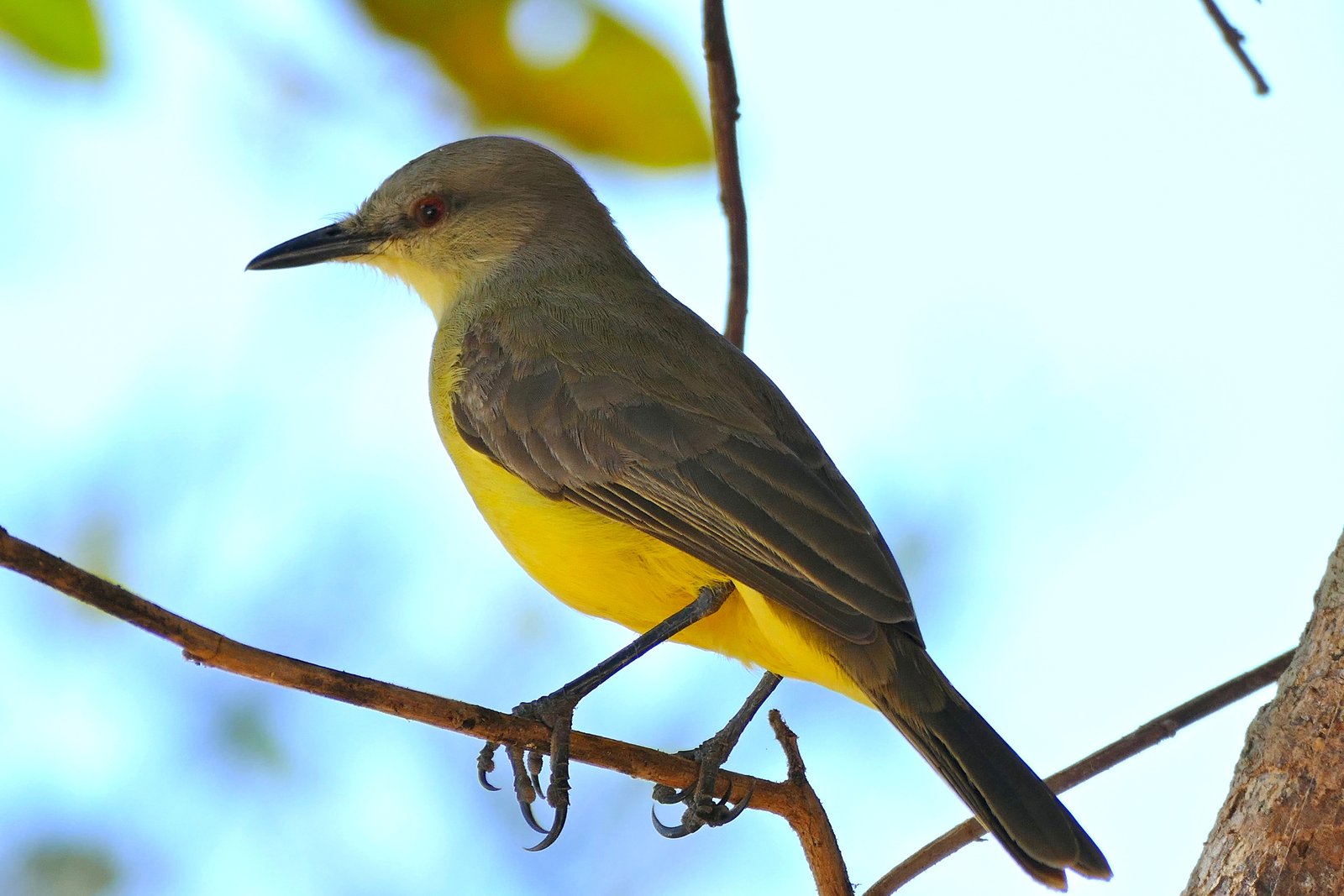
18–20 cm, with long black legs, a straight black bill and an upright stance. The upperparts are greyish brown to olive-brown, the head greyer with a dark stripe through the eye. The throat and underparts are yellow, the throat yellower in the northern form. The tail is brown with paler tips. A red crown patch is usually concealed. The sexes are alike.
Confusion species
Tropical Kingbird Tyrannus melancholicus has a similar yellow-and-grey plumage, but perches high on wires and branches, has a forked tail and a greyish breast, and does not walk on the ground. Great Kiskadee Pitangus sulphuratus has a black-and-white striped head and a heavier bill. Yellow-browed Tyrant Satrapa icterophrys is smaller, with a yellow supercilium, and perches in shrubs.
Habitat
Open pasture with livestock, savanna, wet grassland, riverbanks, parks and lawns in villages, in the lowlands up to about 1000 m, locally higher in the Andean valleys of Colombia. It runs after insects on the ground or catches them in a short flight from a cow or fence. It nests in tree cavities, niches in buildings or old ovenbird nests.
Where the bird is most at home, classified by the vegetation units of the Andes and the west coast.


Range and movements
Colombia: in the Caribbean lowlands, the Magdalena and Cauca valleys, and the llanos east of the Andes. Bolivia: in the lowlands of the north, centre and east (Beni, Santa Cruz). In Peru and Ecuador only scarce, recent records in the lowlands east of the Andes, possibly as a result of expansion with deforestation and cattle ranching. Absent from the Galápagos. Outside the guide area in Venezuela, and from Brazil to Paraguay, Uruguay and northern Argentina.
- Resident
- dark = core range, pale = thinly spread
How and when to look
Check pastures with cattle or capybaras for a yellow tyrant running on the ground or sitting on an animal's back.
Conservation status
Least Concern. The species benefits from the opening of forest for cattle ranching and is expanding locally.
Scientific name
Machetornis rixosa | (Vieillot, 1819)
Vieillot described the species in 1819 as Tyrannus rixosus; because it was later moved to another genus, the author and year stand in brackets. The genus Machetornis was introduced in 1841 by Gray. The genus name comes from Greek makhētēs, 'fighter', and ornis, 'bird', referring to its pugnacious behaviour and habit of taking over other species' nests. The species name comes from Latin rixosus, 'quarrelsome', referring to the bird's behaviour. The specimen the first description was based on came from Paraguay.