All species › Passerines › Tyrant flycatchers and allies › Ochraceous-breasted Flycatcher
Ochraceous-breasted Flycatcher | Nephelomyias ochraceiventris
Okerborsttiran | Mosquerito pechiocráceo | Papa-moscas-de-peito-ocráceo
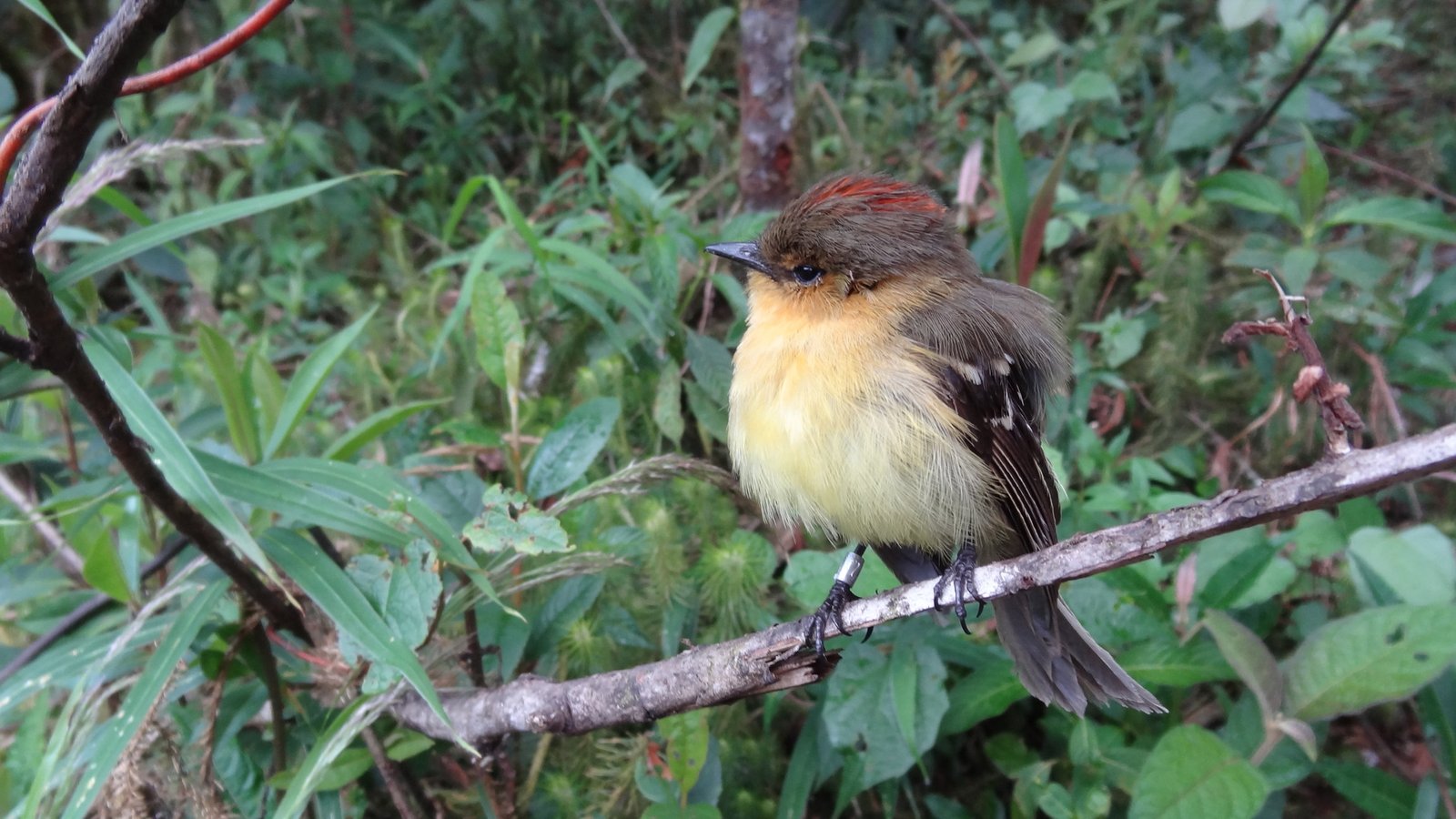
The Ochraceous-breasted Flycatcher is a small tyrant flycatcher of high cloud forest on the east slope of the Andes in Peru and Bolivia. It is marked by its warm ochre breast and pale wing bars, and usually moves in pairs with mixed flocks through the middle and upper levels of the forest.
Voice
A rapid series of high, thin tsip notes and short, dry trills, often heard as the bird moves with a mixed flock.
Recording: GABRIEL LEITE — CC BY-NC-SA 4.0 · xeno-canto
Identification
13 cm, with a short, broad bill and a rather long tail. The head and upperparts are olive-green. The wings are dusky, with two distinct buff to ochre wing bars. The throat and breast are warm ochre, the belly yellow. Adults have a concealed crown patch that is rarely visible. The sexes are nearly alike.
Confusion species
Orange-banded Flycatcher Nephelomyias lintoni has orange wing bars and a less ochre breast, and lives further north, in southern Ecuador and northern Peru. Its relative Nephelomyias pulcher is smaller, with a pale spot in front of the eye, and usually lives lower on the slope. Cinnamon Flycatcher Pyrrhomyias cinnamomeus is entirely cinnamon below, has a rufous patch in the wing and often perches in the open on a lookout. Flavescent Flycatcher Myiophobus flavicans is yellower below, without an ochre tone, and usually lives lower.
Habitat
Humid cloud forest and upper montane forest, especially forest edges and the middle and upper levels of the forest, roughly between 2300 and 3500 m. It catches insects with short sallies to leaves and twigs, often in mixed flocks with tanagers and other tyrant flycatchers. The nest has been little described.
Where the bird is most at home, classified by the vegetation units of the Andes and the west coast.


Range and movements
Peru: on the east slope of the Andes, from the north south of the Marañón south to Puno. Bolivia: in the Yungas of La Paz and Cochabamba. Absent from Colombia, Ecuador and the Galápagos. Does not occur outside the guide area.
- Resident
- dark = core range, pale = thinly spread
How and when to look
Follow mixed flocks along roads through high cloud forest above 2500 m, for example in the Yungas of Cuzco and La Paz; the bird perches upright on a twig in the middle level of the forest and makes short sallies to leaves.
Conservation status
Least Concern. The species is tied to cloud forest, which is locally cleared for pasture and fields.
Scientific name
Nephelomyias ochraceiventris | (Cabanis, 1873) (GBIF: Myiophobus ochraceiventris)
Cabanis described the species in 1873 as Mitrephorus ochraceiventris; because it was later moved to another genus, the author and year stand in brackets. The genus Nephelomyias was introduced in 2009 by Ohlson, Fjeldså & Ericson. The genus name comes from Greek nephelē, 'cloud', and muias, 'fly': a flycatcher of the cloud forest. Latin ochraceus, 'ochre', and venter, 'belly', for the ochre underparts. The specimen the first description was based on came from Maraynioc, Junín, Peru.