All species › Passerines › Tyrant flycatchers and allies › Orange-banded Flycatcher
Orange-banded Flycatcher | Nephelomyias lintoni
Oranjebandtiran | Mosquerito franjinaranja | Papa-moscas-de-faixa-laranja
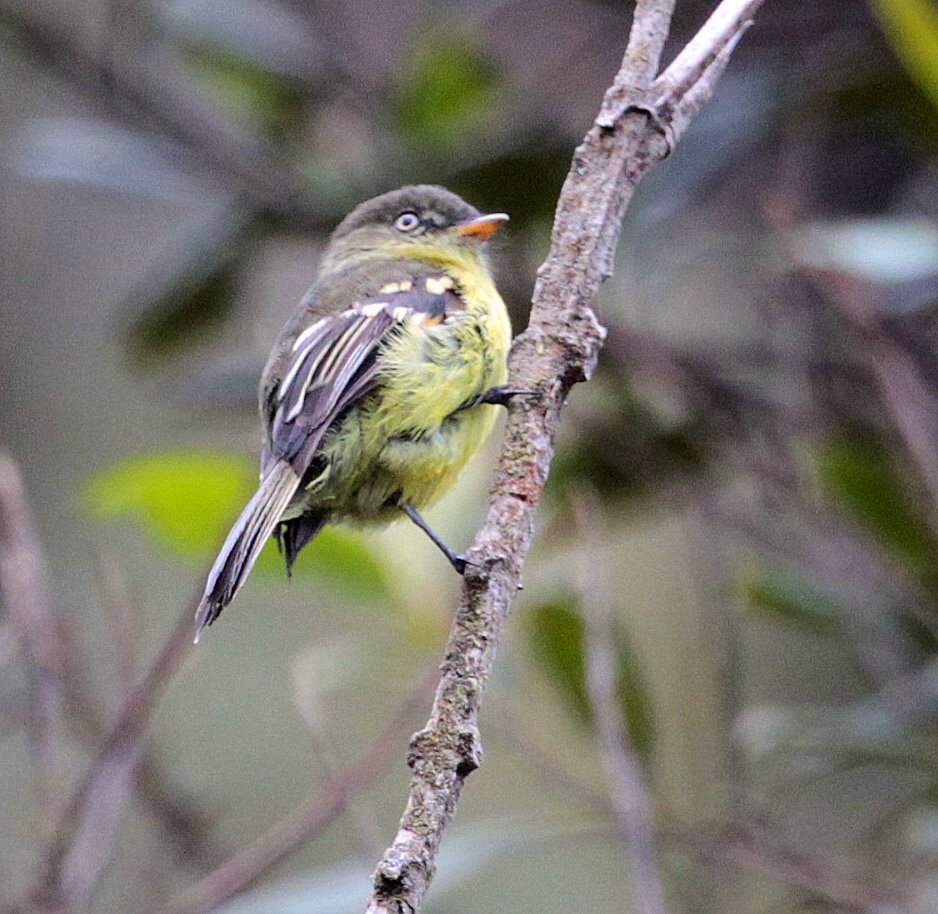
The Orange-banded Flycatcher is a tyrant flycatcher of upper cloud forest with a small range in southern Ecuador and the far north of Peru. It travels in small groups with mixed flocks and stands out by its orange wing bars. It is the northern counterpart of the Ochraceous-breasted Flycatcher.
Voice
High, rapid series of pit notes and a short, sharp twittering, mainly within a foraging group.
Recording: Paul Coopmans — CC BY-NC-SA 4.0 · xeno-canto
Identification
13 cm, with a short bill whose lower mandible is orange-yellow. The upperparts are dark olive-green, the crown slightly darker. The wings are blackish with two broad orange to cinnamon-orange bars. The throat is pale yellow to whitish, the breast olive, the belly yellow. The sexes are alike.
Confusion species
Handsome Flycatcher Nephelomyias pulcher is smaller, has an ochre-brown throat and breast and lives lower. Ochraceous-breasted Flycatcher Nephelomyias ochraceiventris has an ochraceous breast and lives further south, in Peru and Bolivia. Flavescent Flycatcher Myiophobus flavicans has narrower, less orange wing bars and yellow underparts. Yellow-bellied Chat-Tyrant Silvicultrix diadema has a yellow supercilium and keeps low in the understorey.
Habitat
The middle storey and canopy of humid, mossy upper cloud forest and the forest edge, roughly between 2200 and 3000 m. It lives in groups of a few birds that travel with mixed flocks; it perches on outer twigs and makes short sallies and hops after insects. The nest has been little described.
Where the bird is most at home, classified by the vegetation units of the Andes and the west coast.


Range and movements
Ecuador: in the south, in the Andes of Azuay, Loja, Zamora-Chinchipe and Morona-Santiago. Peru: in the far north, in Piura and Cajamarca. Absent from Colombia, Bolivia and the Galápagos. Does not occur outside the guide area.
- Resident
- dark = core range, pale = thinly spread
How and when to look
Search the cloud forest of Podocarpus National Park (Cajanuma) or at Tapichalaca at 2400–2900 m for mixed flocks; look for small flycatchers with orange wing bars on outer branches.
Conservation status
Least Concern. The range is small and upper cloud forest is locally cleared or burned, but the species occurs in several protected areas.
Scientific name
Nephelomyias lintoni | (Meyer de Schauensee, 1951) (GBIF: Myiophobus lintoni)
Meyer de Schauensee described the species in 1951 as Myiophobus lintoni; because it was later moved to another genus, the author and year stand in brackets. The genus Nephelomyias was introduced in 2009 by Ohlson, Fjeldså & Ericson. The genus name comes from Greek nephelē, 'cloud', and muias, 'fly': a flycatcher of the cloud forest. Honours M. Albert Linton, at the time president of the Academy of Natural Sciences of Philadelphia. The specimen the first description was based on came from Cerro Imbana, Loja, Ecuador.