All species › Passerines › Tyrant flycatchers and allies › Handsome Flycatcher
Handsome Flycatcher | Nephelomyias pulcher
Fraaie tiran | Mosquerito hermoso | Papa-moscas-bonito
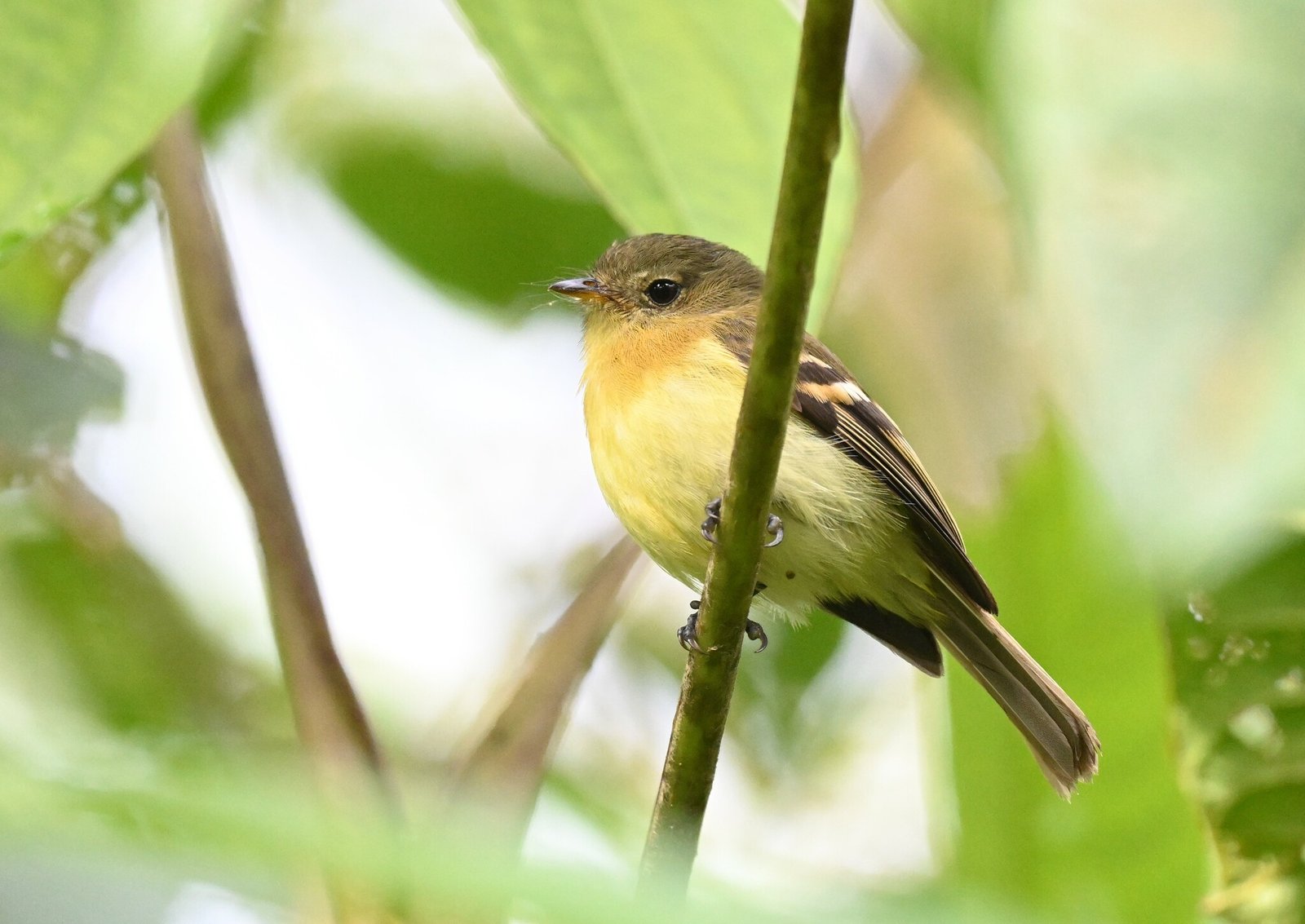
The Handsome Flycatcher is a small tyrant flycatcher of cloud forest that usually travels in small groups with mixed flocks. It has a warm ochraceous breast and broad cinnamon wing bars. Its range is disjunct: in the north in Colombia and Ecuador, in the south in south-eastern Peru.
Voice
High, thin tsip calls and a short, rapid twittering, mainly within a foraging group.
Recording: Olaf Jahn — CC BY-NC-SA 4.0 · xeno-canto
Identification
10 cm, small, with a short bill. The head and upperparts are olive-green, with a narrow pale eye-ring and pale lores. The wings are dark with two broad cinnamon to ochre bars. The throat and breast are warm ochre-brown, the belly yellow. The sexes are alike.
Confusion species
Orange-banded Flycatcher Nephelomyias lintoni is larger, has a pale throat, an olive breast and orange wing bars; it lives only in southern Ecuador and northern Peru. Ochraceous-breasted Flycatcher Nephelomyias ochraceiventris is larger, has an olive throat and lives higher. Flavescent Flycatcher Myiophobus flavicans is larger, yellow below and keeps more alone in the understorey. Cinnamon Flycatcher Pyrrhomyias cinnamomeus is uniform cinnamon-rufous below.
Habitat
The middle storey and canopy of humid cloud forest and forest edges, roughly between 1400 and 2500 m, locally lower west of the Andes. It lives in groups of three to six birds, usually with mixed flocks of tanagers and other insectivores, and catches insects with short hops and sallies to leaves. The nest has been little described.
Where the bird is most at home, classified by the vegetation units of the Andes and the west coast.


Range and movements
Colombia: in the West and Central Andes and locally on the east side of the East Andes. Ecuador: locally on both slopes of the Andes. Peru: on the east slope, mainly in the south-east (Cuzco, Puno); scarce in the north. Absent from Bolivia and the Galápagos. Does not occur outside the guide area.
- Resident
- dark = core range, pale = thinly spread
How and when to look
Search cloud forest at 1600–2300 m for mixed flocks; look for a group of small flycatchers with ochre breasts foraging in the middle storey together with tanagers.
Conservation status
Least Concern. The species is local and scarce but occurs over a fairly large area; loss of cloud forest is a threat.
Scientific name
Nephelomyias pulcher | (Sclater, 1861) (GBIF: Myiophobus pulcher)
Sclater described the species in 1861 as Myiobius pulcher; because it was later moved to another genus, the author and year stand in brackets. The genus Nephelomyias was introduced in 2009 by Ohlson, Fjeldså & Ericson. The genus name comes from Greek nephelē, 'cloud', and muias, 'fly': a flycatcher of the cloud forest. Latin pulcher, 'handsome', for the colourful plumage. The specimen the first description was based on came from Vicinity of Quito, Ecuador.