All species › Passerines › Tyrant flycatchers and allies › Eastern Wood Pewee
Eastern Wood Pewee | Contopus virens
Oostelijke bospiewie | Pibí oriental | Piui-verdadeiro
The Eastern Wood Pewee breeds in eastern North America and winters in northwestern South America, mainly in the lowlands and foothills east of the Andes. In the field it closely resembles Western Wood Pewee; the voice is the most reliable feature. Especially towards the end of the winter it also sings in the guide area.
Voice
The song is a plaintive, whistled pee-a-wee, often alternated with a falling pee-yoo; heard in winter quarters as well, mainly from February to April. The call is a dry chip or a short, rising chweet.
Recording: Rory Nefdt — CC BY-NC-SA 4.0 · xeno-canto
Identification
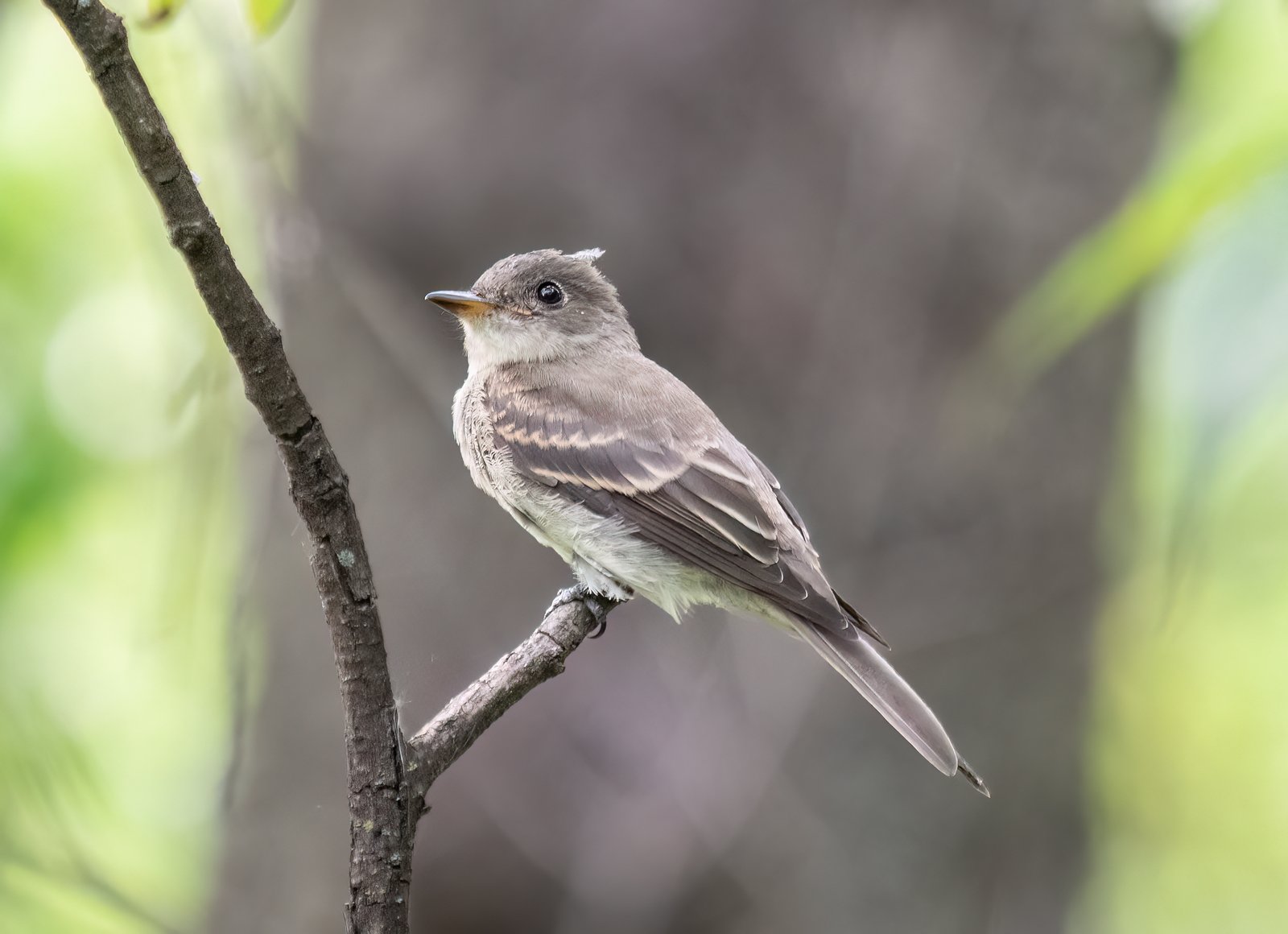
15–16 cm, with long wings reaching well beyond the rump, and a slight crest. The upperparts are greyish olive, slightly greener than in Western Wood Pewee. Two pale, fairly distinct wing bars. The throat is whitish, the breast and flanks pale grey to greyish olive, the ‘vest’ paler and often broken in the centre; the belly is whitish to pale yellow. The lower mandible is usually mostly orange, with a dark tip. No eye-ring. The sexes are alike.
Confusion species
Western Wood Pewee Contopus sordidulus is darker, with a darker vest and a mostly dark lower mandible; the voice is the best distinction. Southern Tropical Pewee Contopus cinereus is smaller, with shorter wings and pale lores. The Empidonax flycatchers, such as Willow Flycatcher Empidonax traillii, are smaller, with shorter wings and often a narrow eye-ring, and move the tail.
Habitat
Edges of humid lowland and foothill forest, secondary forest, várzea, clearings and gardens with tall trees, mostly below 1500 m, higher in the Andes on passage. It perches alone on an open perch in the mid-storey or canopy and sallies after flying insects.
Where the bird is most at home, classified by the vegetation units of the Andes and the west coast.


Range and movements
Colombia: winter visitor and passage migrant in the lowlands and foothills, mainly in the east and north, also in the Andes on passage. Ecuador: winter visitor in the eastern lowlands and foothills, scarcer in the west. Peru: winter visitor in Amazonia and the foothills. Bolivia: winter visitor in the lowlands of the north and centre. Absent from the Galápagos. Outside the guide area it breeds in eastern North America and migrates through Central America and the Caribbean.
- Winter visitor (c. Oct–Mar)
- Passage (Mar–Apr, Oct–Nov)
- dark = core range, pale = thinly spread
How and when to look
From October to April, search forest edges and clearings in the Amazonian lowlands for a grey pewee on an open branch. In March and April the plaintive pee-a-wee song helps with finding and identifying it.
Conservation status
Least Concern. The breeding population has declined over recent decades, but the species is still numerous.
Scientific name
Contopus virens | (Linnaeus, 1766)
Linnaeus described the species in 1766 as [Muscicapa] virens; because it was later moved to another genus, the author and year stand in brackets. The genus Contopus was introduced in 1855 by Cabanis. The genus name combines Greek kontos, 'pole, shaft', with pous, 'foot'. Latin virens, 'green, greenish', after the olive-green upperparts. The specimen the first description was based on came from Carolina, United States.