All species › Passerines › Tyrant flycatchers and allies › Western Wood Pewee
Western Wood Pewee | Contopus sordidulus
Westelijke bospiewie | Pibí occidental | Piui-do-oeste
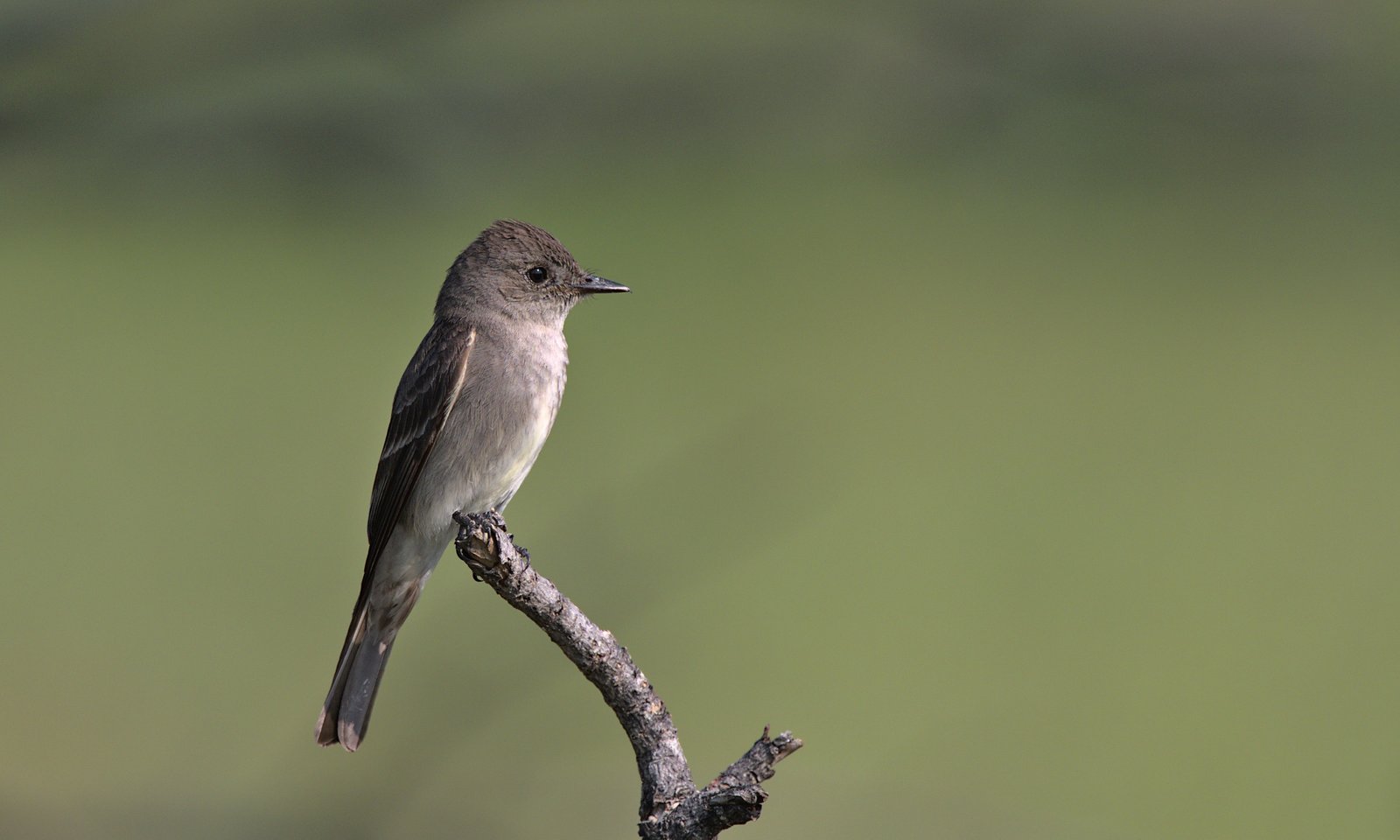
The Western Wood Pewee breeds in western North America and winters mainly along the Andes, from Colombia to Bolivia. In winter quarters it closely resembles Eastern Wood Pewee; the call is the most reliable feature. It sits upright on an open branch and sallies from there after insects.
Voice
The call is a burry, nasal, descending peeer or bzee-yeer. The call is regularly heard in winter quarters and on passage too, mainly in the morning.
Recording: Jacob Wijpkema — CC BY-NC-SA 4.0 · xeno-canto
Identification
15–16 cm, with long wings reaching well beyond the rump, and a slight crest. The upperparts are dark greyish olive. Two narrow, pale wing bars. The throat is pale grey, the breast and flanks grey to greyish olive, forming a fairly dark ‘vest’, the belly pale yellow to whitish. The lower mandible is dark, with at most a pale base. No eye-ring. The sexes are alike; first-year birds have broader, buff wing bars.
Confusion species
Eastern Wood Pewee Contopus virens is slightly greener, with a paler vest and usually a mostly orange lower mandible; the call is the best distinction. Tumbes Pewee Contopus punensis and Southern Tropical Pewee Contopus cinereus are smaller, with shorter wings and pale lores. The Empidonax flycatchers, such as Alder Flycatcher Empidonax alnorum, are smaller, with shorter wings, and often move the tail.
Habitat
Edges of humid montane and foothill forest, open woodland with scattered trees, clearings and forest edges along roads, mostly between 500 and 2500 m, lower on passage. It perches alone on an open, often high perch and sallies after flying insects; in winter it sometimes defends a fixed territory.
Where the bird is most at home, classified by the vegetation units of the Andes and the west coast.


Range and movements
Colombia: winter visitor and passage migrant in all three Andean ranges and the foothills. Ecuador: winter visitor on both Andean slopes, mainly on the east side. Peru: winter visitor along the eastern slope of the Andes and in the adjacent lowlands. Bolivia: winter visitor in the Yungas and foothills. Absent from the Galápagos. Outside the guide area it breeds in western North America and migrates through Central America.
- Winter visitor (c. Oct–Mar)
- Passage (Mar–Apr, Oct–Nov)
- dark = core range, pale = thinly spread
How and when to look
From October to March, search forest edges and clearings in the mountains for a grey pewee on a high, bare branch. Listen for the burry, descending call to separate it from Eastern Wood Pewee.
Conservation status
Least Concern. The breeding population has declined over recent decades, but the species is still numerous.
Scientific name
Contopus sordidulus | Sclater, 1859
Sclater described the species in 1859 and placed it straight away in the genus where it still stands. The genus Contopus was introduced in 1855 by Cabanis. The genus name combines Greek kontos, 'pole, shaft', with pous, 'foot'. Latin sordidulus, diminutive of sordidus, 'dirty, drab': rather drab. The specimen the first description was based on came from Orizaba, Veracruz, Mexico.