All species › Passerines › Tyrant flycatchers and allies › Southern Tropical Pewee
Southern Tropical Pewee | Contopus cinereus
Tropische piewie | Pibí tropical sureño | Papa-moscas-cinzento
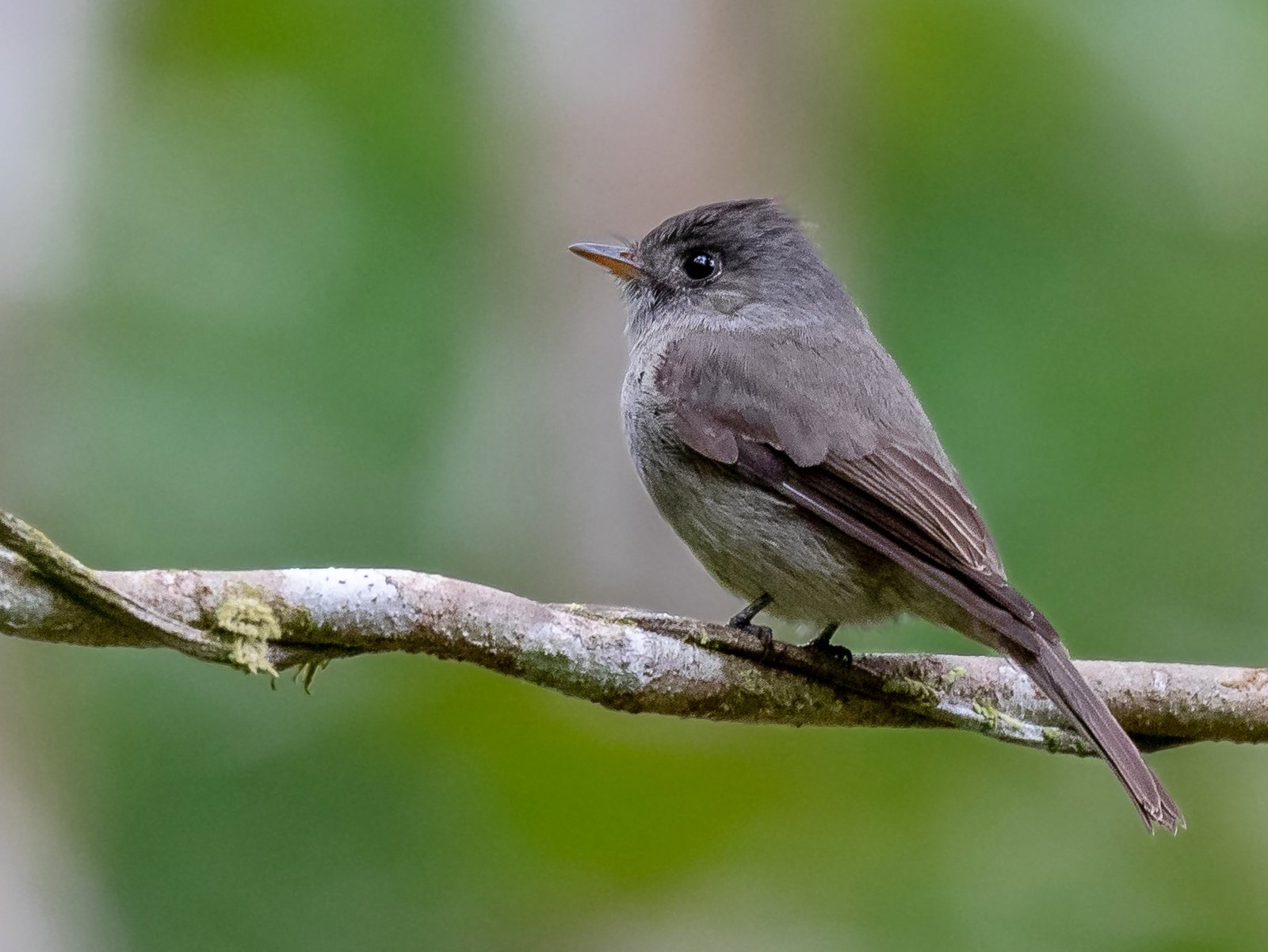
The Southern Tropical Pewee in its present, narrow sense is a pewee of semi-open woodland in eastern Bolivia and further southeast in Brazil, Paraguay and Argentina. The birds of western Ecuador and Peru are now treated as Tumbes Pewee, those of northern Colombia as a separate northern species. It sings and calls throughout the day from a bare branch in the mid-storey.
Voice
The song is a clear, emphatic whistle, repeated at intervals. The call is a very short note, usually given several times in a row. It is heard throughout the day, mainly in the morning, usually from a bare branch in the mid-storey.
Recording: JAYRSON ARAUJO DE OLIVEIRA — CC BY-NC-SA 4.0 · xeno-canto
Identification
13.5–14.5 cm, with a slight crest and a broad, flat bill. The crown is dark greyish brown, the upperparts olive-grey. The lores are pale grey to whitish. The wings are dark, with two narrow, pale wing bars. The throat is whitish, the breast greyish olive, the belly pale yellow to white. The lower mandible is orange-yellow. The sexes are alike.
Confusion species
Western Wood Pewee Contopus sordidulus and Eastern Wood Pewee Contopus virens, which occur as winter visitors, are larger, with longer wings and without pale lores. Euler's Flycatcher Lathrotriccus euleri is browner, with buff wing bars and an eye-ring, and sits lower in the forest. Fuscous Flycatcher Cnemotriccus fuscatus is brown with a pale supercilium and buff wing bars.
Habitat
Semi-open country with light woodland, secondary forest, plantations and edges of semi-deciduous forest; mostly below 1300 m, in Bolivia exceptionally up to 2850 m. It catches flying insects from a fixed perch and often returns to the same branch. The nest is a small cup of fibres and lichen on a horizontal branch.
Where the bird is most at home, classified by the vegetation units of the Andes and the west coast.


Range and movements
Bolivia: in the lowlands and lower slopes of the east, mainly in Santa Cruz and in the southeast towards the Chaco. Peru: rare migrant in the southeast in the austral winter. Absent from Colombia, Ecuador and the Galápagos; the pewees there belong to other species. Outside the guide area in Brazil, Paraguay and northern Argentina.
- Resident
- dark = core range, pale = thinly spread
How and when to look
In eastern Bolivia, search forest edges, semi-open woodland and plantations for a small grey bird on a bare branch in the mid-storey. The repeated whistle helps to locate it.
Conservation status
Least Concern. The species is widespread and adapts to semi-open and secondary woodland.
Scientific name
Contopus cinereus | (Spix, 1825)
Spix described the species in 1825 as Platyrhynchus cinereus; because it was later moved to another genus, the author and year stand in brackets. The genus Contopus was introduced in 1855 by Cabanis. The genus name combines Greek kontos, 'pole, shaft', with pous, 'foot'. Latin cinereus, 'ash-grey'. The specimen the first description was based on came from Rio de Janeiro, Brazil.