All species › Passerines › Tyrant flycatchers and allies › Blackish Pewee
Blackish Pewee | Contopus nigrescens
Zwarte piewie | Pibí negruzco | Piui-preto
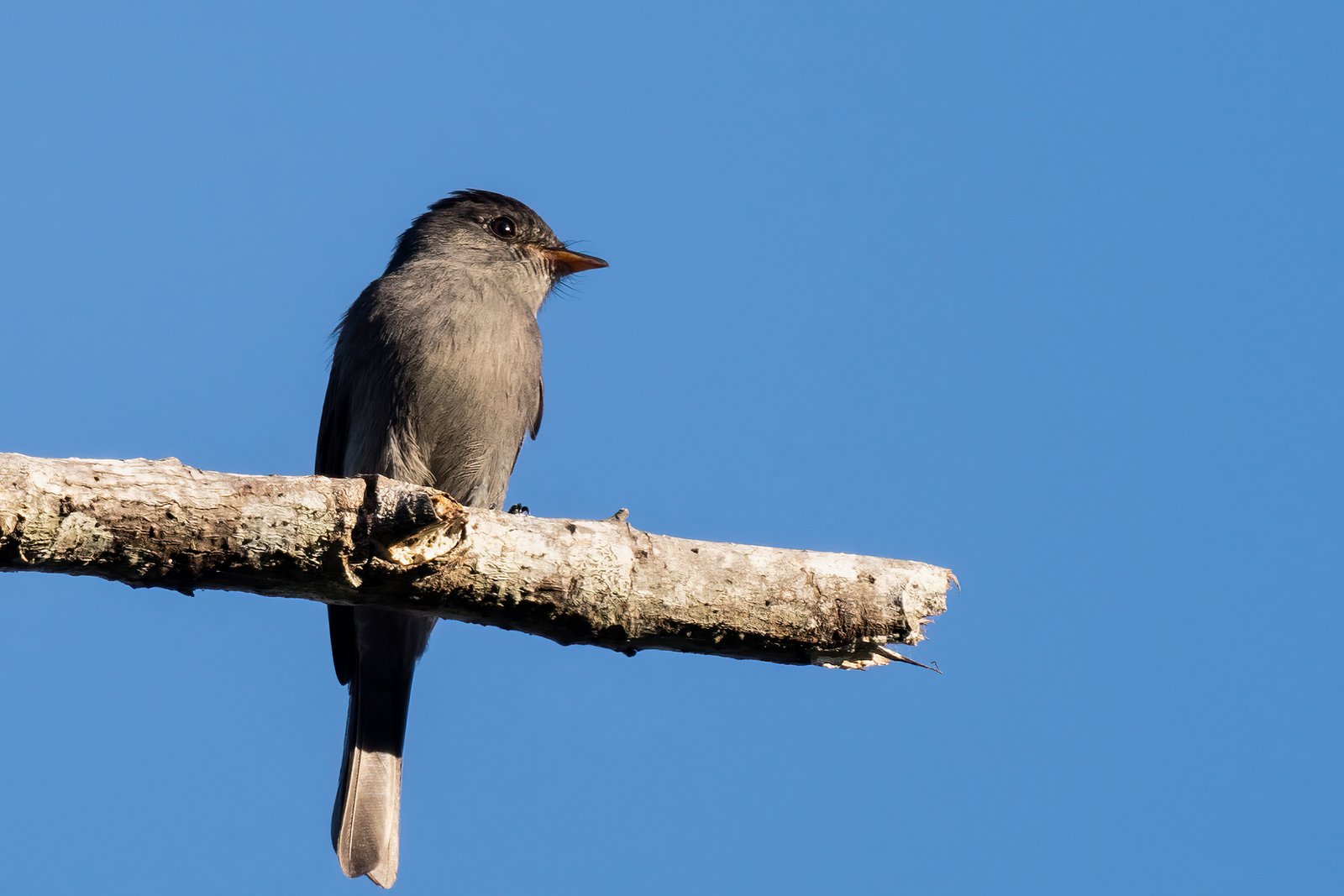
The Blackish Pewee is a small, almost uniformly dark grey pewee of the foothills on the eastern slope of the Andes. It sits upright on a bare, protruding branch high in a tree at the forest edge. Its range is fragmented: besides the Andes, the species occurs far away in Guyana and eastern Brazil.
Voice
The song in Ecuador is a short, somewhat burry chee-bew, repeated at intervals of a few seconds. The call is a sharp, repeated pip. Birds in Peru sing a burry rising-and-falling note and call with a series of falling pew notes.
Recording: Nick Athanas — CC BY-NC-SA 3.0 · xeno-canto
Identification
13 cm, with a slight crest and a broad, flat bill. The crown is blackish grey, the rest of the plumage dark sooty grey, the throat slightly paler. The lores are paler grey. The wings are blackish brown, without distinct wing bars. The upper mandible is black, the lower mandible pale greyish ochre. The sexes are alike. Juveniles have broad whitish wing bars and pale feather edges.
Confusion species
Smoke-colored Pewee Contopus fumigatus is larger, paler grey, with a more obvious crest and an orange lower mandible, and usually lives higher up. Olive-sided Flycatcher Contopus cooperi, which uses the same kind of perches as a winter visitor, is larger and has a dark ‘vest’ with a white central stripe down the breast and belly. Black Phoebe Sayornis nigricans is black with a white belly and white wing edges and sits low along streams.
Habitat
Canopy and edges of humid foothill and lower montane forest, often along clearings and streams; in Ecuador mostly between 400 and 900 m, in Peru between 600 and 1500 m. It lives alone or in pairs, sallies from a high, open perch after flying insects and often returns to the same branch, where it shivers its tail.
Where the bird is most at home, classified by the vegetation units of the Andes and the west coast.


Range and movements
Colombia: possibly in the far south, unconfirmed. Ecuador: locally along almost the entire eastern slope of the Andes. Peru: locally on the eastern slope in the north and centre. Absent from Bolivia and the Galápagos. Outside the guide area in southern Guyana and scattered in eastern Amazonian Brazil.
- Resident
- dark = core range, pale = thinly spread
How and when to look
Scan dead, protruding branches above the canopy along roads through foothill forest on the eastern slope. A small dark bird that keeps returning to the same branch and shivers its tail is often this species. The song is heard in the morning.
Conservation status
Least Concern. The species is local and not numerous, but has a large range; deforestation of the foothills is a local threat.
Scientific name
Contopus nigrescens | (Sclater & Salvin, 1880)
Sclater & Salvin described the species in 1880 as Myiochanes nigrescens; because it was later moved to another genus, the author and year stand in brackets. The genus Contopus was introduced in 1855 by Cabanis. The genus name combines Greek kontos, 'pole, shaft', with pous, 'foot'. Latin nigrescens, 'blackish'. The specimen the first description was based on came from Sarayacu, Pastaza, Ecuador.