All species › Passerines › Tyrant flycatchers and allies › Tumbes Pewee
Tumbes Pewee | Contopus punensis
Tumbespiewie | Pibí de Tumbes | Piui-de-tumbes
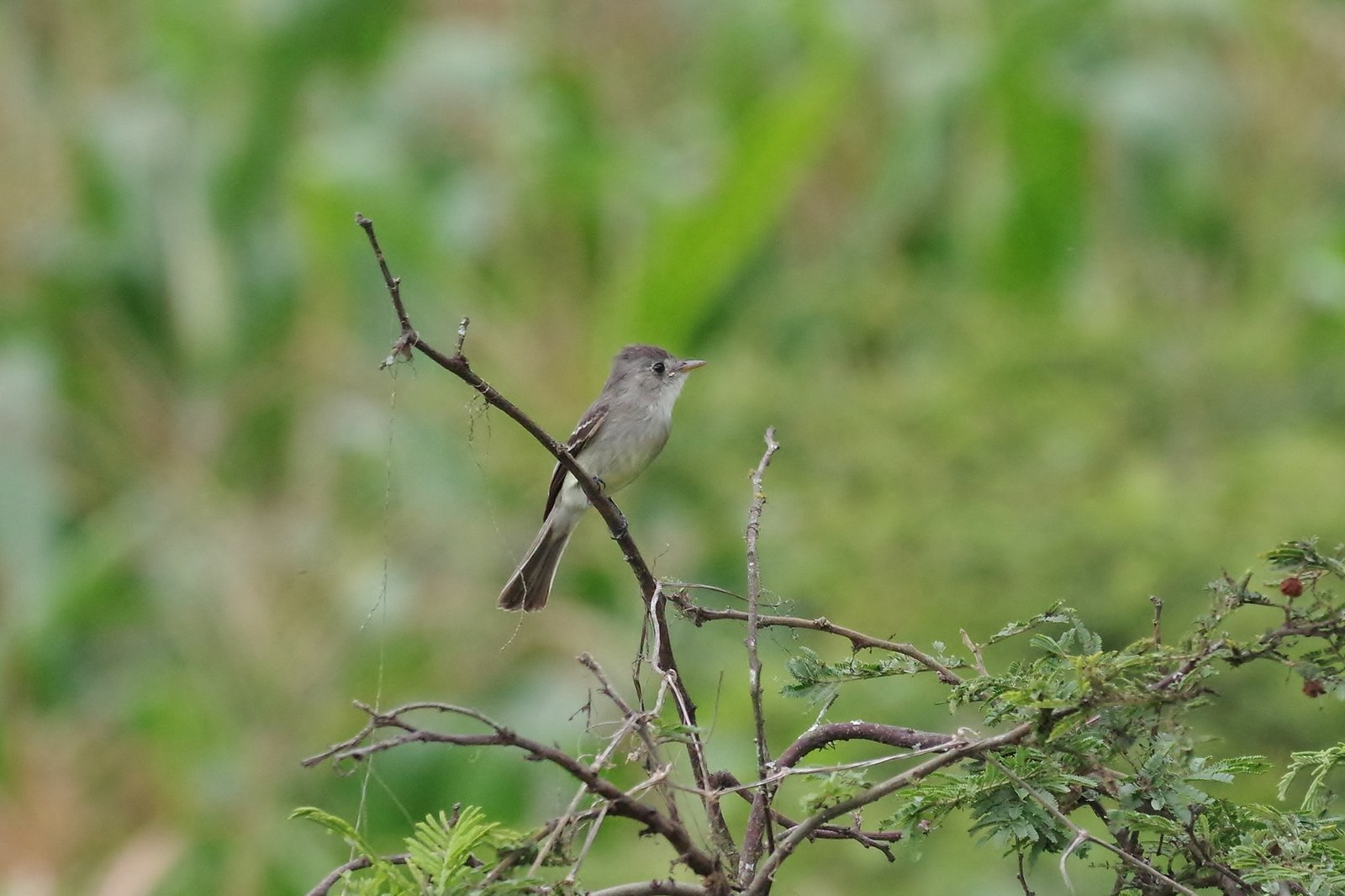
The Tumbes Pewee is a small, greyish-olive pewee of the dry and semi-humid forests west of the Andes in Ecuador and Peru. It was long treated as a subspecies of the Tropical Pewee and is now regarded as a separate species. It sits upright on a bare branch in the mid-storey and sallies from there after insects.
Voice
The song is a clear, emphatic whistled phrase, mainly in the early morning and late afternoon from a branch in the mid-storey. The call is a single tee or a soft chatter.
Recording: Leonardo Ordóñez-Delgado — CC BY-NC-SA 4.0 · xeno-canto
Identification
13–14 cm, with a slight crest and a broad, flat bill. The crown is dark olive-grey, the upperparts olive-grey. The lores are white to greyish white and there is a narrow white eye-ring. The wings are dark, with two narrow, pale wing bars. The chin and throat are white, the breast pale greyish olive, the belly whitish to pale yellow. The lower mandible is orange-yellow. The sexes are alike.
Confusion species
Smoke-colored Pewee Contopus fumigatus is larger, uniformly dark grey, with a more obvious crest, and lives higher up in humid montane forest. Western Wood Pewee Contopus sordidulus, which occurs as a winter visitor, has longer wings, a darker breast and lacks the white lores. Grey-breasted Flycatcher Lathrotriccus griseipectus has shorter wings, a more conspicuous eye-ring and distinct wing bars, and sits lower in the vegetation.
Habitat
Deciduous and semi-humid forest, forest edges and clearings, Podocarpus woodland and locally mangroves; in Ecuador mostly below 1500 m, sometimes to 1900 m, in Peru up to 2800 m. It catches flying insects from a fixed perch and often returns to the same branch. The nest is a small cup of plant fibres and lichen on a horizontal branch.
Where the bird is most at home, classified by the vegetation units of the Andes and the west coast.


Range and movements
Colombia: possibly in the far southwest, unconfirmed. Ecuador: in the west, from Esmeraldas and northern Manabí south to El Oro and Loja. Peru: west of the Andes, from Tumbes south to Huancavelica. Absent from Bolivia and the Galápagos. Does not occur outside the guide area.
- Resident
- dark = core range, pale = thinly spread
How and when to look
Search dry forest and forest edges in southwestern Ecuador and northwestern Peru for a small grey bird that sits upright on a bare branch and keeps returning to the same spot. The song is heard mainly in the early morning.
Conservation status
Least Concern. The species is fairly common within its limited range, but the dry forest of the Tumbes region is locally cleared and grazed.
Scientific name
Contopus punensis | Lawrence, 1869
Lawrence described the species in 1869 and placed it straight away in the genus where it still stands. The genus Contopus was introduced in 1855 by Cabanis. The genus name combines Greek kontos, 'pole, shaft', with pous, 'foot'. Refers to Puná Island in the Gulf of Guayaquil, Ecuador. The specimen the first description was based on came from Isla Puná, Ecuador.