All species › Passerines › Tyrant flycatchers and allies › Smoke-colored Pewee
Smoke-colored Pewee | Contopus fumigatus
Leigrijze piewie | Pibí ahumado | Piuí-de-topete
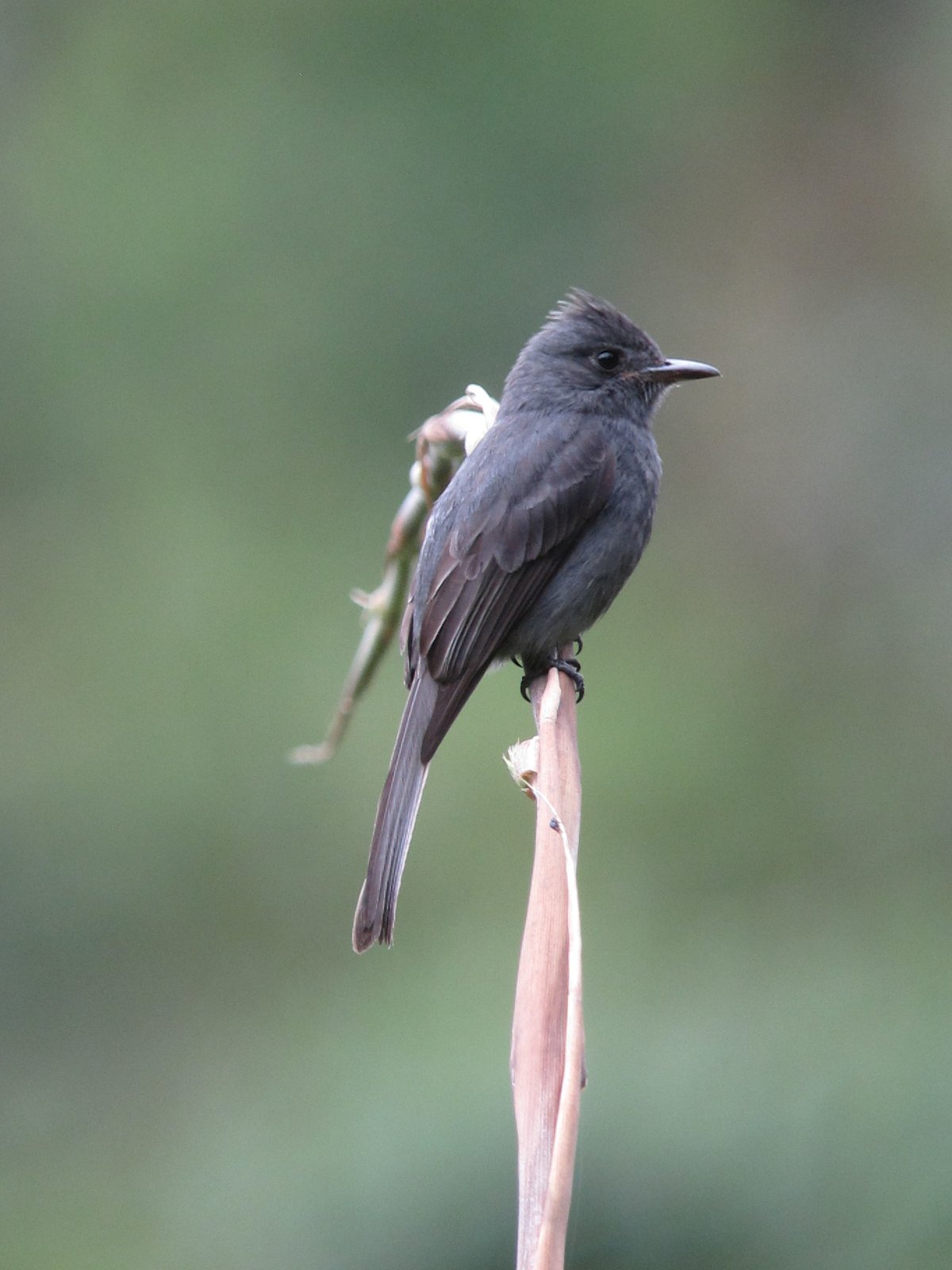
The Smoke-colored Pewee is a uniformly grey pewee with a pointed crest, found throughout the Andes of the guide area. It perches conspicuously on top of a dead tree or a bare branch above the forest edge. Its series of pip calls are among the sounds of montane forest edges.
Voice
A repeated, clear pip-pip-pip, often in series of three; at dusk and dawn a whistled song of a few notes.
Recording: Jerome Fischer — CC BY-NC-SA 4.0 · xeno-canto
Identification
17 cm. A fairly large pewee with a pointed, shaggy crest and a fairly long tail. The whole plumage is smoky grey to dark slate-grey, the throat and belly slightly paler. The wings are dark, with at most indistinct grey wing-bars. The upper mandible is black, the lower mandible orange-yellow. Sexes alike; juveniles have buffy wing-bars.
Confusion species
Olive-sided Flycatcher Contopus cooperi is stockier, with a shorter tail, a white 'open vest' on the underparts and often white tufts at the sides of the rump. Western Wood Pewee Contopus sordidulus and Eastern Wood Pewee Contopus virens are smaller, browner and have clear wing-bars. Blackish Pewee Contopus nigrescens is smaller and darker and lives lower in the foothills. Southern Tropical Pewee Contopus cinereus is smaller, with pale lores.
Habitat
Edges and clearings of montane forest and cloud forest, landslides, stream valleys, mountain road verges and semi-open country with tall trees, mainly between 1000 and 2800 m, locally higher or lower. It perches high on an open dead branch, sallies for flying insects and returns to the same branch. The nest is a small, shallow cup of moss and lichen on a horizontal branch.
Where the bird is most at home, classified by the vegetation units of the Andes and the west coast.


Range and movements
Colombia: in all three Andean ranges, the Sierra Nevada de Santa Marta and the Serranía de Perijá. Ecuador: on both slopes of the Andes. Peru: on the eastern slope and in the north also on the western slope. Bolivia: in the Yungas on the eastern slope. Absent from the Galápagos. Outside the guide area in Venezuela, the tepuis and north-western Argentina.
- Resident
- dark = core range, pale = thinly spread
How and when to look
Along a mountain road through cloud forest, check the tops of dead trees and bare branches above the forest edge, and listen for the repeated pip-pip-pip.
Conservation status
Least Concern. The species is widespread and fairly common and tolerates forest edges and partly logged forest.
Scientific name
Contopus fumigatus | (d'Orbigny, ACVMD & de Lafresnaye, 1837)
D'Orbigny, ACVMD & de Lafresnaye described the species in 1837 as T[yrannus] fumigatus; because it was later moved to another genus, the author and year stand in brackets. The genus Contopus was introduced in 1855 by Cabanis. The genus name combines Greek kontos, 'pole, shaft', with pous, 'foot'. Latin fumigatus, 'smoked', after the smoky-grey plumage. The specimen the first description was based on came from Yungas, Bolivia.