All species › Passerines › Tyrant flycatchers and allies › Olive-sided Flycatcher
Olive-sided Flycatcher | Contopus cooperi
Sparrenpiewie | Pibí boreal | Piuí-boreal
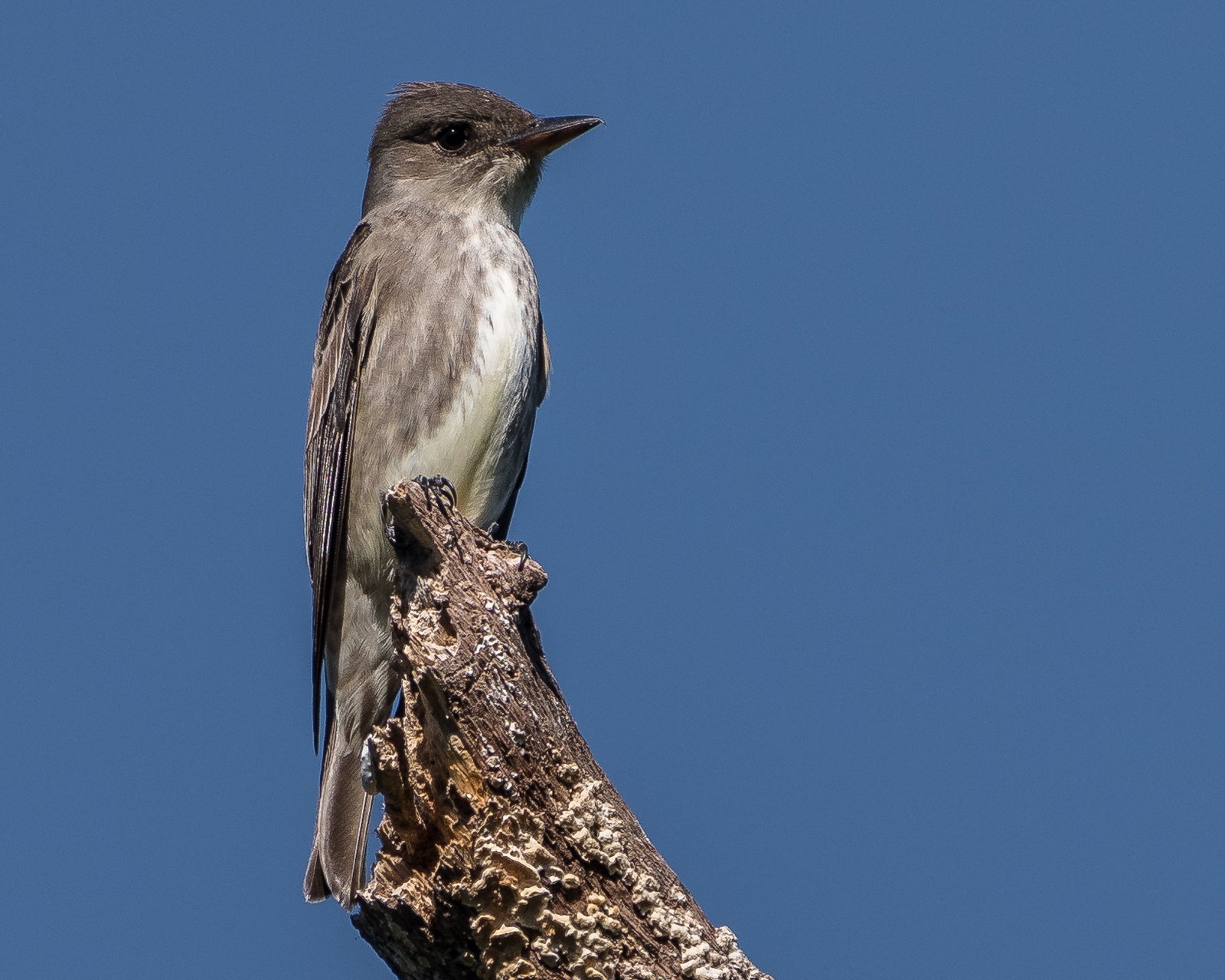
The Olive-sided Flycatcher breeds in coniferous forest of Alaska, Canada and the mountains of the western United States and winters mainly in the Andes from Venezuela to Bolivia. It almost always perches on the highest bare branch of a tree, from where it catches large flying insects. Its song is rendered in English as 'quick, three beers'.
Voice
The call is a repeated pip-pip-pip. The song, a loud, whistled whit-WHEE-oo, is also heard on the wintering grounds, mainly in March and April.
Recording: Greg Irving — CC BY-NC-SA 4.0 · xeno-canto
Identification
18–19 cm. A stocky, large-headed pewee with a short tail and a large bill with a pale base to the lower mandible. The upperparts are dark greyish olive. Characteristic is the 'open vest': dark greyish olive on breast sides and flanks, separated by a white to yellowish-white central stripe from throat to belly. White tufts are often visible at the sides of the rump. Wing-bars indistinct. Sexes alike.
Confusion species
Smoke-colored Pewee Contopus fumigatus is uniformly grey, without a clear vest, with a longer tail and a more pointed crest. Eastern Wood Pewee Contopus virens and Western Wood Pewee Contopus sordidulus are smaller and slimmer, with clear wing-bars and no white central stripe. Blackish Pewee Contopus nigrescens is smaller and uniformly dark slate-grey.
Habitat
In winter at edges of montane forest and cloud forest, clearings with dead trees, landslides, foothill forest and plantations with shade trees, mainly between 1000 and 3000 m, on migration also lower. It perches high on an open dead branch, sallies for bees, wasps and other flying insects and returns to the same branch; it often defends a fixed winter territory. Breeds in North America; the nest is placed high on a branch of a conifer.
Where the bird is most at home, classified by the vegetation units of the Andes and the west coast.


Range and movements
Colombia: winter visitor in all three Andean ranges, the Sierra Nevada de Santa Marta and the Serranía de Perijá, also in the foothills. Ecuador: winter visitor on both slopes of the Andes. Peru: winter visitor, mainly on the eastern slope. Bolivia: scarcer winter visitor in the Yungas. Absent from the Galápagos. Also winters in Central America and Venezuela.
- Winter visitor (c. Oct–Mar)
- dark = core range, pale = thinly spread
How and when to look
From October to March, check the tops of dead trees above the forest edge along mountain roads in Colombia and Ecuador; a bird often stays there for hours. Listen for the repeated pip-pip-pip.
Conservation status
Least Concern. The species has declined strongly since the 1970s, partly through loss of montane forest on the wintering grounds and changes in boreal forests.
Scientific name
Contopus cooperi | (Nuttall, 1831)
Nuttall described the species in 1831 as Muscicapa cooperi; because it was later moved to another genus, the author and year stand in brackets. The genus Contopus was introduced in 1855 by Cabanis. The genus name combines Greek kontos, 'pole, shaft', with pous, 'foot'. Named after the American zoologist and collector William Cooper (1798–1864), a founding member of the Lyceum of Natural History in New York. The specimen the first description was based on came from (according to the description).