All species › Passerines › Tyrant flycatchers and allies › Yellow-browed Tyrant
Yellow-browed Tyrant | Satrapa icterophrys
Geelbrauwtiran | Suirirí amarillo | Suiriri-pequeno
The Yellow-browed Tyrant is a medium-sized, olive-and-yellow tyrant flycatcher of semi-open country with shrubs and scattered trees, often near water. In the guide area it breeds in Bolivia; birds from the south of the range move to Amazonia in the austral winter and then reach southeastern Peru. It usually perches in the open on a low to mid-height branch.
Voice
Not very vocal. The song is a short, rising series of four to five notes. The calls are a mild but sharp whee and a low, double cheep.
Recording: Ricardo José Mitidieri — CC BY-NC-SA 4.0 · xeno-canto
Identification
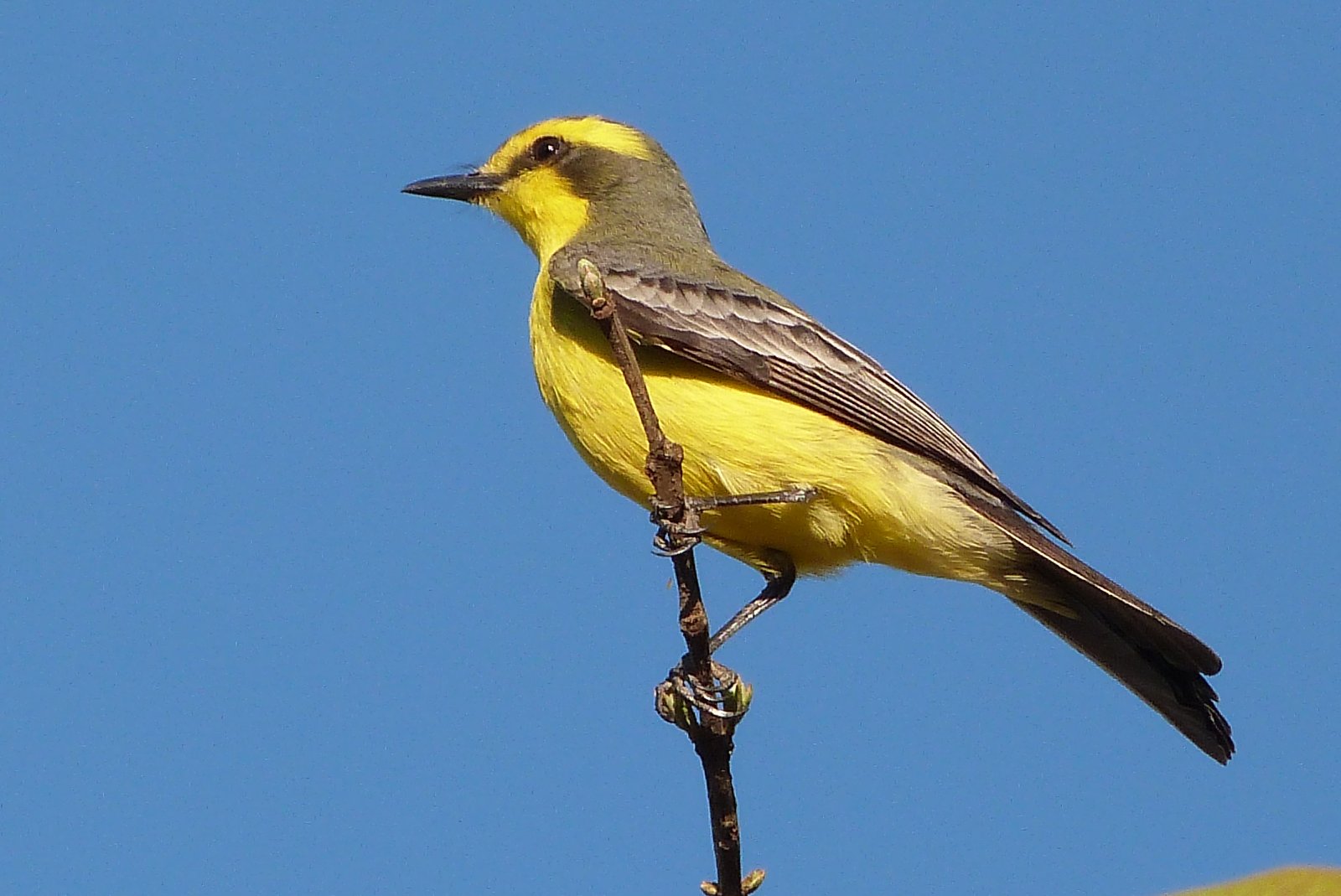
15–16.5 cm. The male has a dark greyish-olive face with a broad, bright yellow supercilium. The upperparts are dark olive, the wings dark with two whitish wing bars. The underparts are bright yellow, with an olive wash on the sides of the breast. The female is duller, with a less vivid supercilium and throat, and olive mottling on the throat and breast. Juveniles resemble the female.
Confusion species
Social Flycatcher Myiozetetes similis has a white supercilium, a blackish mask and a white throat, and lives in noisy small groups. Tropical Kingbird Tyrannus melancholicus is larger, with a grey head without a supercilium and a forked tail. Rusty-margined Flycatcher Myiozetetes cayanensis has a white supercilium and rufous edges to the flight feathers.
Habitat
Forest edges, shrubby fields, pastures with scattered trees, gallery forest and vegetation around lakes and marshes; in Bolivia up to about 2800 m, in Peru and Colombia in the lowlands. It perches in the open and sallies after insects in the air or in the foliage. The nest is an open cup in a tree or shrub.
Where the bird is most at home, classified by the vegetation units of the Andes and the west coast.


Range and movements
Colombia: non-breeding visitor in the eastern lowlands, scarce. Ecuador: at most a rare vagrant in the east. Peru: rare winter visitor in the far southeast in the austral winter. Bolivia: in the north and east; breeds mainly in the east and south, with more birds in the north in the austral winter. Absent from the Galápagos. Outside the guide area in Venezuela and from Brazil to Paraguay, Uruguay and Argentina.
- Resident
- dark = core range, pale = thinly spread
How and when to look
In eastern Bolivia, search marsh edges, gallery forest and shrubby pastures for a yellow tyrant flycatcher with a conspicuous yellow supercilium on an open branch. In the austral winter (June–September) the chances are best in northern Bolivia and southeastern Peru.
Conservation status
Least Concern. The species is widespread and also occurs in semi-open land altered by humans.
Scientific name
Satrapa icterophrys | (Vieillot, 1818)
Vieillot described the species in 1818 as Muscicapa icterophrys; because it was later moved to another genus, the author and year stand in brackets. The genus Satrapa was introduced in 1844 by Strickland. The genus name comes from Latin satrapa (Greek satrapēs), 'satrap', a Persian provincial governor. Strickland (1844) meant it as a petty ruler, a nod to the tyrant flycatchers. The species name comes from Greek ikteros, 'jaundice, yellow', and ophrus, 'eyebrow', after the yellow supercilium. The specimen the first description was based on came from Paraguay.