All species › Passerines › Tyrant flycatchers and allies › Northern Tufted Flycatcher
Northern Tufted Flycatcher | Mitrephanes phaeocercus
Noordelijke kuiftiran | Mosquerito moñudo | Papa-moscas-topetudo-do-norte
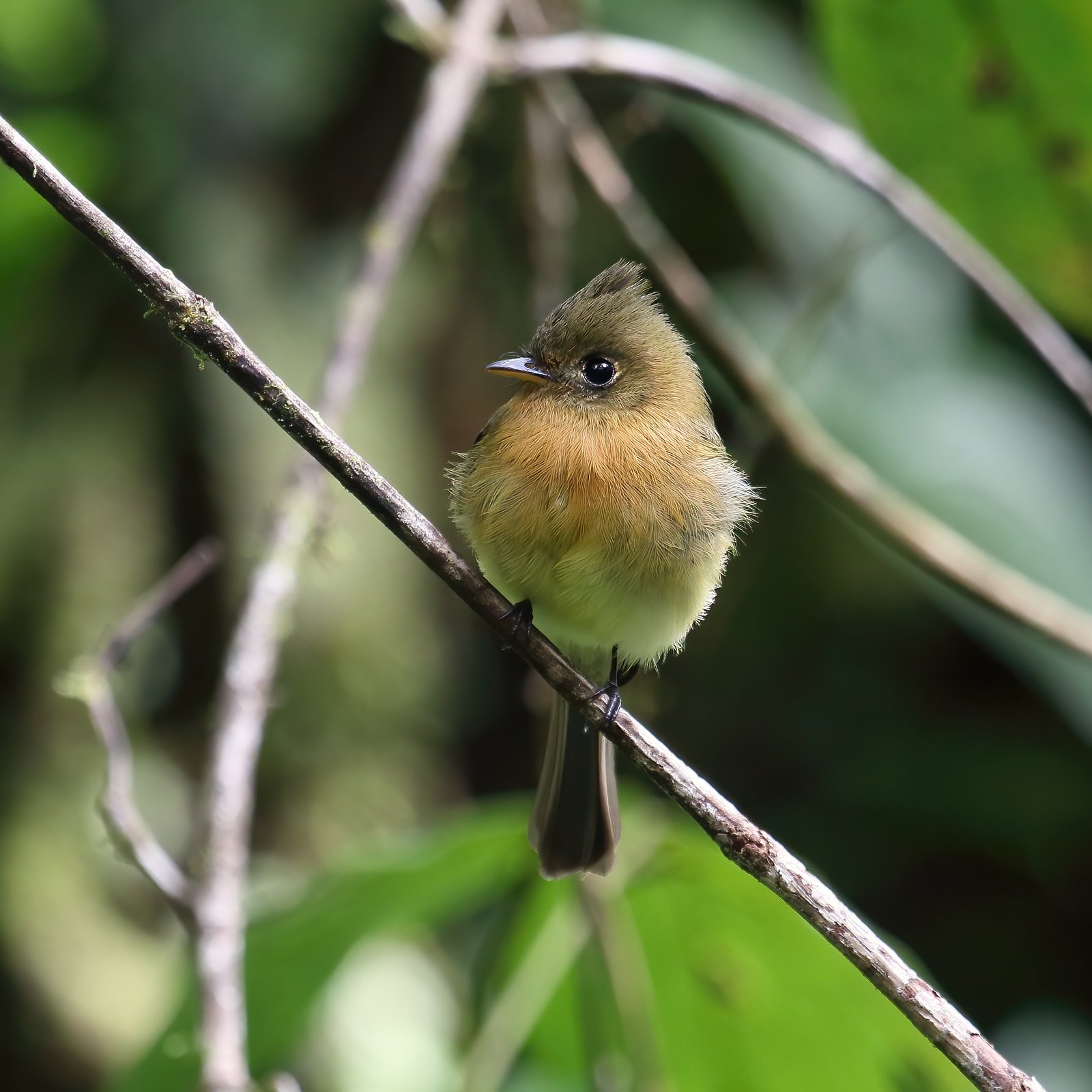
The Northern Tufted Flycatcher ranges from Mexico to north-western Ecuador; in the guide area only on the Pacific side of Colombia and Ecuador. The birds here belong to the subspecies berlepschi, which is duller than those of Central America. Like Olive Tufted Flycatcher it perches on an open twig, makes short sallies and quivers its tail on landing.
Voice
A rapid series of high, clear notes pee-pee-pee-pee or chee-chee-chee, often given when sallying.
Recording: Manuel Grosselet - Rebeca Martinez — CC BY-NC-SA 4.0 · xeno-canto
Identification
12–13 cm. Small, with a pointed crest. The upperparts are olive-brown. Throat and breast are ochre-olive, the belly pale yellow. There is a narrow pale ring around the eye. The wings are dark with two ochre-buff to greyish wing-bars. The lower mandible is pale. Sexes alike.
Confusion species
Cinnamon Flycatcher Pyrrhomyias cinnamomeus has entirely cinnamon-rufous underparts and a cinnamon wing patch and mostly lives higher. Orange-crested Flycatcher Myiophobus phoenicomitra lacks a pointed crest and perches more hidden. Ornate Flycatcher Myiotriccus ornatus has a white spot in front of the eye and a yellow rump. Olive Tufted Flycatcher Mitrephanes olivaceus lives only in Peru and Bolivia.
Habitat
Edges and clearings of humid foothill forest and lower montane forest, also stream valleys and road verges, mainly between about 400 and 1600 m. It perches in the middle storey on a bare twig and sallies briefly for flying insects, often returning to the same twig. The nest is a small cup of moss and lichen on a horizontal branch.
Where the bird is most at home, classified by the vegetation units of the Andes and the west coast.


Range and movements
Colombia: on the Pacific slope of the Western Andes and in the Chocó foothills. Ecuador: in the north-west, on the western slope of the Andes. Absent from Peru, Bolivia and the Galápagos. Outside the guide area from Mexico to Panama.
- Resident
- dark = core range, pale = thinly spread
How and when to look
In the foothills of north-western Ecuador, for example around Mindo and Milpe, search along streams and forest edges for a small flycatcher with a pointed crest that keeps returning to the same open twig.
Conservation status
Least Concern. Locally fairly common in the guide area, but dependent on forest; deforestation in the Chocó and western Ecuador reduces its habitat.
Scientific name
Mitrephanes phaeocercus | (Sclater, 1859)
Sclater described the species in 1859 as Mitrephorus phaeocercus; because it was later moved to another genus, the author and year stand in brackets. The genus Mitrephanes was introduced in 1882 by Coues. The genus name comes from Greek mitra, 'headband, turban', and -phanēs, 'showing', referring to the crest. The species name comes from Greek phaios, 'dusky', and kerkos, 'tail'. The specimen the first description was based on came from Córdoba, Veracruz, Mexico.