All species › Passerines › Tyrant flycatchers and allies › Olive Tufted Flycatcher
Olive Tufted Flycatcher | Mitrephanes olivaceus
Yungastiran | Mosquero moñudo oliváceo | Papa-moscas-topetudo-oliváceo
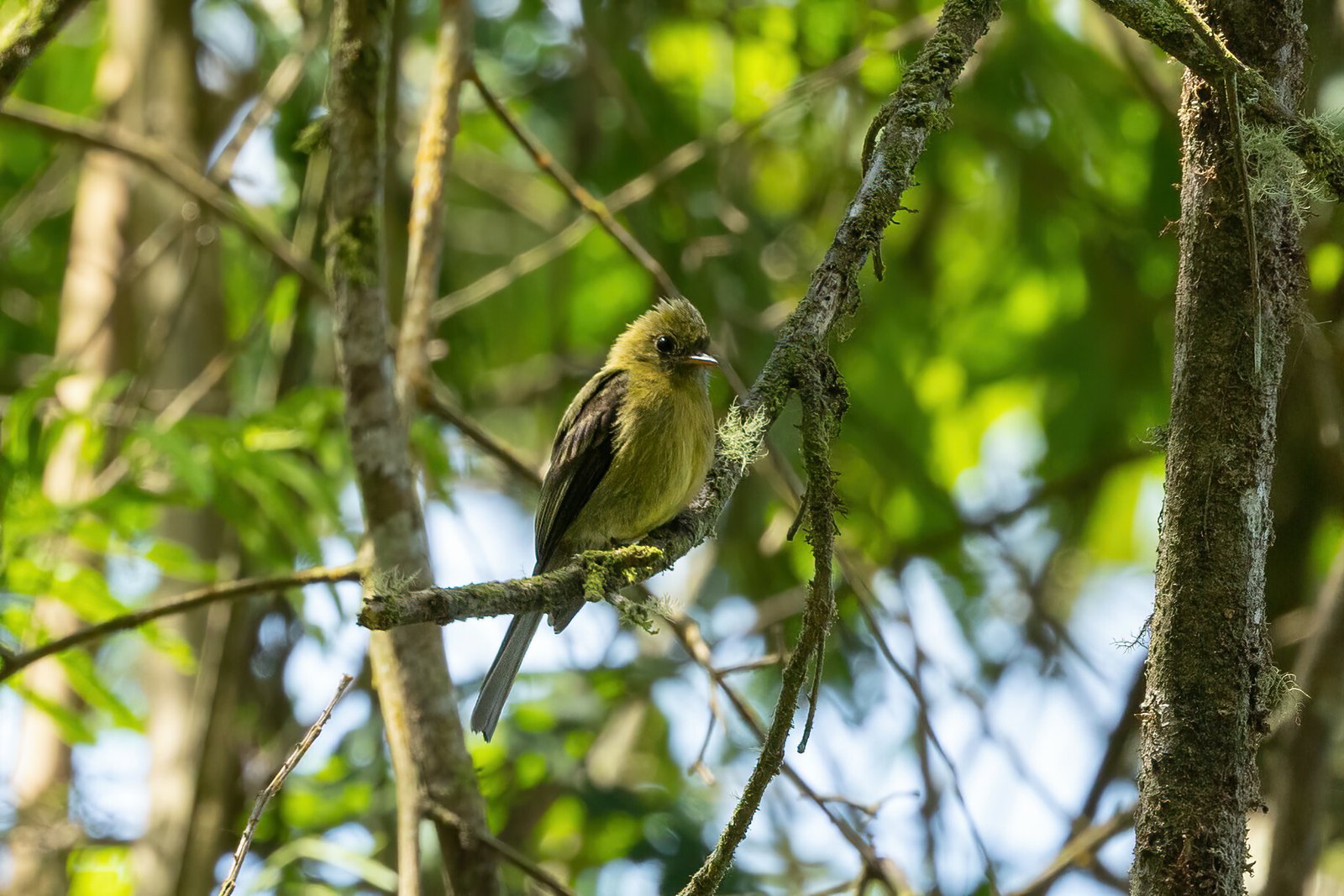
The Olive Tufted Flycatcher is a small tufted flycatcher of montane forest on the eastern slope of the Andes in Peru and Bolivia. It is a close relative of Northern Tufted Flycatcher, which lives in the north-west of the guide area. It often perches on an open twig along the forest edge and quivers its tail after landing.
Voice
A rapid, high series pee-pee-pee-pee, sometimes as a short trill; also short, sharp calls.
Recording: Guilherme Melo — CC BY-NC-SA 4.0 · xeno-canto
Identification
13 cm. Small, with a pointed crest that is often raised. Head and upperparts are olive-green. The breast is olive, merging into a pale yellow belly. The lores and a narrow eye-ring are greyish. The wings are dark with two indistinct, olive-grey wing-bars. The lower mandible is pale orange. Sexes alike.
Confusion species
Cinnamon Flycatcher Pyrrhomyias cinnamomeus uses similar sites, but has cinnamon-rufous underparts and a cinnamon wing patch, without a pointed crest. Ochraceous-breasted Flycatcher Nephelomyias ochraceiventris lives higher and has an ochre breast. Euler's Flycatcher Lathrotriccus euleri has no crest, cinnamon-buff wing-bars and lives lower down in the forest interior. The wood pewees Contopus are larger, with longer wings.
Habitat
Edges and clearings of humid montane forest and cloud forest, also stream valleys, landslides and verges of mountain roads, roughly between 1000 and 2500 m. It perches in the middle storey on an open twig, sallies briefly for flying insects and often returns to the same perch. It lives alone or in pairs. Little is known about the nest.
Where the bird is most at home, classified by the vegetation units of the Andes and the west coast.


Range and movements
Peru: on the eastern slope of the Andes, from north to south. Bolivia: in the Yungas of La Paz and Cochabamba. Absent from Colombia, Ecuador and the Galápagos. It does not occur outside the guide area.
- Resident
- dark = core range, pale = thinly spread
How and when to look
Along roads through montane forest on the eastern slope, for example the Manu road in Peru or in the Yungas of La Paz, search bare twigs at the forest edge for a small olive flycatcher with a pointed crest that returns to the same twig after a sally.
Conservation status
Least Concern. The species is fairly common over a large area and tolerates forest edges; deforestation of the Andean slope is a local threat.
Scientific name
Mitrephanes olivaceus | Berlepsch & Sztolcman, 1894
Berlepsch & Sztolcman described the species in 1894 and placed it straight away in the genus where it still stands. The genus Mitrephanes was introduced in 1882 by Coues. The genus name comes from Greek mitra, 'headband, turban', and -phanēs, 'showing', referring to the crest. The species name comes from Latin olivaceus, 'olive-green', referring to the plumage. The specimen the first description was based on came from Garita del Sol, Peru.