All species › Passerines › Tyrant flycatchers and allies › Masked Water Tyrant
Masked Water Tyrant | Fluvicola nengeta
Maskerwatertiran | Viudita enmascarada | Lavadeira-mascarada
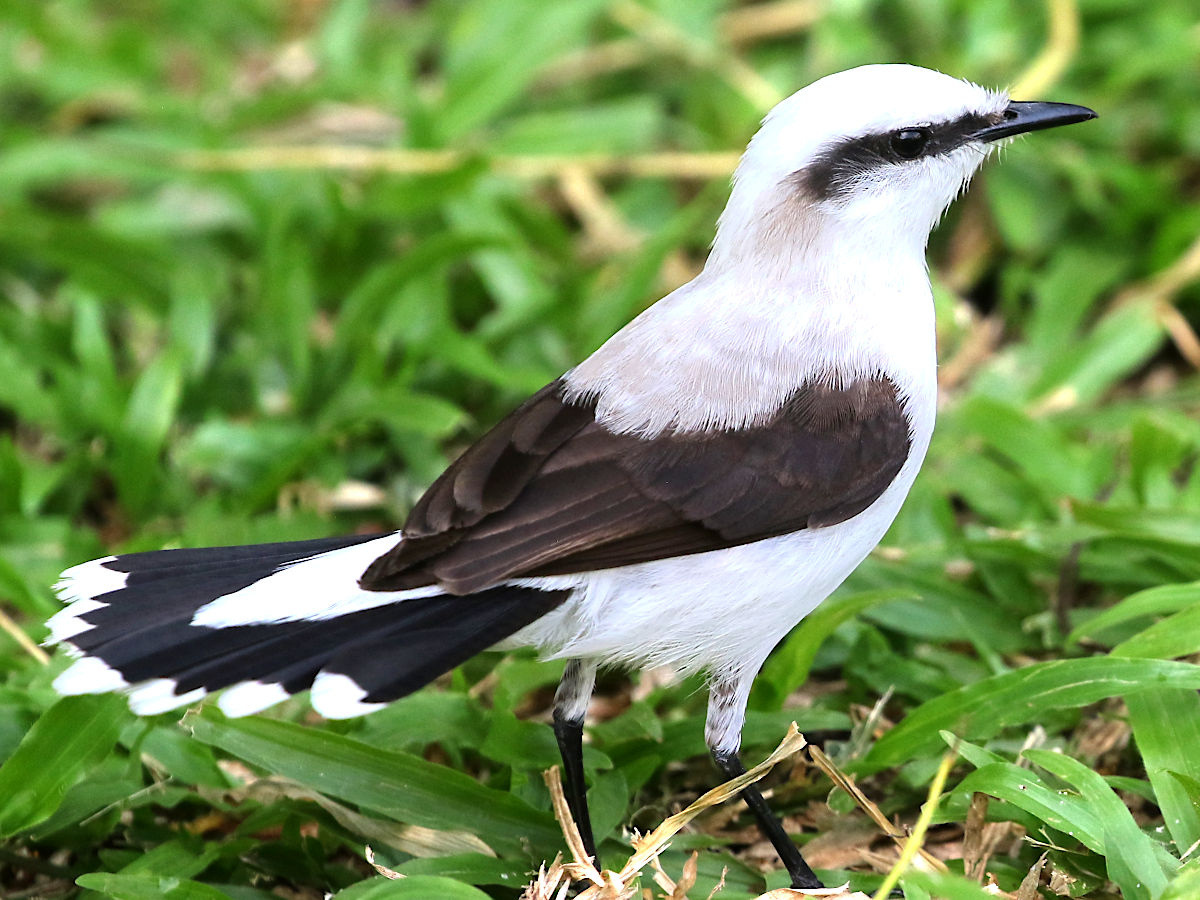
The Masked Water Tyrant is a white and pale grey tyrant with a narrow black eye-stripe, black wings and a black tail. It occurs in two widely separated areas: western Ecuador and north-western Peru, and eastern Brazil. It often walks and hops on the ground along the water.
Voice
A short, sharp keep or chek, often repeated, and a dry crackling in display flight.
Recording: JAYRSON ARAUJO DE OLIVEIRA — CC BY-NC-SA 4.0 · xeno-canto
Identification
15 cm. Head and underparts white, with a narrow black stripe from the bill through the eye. The back is pale grey, the wings are blackish and the tail is black with a narrow white terminal band. Bill and legs are black. Sexes alike. Juveniles are duller, with brownish grey on the head and back.
Confusion species
Pied Water Tyrant Fluvicola pica lives only east of the Andes, is smaller and has a black back and no eye-stripe. In the guide area the Masked Water Tyrant is distinguished by its range west of the Andes and the combination of white head, eye-stripe and pale grey back.
Habitat
Banks of ponds, lakes and rivers, marshes, wet pastures, ditches, rice fields and gardens near water, in the lowlands and on lower slopes, mostly below 1000 m. It searches for insects on the ground and among bankside vegetation. The nest is a globular structure of grass with a side entrance, in a shrub or tree near water.
Where the bird is most at home, classified by the vegetation units of the Andes and the west coast.


Range and movements
Ecuador: in the western lowlands and on the lower western slopes, from Esmeraldas to El Oro and Loja. Peru: in the north-west, mainly in Tumbes and Piura. Absent from Bolivia and the Galápagos; in Colombia at most in the far south-west, without an established population. Outside the guide area in eastern Brazil.
- Resident
- dark = core range, pale = thinly spread
How and when to look
Search along ponds, ditches and rice fields in the lowlands of western Ecuador; the birds often walk in the open on mud or grass and stand out by the black and white of wings and tail.
Conservation status
Least Concern. It benefits from rice fields and other wet farmland.
Scientific name
Fluvicola nengeta | (Linnaeus, 1766)
Linnaeus described the species in 1766 as [Lanius] Nengeta; because it was later moved to another genus, the author and year stand in brackets. The genus Fluvicola was introduced in 1827 by Swainson. The genus name comes from Latin fluvius, 'river', and -cola, 'dweller'. The species name nengeta comes from the Tupi name Guirá nheengetá, roughly 'whispering bird', recorded by Marcgrave in 1648 as 'Guiraru Nheengeta' for an unidentified bird. The specimen the first description was based on came from Brazil.