All species › Passerines › Tyrant flycatchers and allies › Pied Water Tyrant
Pied Water Tyrant | Fluvicola pica
Bonte watertiran | Viudita pía | Lavadeira-do-norte
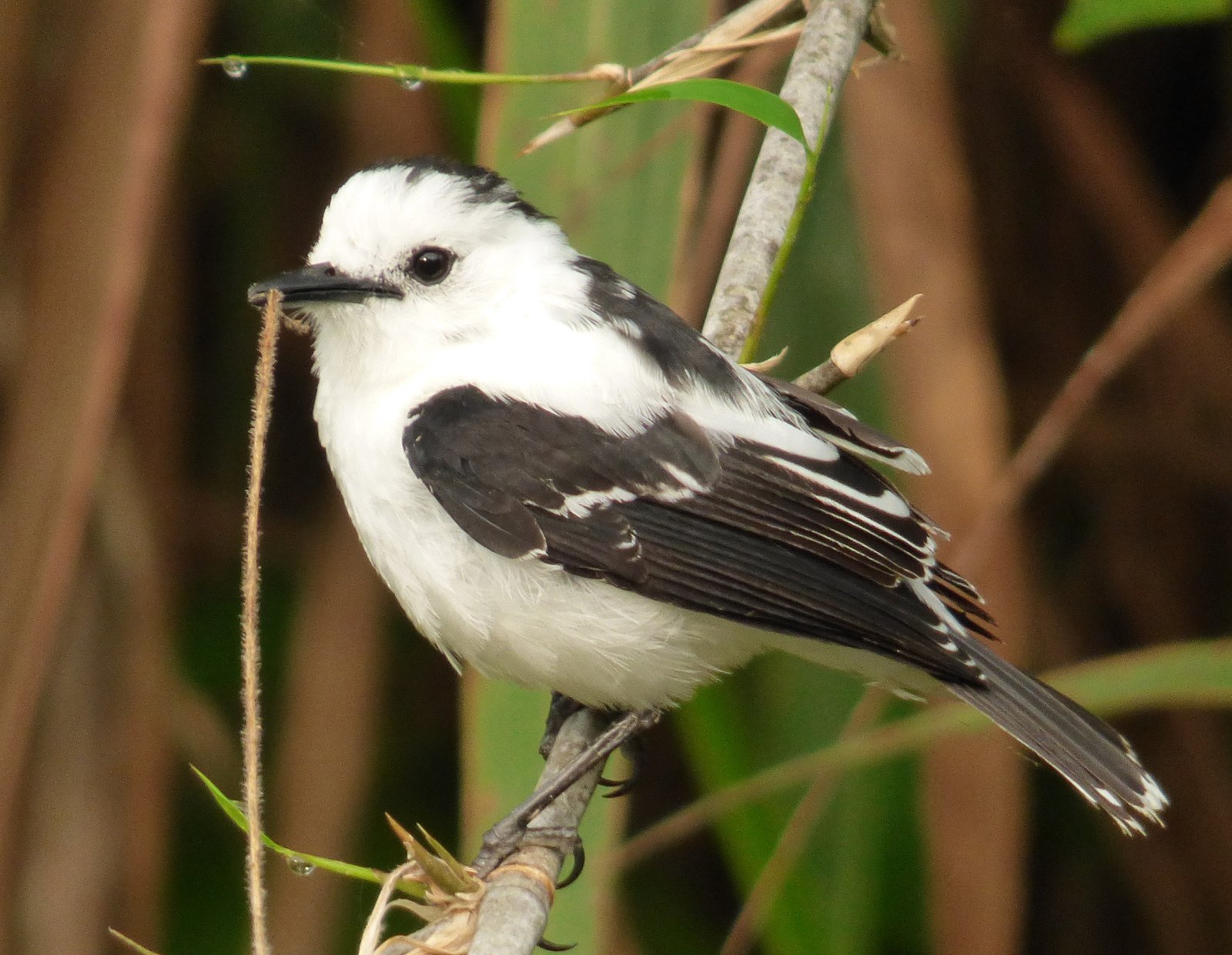
The Pied Water Tyrant is a small, black-and-white tyrant of marshes and banks with floating plants. It hops and flutters low among the aquatic plants, often flicking its tail. Two clearly different forms occur in the guide area: the northern form in Colombia and the southern form (albiventer), which many authors treat as a separate species, Black-backed Water Tyrant.
Voice
A short, nasal dzweep or chip, and a soft, scratchy twitter.
Recording: Jaime Suárez — CC BY-NC-SA 4.0 · xeno-canto
Identification
13 cm. Forehead, face and underparts white. The northern form has a black hindcrown, nape and back, with white on the scapulars and rump; the wings and tail are black, the flight feathers with narrow white edges and the tail with a white terminal band. The southern form has an all-black back and more black on the crown and nape. Sexes nearly alike; in the female the black on the back is browner. Juveniles are greyish-brown where adults are black.
Confusion species
Masked Water Tyrant Fluvicola nengeta, only west of the Andes, is larger, with a pale grey back and a narrow black eye-stripe. The male White-headed Marsh Tyrant Arundinicola leucocephala has a black body and only a white head. White Monjita Xolmis irupero of southern Bolivia is largely white, with only black wing tips and a black tail tip, and lives in dry open country.
Habitat
Marshes, banks of lakes and oxbow lakes with floating plants and low shrubs, wet savanna, ditches and rice fields in the lowlands, mostly below 500 m. It searches for insects among aquatic plants and on mud. The nest is a globular structure of grass with a side entrance, in a shrub or tree over water.
Where the bird is most at home, classified by the vegetation units of the Andes and the west coast.


Range and movements
Colombia: the northern form in the Caribbean lowlands, the Magdalena valley and the Llanos; the southern form as a rare winter visitor in the Amazonian lowlands. Ecuador: the southern form as a rare winter visitor in the Amazonian lowlands. Peru: the southern form as an austral winter visitor in the Amazonian lowlands, mainly in the south-east. Bolivia: the southern form in the lowlands of the north and east, including the Beni savannas; partly resident. Absent from the Galápagos. Outside the guide area the northern form from Panama to Venezuela, the Guianas and northern Brazil; the southern form in eastern and southern Brazil, Paraguay, Uruguay and northern Argentina.
- Resident
- dark = core range, pale = thinly spread
How and when to look
In Colombia search the marshes of the Caribbean lowlands and the Llanos, and in Bolivia the lagoons and marshes of the Beni. The birds perch low on floating plants and their black-and-white pattern makes them recognisable even at a distance.
Conservation status
Least Concern. Common in suitable marshland.
Scientific name
Fluvicola pica | (Boddaert, 1783)
Boddaert described the species in 1783 as Muscicapa pica; because it was later moved to another genus, the author and year stand in brackets. The genus Fluvicola was introduced in 1827 by Swainson. The genus name comes from Latin fluvius, 'river', and -cola, 'dweller'. The species name comes from Latin pica, 'magpie', referring to the black-and-white plumage. The specimen the first description was based on came from Cayenne, French Guiana.