All species › Passerines › Tyrant flycatchers and allies › Slender-footed Tyrannulet
Slender-footed Tyrannulet | Zimmerius gracilipes
Slankpootvliegenpikker | Mosquerito patifino | Poiaeiro-de-pata-fina
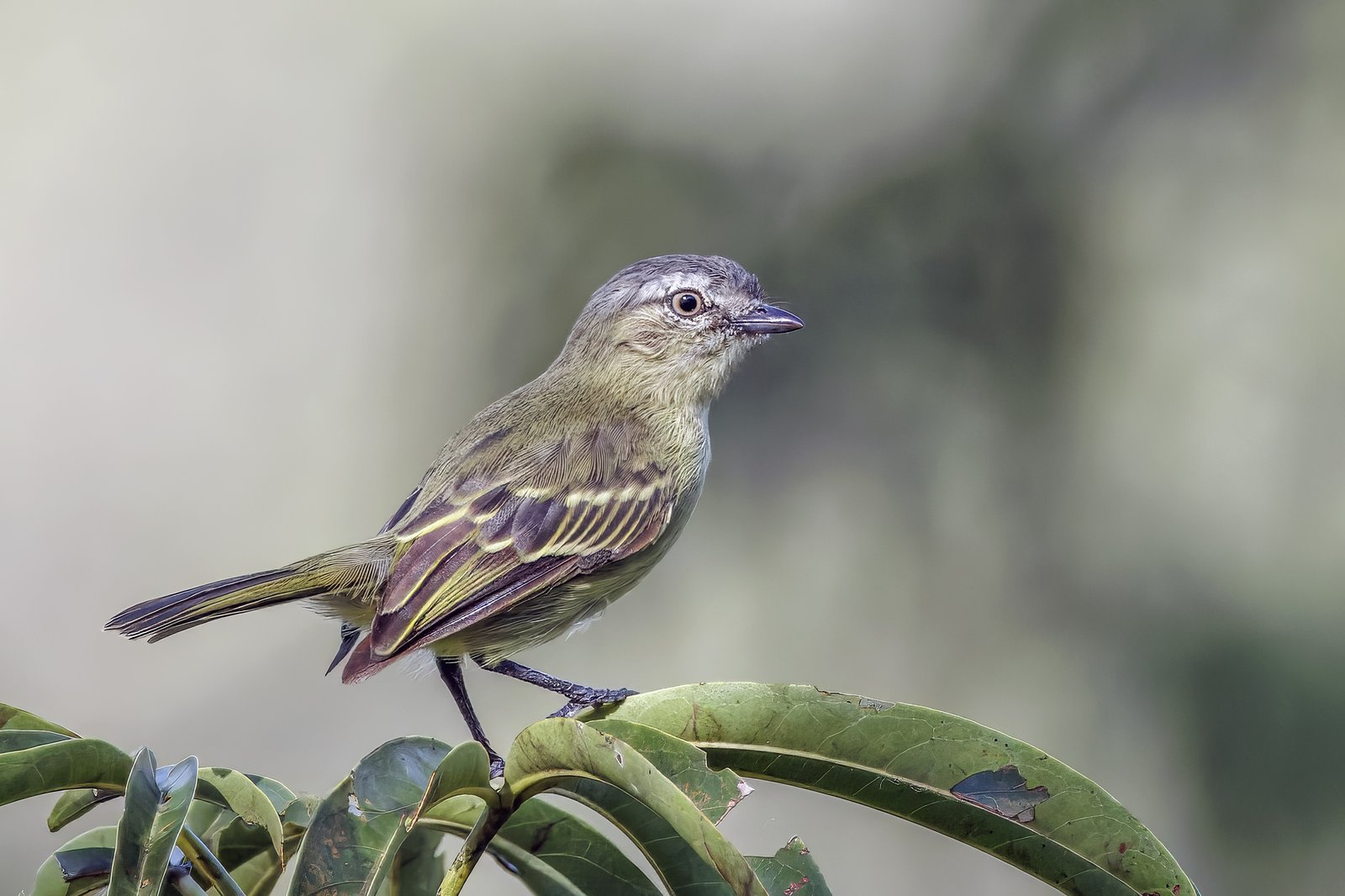
The Slender-footed Tyrannulet is a small, grey-green tyrant flycatcher of the treetops in the Amazonian lowlands. It lives high in the canopy and usually gives itself away by its short series of whistles, which are among the regular sounds of the rainforest. Its name refers to its short, thin legs.
Voice
A short series of three or four soft, clear whistles, tuu-tuu-tuu, and single, slightly rising whistles.
Recording: Paul Coopmans — CC BY-NC-SA 4.0 · xeno-canto
Identification
10.5 cm, with a small, dark bill, short, thin legs and a rather long tail. The crown is grey, the back olive-green, with a faint pale eyebrow. The wing feathers have distinct yellow edges, without true wing bars. In adults the iris is pale, greyish white. The throat and breast are pale grey, the belly pale yellow. The sexes are alike.
Confusion species
Red-billed Tyrannulet Zimmerius cinereicapilla is larger, with a reddish lower mandible, and lives in the foothills. Mishana Tyrannulet Zimmerius villarejoi in the white-sand forest of Loreto and San Martín is very similar and is told mainly by voice. White-lored Tyrannulet Ornithion inerme has white lores and rows of white spots on the wing. Yellow-crowned Tyrannulet Tyrannulus elatus has a yellow crown stripe, grey cheeks and wing bars. Southern Beardless Tyrannulet Camptostoma obsoletum has a small crest and pale wing bars.
Habitat
The canopy and edges of humid lowland forest, both terra firme and várzea, also secondary forest and clearings with tall trees, up to about 1000 m. It eats small insects and many berries, especially of mistletoes, and moves with mixed canopy flocks. The nest has been little described.
Where the bird is most at home, classified by the vegetation units of the Andes and the west coast.


Range and movements
Colombia: in the lowlands east of the Andes, mainly in Amazonia. Ecuador: in the eastern lowlands. Peru: throughout the Amazonian lowlands. Bolivia: in the lowlands of the north and centre, in Pando, Beni, La Paz and Santa Cruz. Absent from the Galápagos. Outside the guide area in southern Venezuela, the Guianas and Amazonian Brazil.
- Resident
- dark = core range, pale = thinly spread
How and when to look
Listen at lodges and canopy towers in the lowlands, for example around Iquitos or in Yasuní, for the short series of whistles from the treetops; from a tower the bird can be seen at close range in the canopy.
Conservation status
Least Concern. The species is widespread and also occurs in secondary forest.
Scientific name
Zimmerius gracilipes | (Sclater & Salvin, 1868)
Sclater & Salvin described the species in 1868 as Tyranniscus gracilipes; because it was later moved to another genus, the author and year stand in brackets. The genus Zimmerius was introduced in 1977 by Traylor. The genus name honours the American ornithologist John Todd Zimmer (1889–1957), who did much work on the classification of Neotropical birds. The specific name comes from Latin gracilis, 'slender', and pes, 'foot': 'slender-footed'. The specimen the first description was based on came from Pebas, Loreto, Peru.