All species › Passerines › Tyrant flycatchers and allies › Tumbes Tyrant
Tumbes Tyrant | Ochthoeca salvini
Tumbestiran | Pitajo de Tumbes | Papa-moscas-de-tumbes
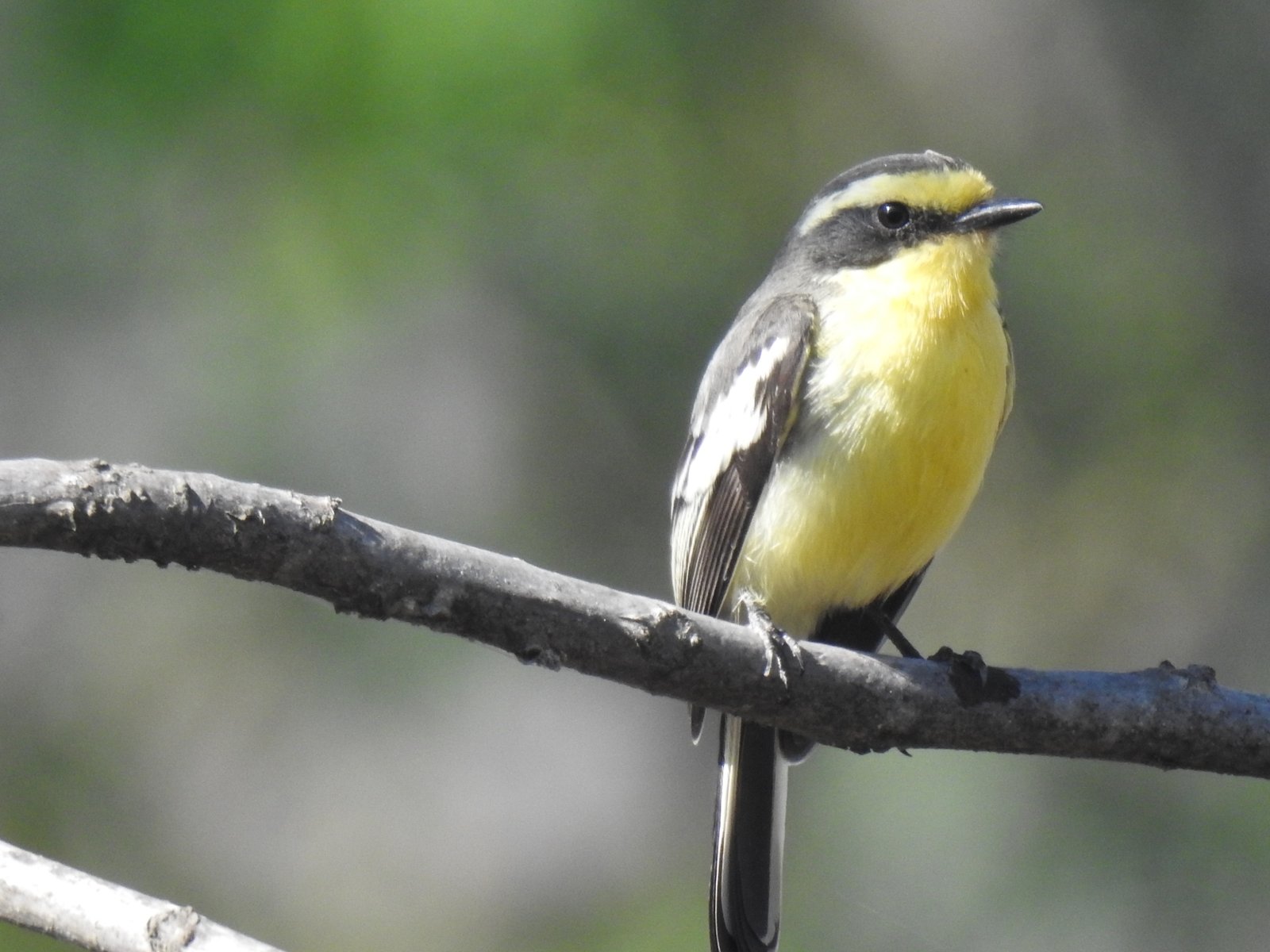
The Tumbes Tyrant is a small tyrant flycatcher of the dry forest and thorn scrub of north-western Peru, with bright yellow underparts and a long white supercilium. It is one of the species found only in the Tumbes region. It used to be placed in its own genus, Tumbezia; it is now included with the chat-tyrants.
Voice
A short series of high, thin whistles and a short, sharp tsit as a call, mainly in the early morning.
No recording with a suitable Creative Commons licence is available for this species yet.
Identification
13 cm, with a thin, black bill and an upright posture. The upperparts are dark greyish brown to olive-grey, the crown dark grey. A long, broad white supercilium runs back to the nape, with a dark eye-stripe below it. The wings are dark with two white wing bars. The underparts are bright yellow. The sexes are alike.
Confusion species
Social Flycatcher Myiozetetes similis is larger, with a short, thick bill, a dark mask and rufous edges to the wing. Short-tailed Field Tyrant Muscigralla brevicauda has a very short tail and long pale legs and lives on the ground in open country. Grey-and-white Tyrannulet Pseudelaenia leucospodia is grey and white, without yellow, and has a small crest.
Habitat
Dry forest, thorn scrub with Prosopis and acacia, riverside scrub and shrubby valleys in the lowlands and on the lower slopes, from sea level to about 1000 m. It lives alone or in pairs and perches low to mid-level on branches, from where it makes short sallies to insects. The nest is a small cup in a shrub.
Where the bird is most at home, classified by the vegetation units of the Andes and the west coast.


Range and movements
Peru: in the north-west, in the lowlands and on the lower slopes of Tumbes, Piura, Lambayeque and La Libertad. Ecuador: no established population; there are at most a few records from the far south-west, close to the Peruvian border. Absent from Colombia, Bolivia and the Galápagos. Does not occur outside the guide area.
- Resident
- dark = core range, pale = thinly spread
How and when to look
Search shrubby dry valleys and riverside scrub inland in Piura and Lambayeque, for instance at Chaparrí or around Olmos; look for the white supercilium and the yellow belly.
Conservation status
Near Threatened. The small range lies in the dry forest of the Tumbes region, which is disappearing through logging, charcoal production, farming and grazing by goats.
Scientific name
Ochthoeca salvini | Taczanowski, 1877 (GBIF: Tumbezia salvini)
Taczanowski described the species in 1877 and placed it straight away in the genus where it still stands. The genus Ochthoeca was introduced in 1847 by Cabanis. The genus name combines Greek okhthos, 'bank' or 'mound', with oikos, 'dwelling'. Honours Osbert Salvin (1835–1898), British ornithologist and entomologist, co-author of the Biologia Centrali-Americana. The specimen the first description was based on came from Tumbes, Peru.