All species › Waders, gulls and terns › Skimmers, noddies, terns and gulls › Royal Tern
Royal Tern | Thalasseus maximus
Koningsstern | Charrán real | Trinta-réis-real
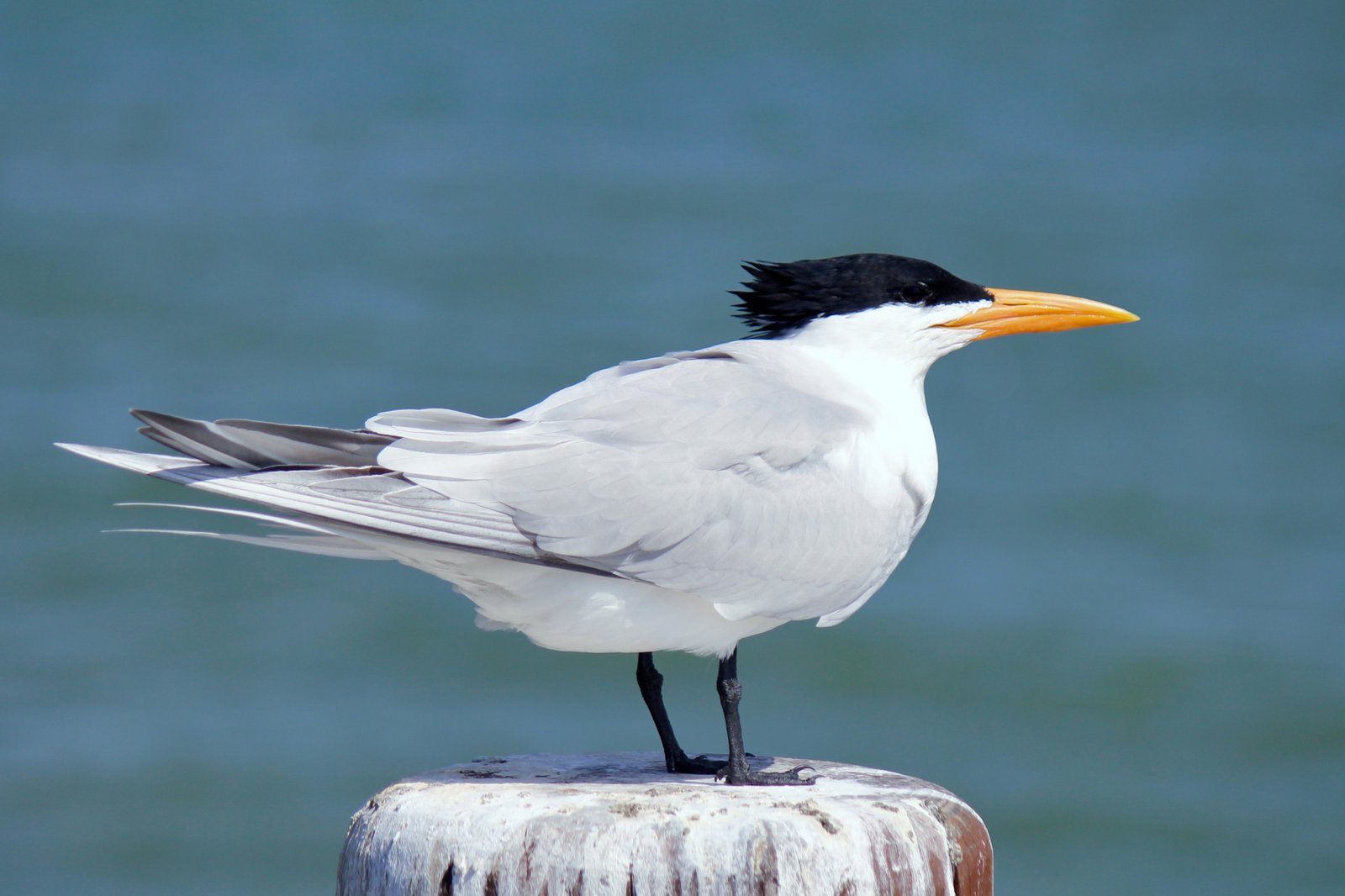
The Royal Tern is a large tern with a thick orange bill and a shaggy black crest; after the Caspian Tern it is the largest tern along the coasts of the guide area. It breeds in dense colonies on sandy islands in North and Central America and the Caribbean and moves south after breeding. Along the Pacific and Caribbean coasts it is present year-round, mainly as a non-breeding bird.
Voice
A loud, rolling kreeet or keerip, lower than in smaller terns; flocks at roosts keep up a constant screeching.
Recording: David Darrell-Lambert — CC BY-NC-SA 4.0 · xeno-canto
Identification
45–50 cm, a large, slender tern with a thick, straight, orange to orange-red bill, long, narrow wings and a moderately forked tail. In breeding plumage, mainly February–June, the crown is entirely black with a short, shaggy crest. Outside the breeding season, the plumage in which most birds in the guide area are seen, the forehead is white and a black, shaggy hindcrown remains that usually does not enclose the eye. The upperparts are pale grey, the underparts white. From below the wings are white with a dark grey trailing edge to the outer primaries. The legs are black. Juveniles have a yellower bill, dark spots on the mantle and wing coverts and a dark tail tip. The sexes are alike.
Confusion species
Elegant Tern Thalasseus elegans is smaller and slimmer, with a longer, thinner, slightly drooping bill that becomes yellower towards the tip, and a longer crest; in non-breeding plumage the black of the hindcrown extends around the eye. Caspian Tern Hydroprogne caspia is larger and heavier, with a thick, blood-red bill with a dark tip and blackish primaries from below. Sandwich Tern Thalasseus sandvicensis is smaller, with a slender black bill with a yellow tip. Gull-billed Tern Gelochelidon nilotica has a short, thick black bill and no crest.
Habitat
Sandy beaches, river mouths, lagoons, harbours and mangrove coasts; it forages mainly over shallow sea water close inshore. It plunge-dives from a few metres for fish and also takes shrimps and small squid. It roosts in groups on sandbars and beaches, often with gulls and other terns. It breeds in dense colonies on low, bare islands; as far as known not in the guide area.
Where the bird is most at home, classified by the vegetation units of the Andes and the west coast.


Range and movements
In Colombia along the Caribbean and Pacific coasts, fairly common. In Ecuador along the whole coast, including the Gulf of Guayaquil; a rare visitor to the Galápagos. In Peru along the coast, common in the north and scarcer to the south. Absent from Bolivia. Breeds on the coasts of the south-eastern United States, Mexico and the Caribbean and, in a separate population, in Uruguay and Argentina; outside the breeding season along the Atlantic and Pacific coasts into South America.
- Resident
- dark = core range, pale = thinly spread
How and when to look
On beaches and sandbars at river mouths, such as in the Gulf of Guayaquil and along the coast of northern Peru, Royal Terns often roost among other terns, gulls and pelicans; there you can compare bill shape and head pattern of birds standing side by side. Immature birds also stay through the northern summer.
Conservation status
Not Evaluated in the current circumscription of the species; as a whole widespread and numerous. Colonies are sensitive to disturbance and to the loss of breeding islands through coastal development and rising sea level.
Scientific name
Thalasseus maximus | (Boddaert, 1783)
Boddaert described the species in 1783 as Sterna maxima; because it was later moved to another genus, the author and year stand in brackets. The genus Thalasseus was introduced in 1822 by Boie. The genus name comes from Greek thalassa, 'sea'; thalasseus means 'seaman' or 'fisherman'. The specific name comes from Latin maximus, 'largest'. The specimen the first description was based on came from Cayenne, French Guiana.