All species › Passerines › Ovenbirds and woodcreepers › Ruddy Woodcreeper
Ruddy Woodcreeper | Dendrocincla homochroa
Rosse muisspecht | Trepatroncos rojizo | Arapaçu-ruivo
The Ruddy Woodcreeper is a warm rufous-brown woodcreeper that mainly follows army-ant swarms. It lives from Mexico to northern Colombia and north-western Venezuela. In the guide area it occurs only in northern Colombia.
Voice
At ant swarms loud, nasal calls and a rapid, dry rattle. The song is a rapid, rising and then falling series of sharp notes, mainly at dawn and dusk.
Recording: Francisco Troncoso — CC BY-NC-SA 4.0 · xeno-canto
Identification
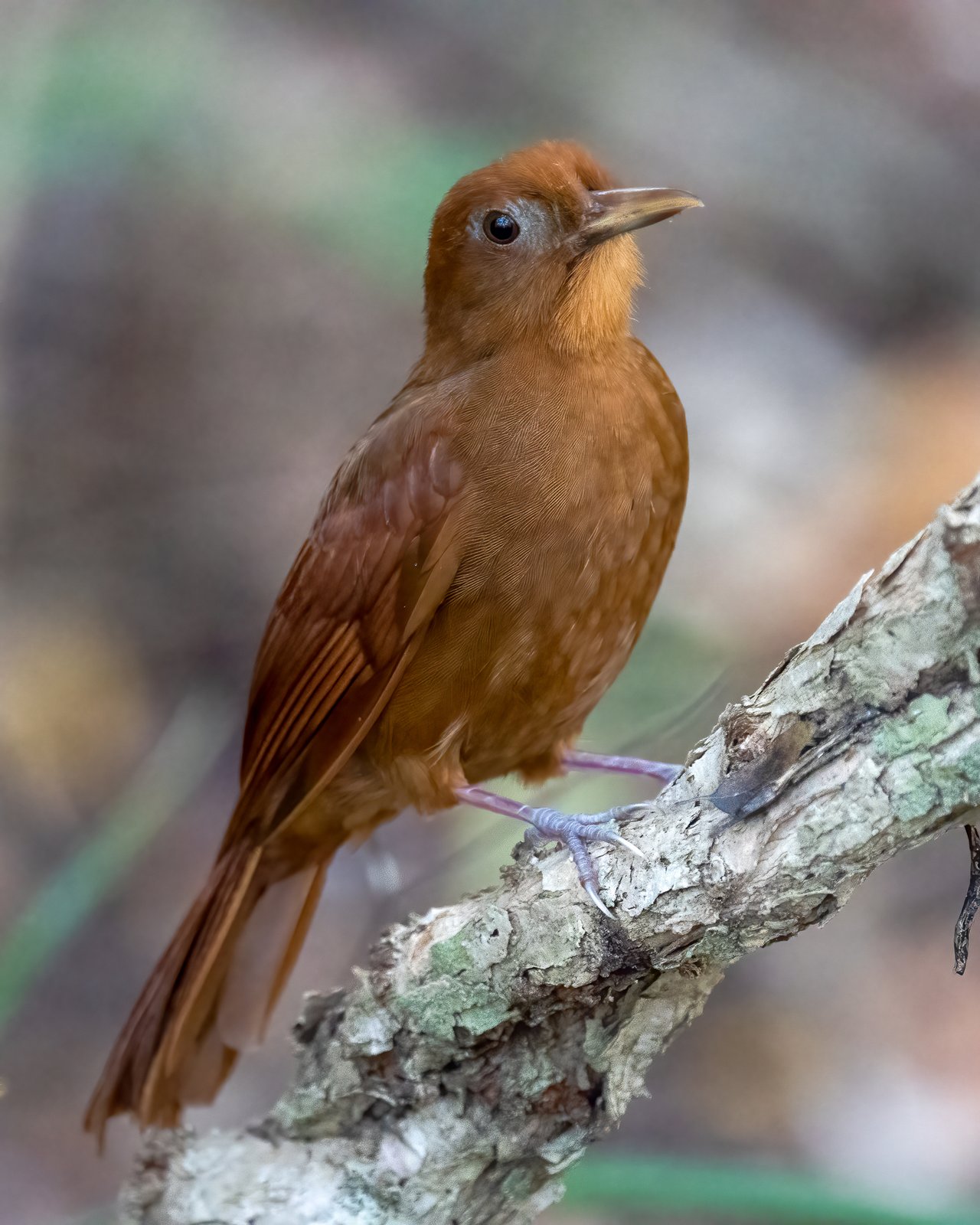
19–21 cm, with a straight, horn-coloured bill and a stiff, rufous tail. The plumage is almost plain warm rufous-brown, with a brighter rusty crown, wings and tail and a slightly paler, cinnamon throat. The lores are greyish. There are no streaks or spots. The sexes are alike.
Confusion species
Plain-brown Woodcreeper Dendrocincla fuliginosa is duller greyish brown, with a grey cheek and a dark malar stripe, and also follows ant swarms. Piping Long-tailed Woodcreeper Deconychura typica is slimmer and more olive-brown, with fine streaks on the breast and crown. Other woodcreepers in northern Colombia are clearly streaked or spotted.
Habitat
The interior and edges of humid and semi-humid forest in the lowlands, foothills and lower montane forest, from sea level to about 1500 m. It follows army-ant swarms and catches fleeing insects and other invertebrates on low trunks and on the ground. The nest is in a tree cavity.
Where the bird is most at home, classified by the vegetation units of the Andes and the west coast.


Range and movements
Colombia: in the north, in the Caribbean lowlands, the Sierra Nevada de Santa Marta, the Serranía de Perijá, the northern Magdalena valley and the northern spurs of the Andes to the Gulf of Urabá. Absent from Ecuador, Peru, Bolivia and the Galápagos. Outside the guide area from southern Mexico to Panama and in north-western Venezuela.
- Resident
- dark = core range, pale = thinly spread
How and when to look
Search humid forest in northern Colombia, for example on the lower slopes of the Sierra Nevada de Santa Marta, for an army-ant swarm and wait quietly there. The rufous woodcreeper often clings low on a trunk above the swarm.
Conservation status
Least Concern. The species has a large range but is tied to forest with ant colonies; much of that forest in northern Colombia has been cleared.
Scientific name
Dendrocincla homochroa | (Sclater, 1860)
Sclater described the species in 1860 as Dendromanes homochrous; because it was later moved to another genus, the author and year stand in brackets. The genus Dendrocincla was introduced in 1840 by Gray. The genus name comes from Ancient Greek dendron, 'tree', and kinklos, an unidentified tail-wagging bird, often rendered as 'wagtail'. The species name comes from Ancient Greek homokhroos, 'uniformly coloured', for the plain rufous plumage. The specimen the first description was based on came from Teotalcingo, Oaxaca, Mexico.