All species › Passerines › Ovenbirds and woodcreepers › White-chinned Woodcreeper
White-chinned Woodcreeper | Dendrocincla merula
Witkinmuisspecht | Trepatroncos barbiblanco | Arapaçu-da-taoca
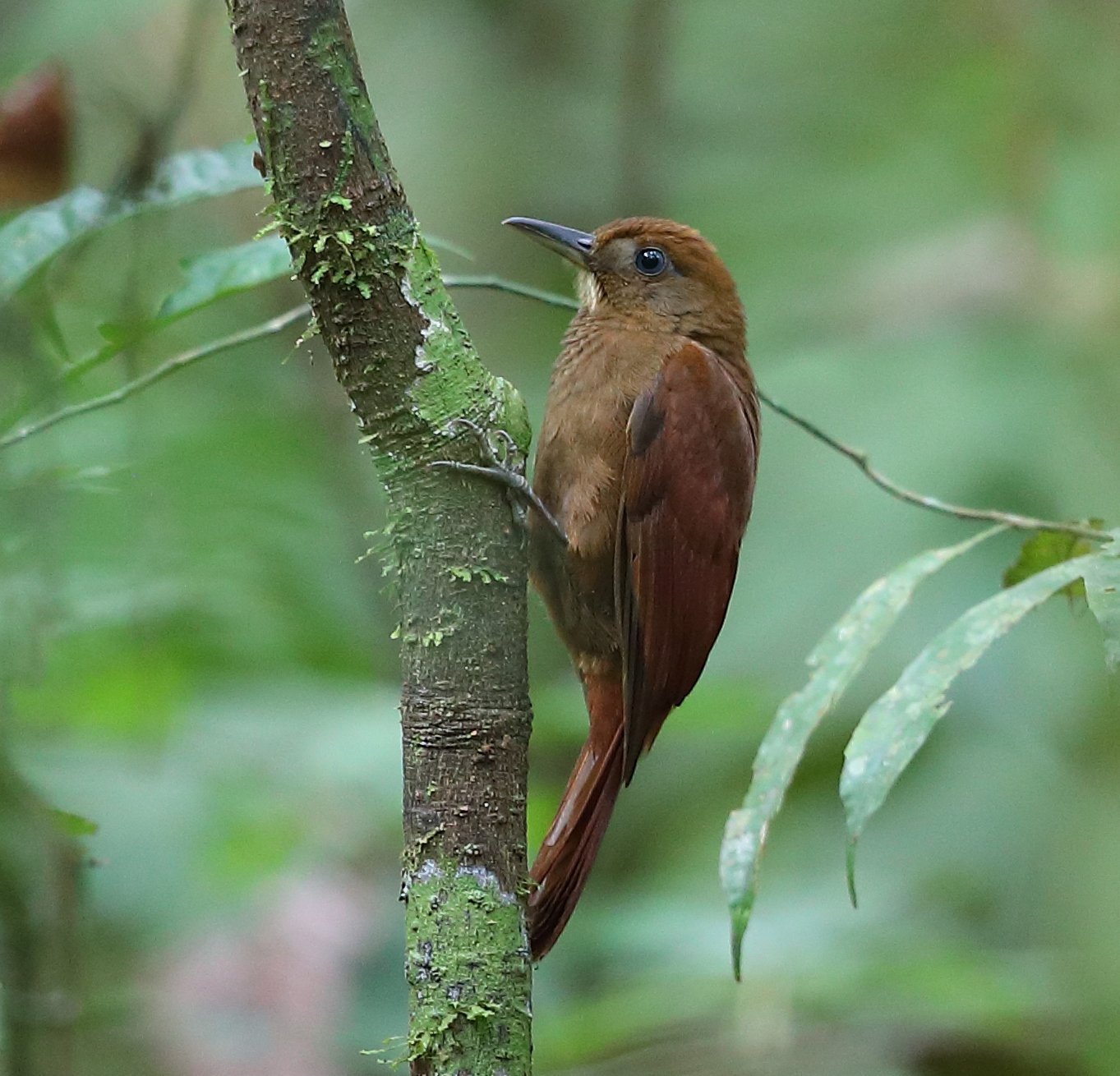
The White-chinned Woodcreeper is a dark brown woodcreeper of Amazonian rainforest that follows army-ant swarms almost exclusively. It catches the insects that flee ahead of the ants and is therefore nearly always found low in the forest at an ant swarm. The small white chin patch gives it its name.
Voice
At ant swarms loud, nasal calls and a rapid, dry rattle. The song, mainly at dusk, is a series of clear, descending notes.
Recording: Daniel F. Lane — CC BY-NC-SA 4.0 · xeno-canto
Identification
18–20 cm, with a straight, dark bill and a stiff, rufous tail. The plumage is plain dark olive-brown, slightly warmer on the wings and tail. On the chin is a small white patch that shows when the bird raises its head. The eye is grey or bluish grey in adults. The sexes are alike.
Confusion species
Plain-brown Woodcreeper Dendrocincla fuliginosa is paler and greyer brown, with a grey cheek, a dark malar stripe and no white chin; it also follows ant swarms. Cinnamon-throated Woodcreeper Dendrexetastes rufigula has a cinnamon throat and a pale bill and sits higher in the trees. Ant-following Amazonian Barred Woodcreeper Dendrocolaptes certhia is larger and finely barred.
Habitat
The interior of humid terra firme rainforest and seasonally flooded forest, from the lowlands to about 900 m. It follows army-ant swarms and picks fleeing insects and other invertebrates from low trunks and branches. The nest is in a cavity in a tree or stump.
Where the bird is most at home, classified by the vegetation units of the Andes and the west coast.


Range and movements
Colombia: in the Amazon region of the south-east. Ecuador: in the lowlands east of the Andes. Peru: in the Amazon basin. Bolivia: in the northern lowlands. Absent west of the Andes and from the Galápagos. Outside the guide area in southern Venezuela, the Guianas and the Brazilian Amazon.
- Resident
- dark = core range, pale = thinly spread
How and when to look
Search terra firme forest for an army-ant swarm, recognisable by the antbirds, tanagers and woodcreepers hovering low above it. Wait quietly at the swarm; the White-chinned Woodcreeper often clings vertically to a low trunk and drops to the ground now and then.
Conservation status
Least Concern. Because the species depends on large ant colonies in undisturbed forest, it quickly disappears from fragmented forest.
Scientific name
Dendrocincla merula | (Lichtenstein, 1820)
Lichtenstein described the species in 1820 as Dendrocolaptes Merula; because it was later moved to another genus, the author and year stand in brackets. The genus Dendrocincla was introduced in 1840 by Gray. The genus name comes from Ancient Greek dendron, 'tree', and kinklos, an unidentified tail-wagging bird, often rendered as 'wagtail'. The species name comes from Latin merula, 'blackbird', for the dark plumage. The specimen the first description was based on came from Cayenne, French Guiana.