All species › Passerines › Ovenbirds and woodcreepers › Tyrannine Woodcreeper
Tyrannine Woodcreeper | Dendrocincla tyrannina
Tiranmuisspecht | Trepatroncos tiranino | Arapaçu-tirano
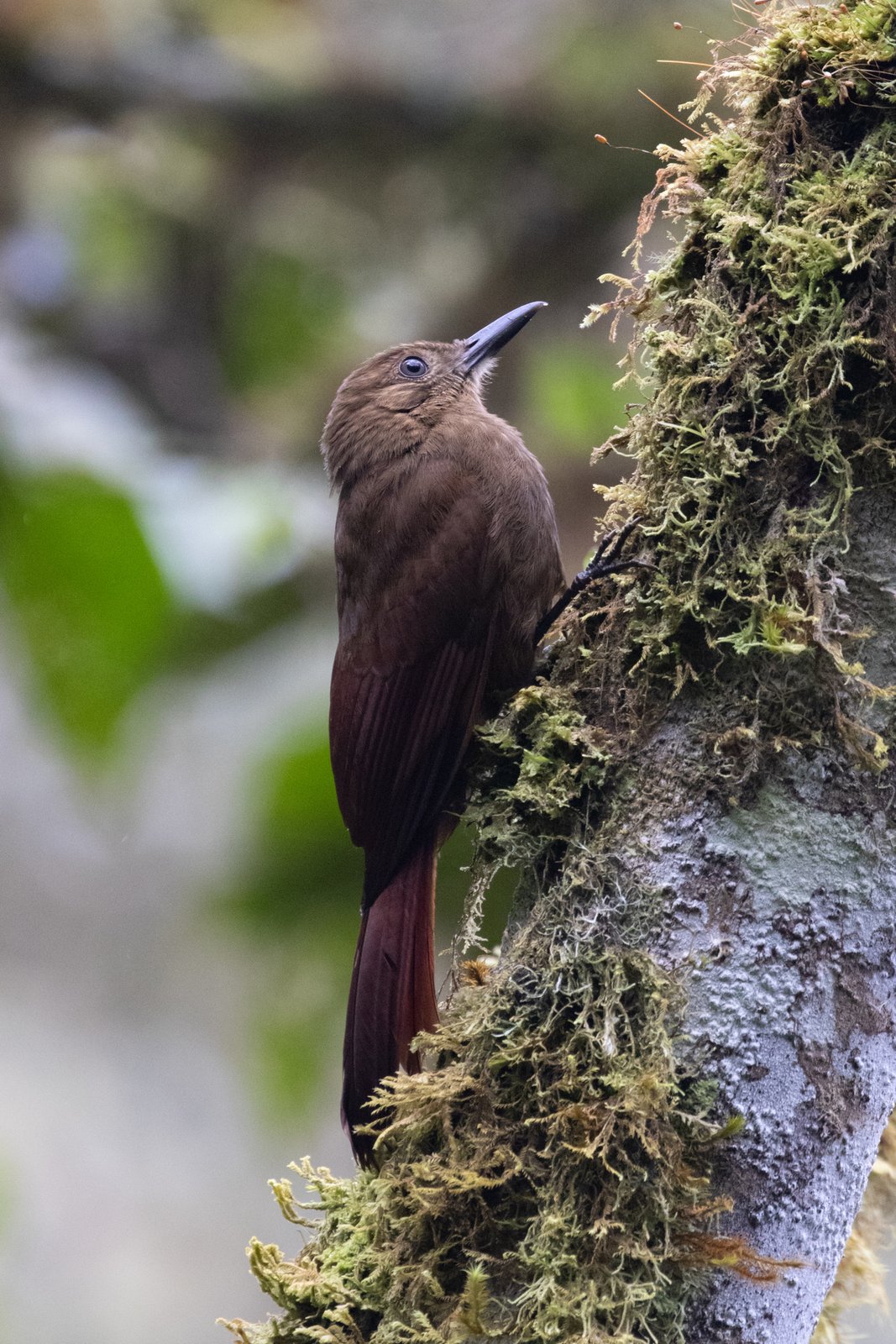
The Tyrannine Woodcreeper is a large, plain brown woodcreeper of Andean cloud forest. It is the only Dendrocincla of higher montane forest and lives higher than most other woodcreepers. Its long, rattling song is heard mainly at dawn and dusk.
Voice
The song is a long, accelerating series of loud notes that turns into a rattle, first swelling and then fading, mainly at first light and at dusk. The call is a loud, nasal chew.
Recording: Jonas Nilsson — CC BY-NC-SA 4.0 · xeno-canto
Identification
22–25 cm, large and bulky, with a straight, fairly heavy, dark bill and a stiff, rufous tail. The plumage is almost plain olive-brown, with fine, pale shaft streaks on the crown, throat and breast that show only at close range. The wings and tail are warmer rufous. The eye is dark. The sexes are alike.
Confusion species
Strong-billed Woodcreeper Xiphocolaptes promeropirhynchus is larger, with a much heavier, slightly decurved bill and distinct streaks on the head and breast. Montane Woodcreeper Lepidocolaptes lacrymiger is smaller, with a thin, decurved bill and heavily spotted underparts. Olive-backed Woodcreeper Xiphorhynchus triangularis is smaller, with a scaled throat and spotted breast. Plain-brown Woodcreeper Dendrocincla fuliginosa lives lower, is smaller and has a grey cheek and a dark malar stripe.
Habitat
Cloud forest and upper montane forest with much moss and many epiphytes, also forest edges, mostly between 1500 and 3000 m, locally higher. It searches trunks and thick, mossy branches for insects and other invertebrates, alone or with mixed flocks, and sometimes follows army-ant swarms. The nest is in a tree cavity.
Where the bird is most at home, classified by the vegetation units of the Andes and the west coast.


Range and movements
Colombia: in all three Andean ranges. Ecuador: on both slopes of the Andes. Peru: on the eastern slope of the Andes along the whole length of the country, and in the north also on the western slope. Bolivia: at most in the far north-west, adjoining the population in southern Peru. Absent from the Galápagos. Outside the guide area in the Andes of western Venezuela.
- Resident
- dark = core range, pale = thinly spread
How and when to look
At dusk in cloud forest, listen for the long, rattling song, and by day follow mixed flocks, where the large brown woodcreeper climbs mossy trunks.
Conservation status
Least Concern. The species has a large range in the Andes but depends on montane forest and disappears where it is cleared for farming and pasture.
Scientific name
Dendrocincla tyrannina | (de Lafresnaye, 1851)
De Lafresnaye described the species in 1851 as Dendrocops tyranninus; because it was later moved to another genus, the author and year stand in brackets. The genus Dendrocincla was introduced in 1840 by Gray. The genus name comes from Ancient Greek dendron, 'tree', and kinklos, an unidentified tail-wagging bird, often rendered as 'wagtail'. The species name comes from Modern Latin tyranninus, 'like a tyrant flycatcher', from Latin tyrannus, 'tyrant'. The specimen the first description was based on came from Bogotá, Colombia.