All species › Passerines › Ovenbirds and woodcreepers › Spectacled Prickletail
Spectacled Prickletail | Siptornis striaticollis
Brilstekelstaart | Colapúa frontino | Rabo-de-espinho-de-óculos
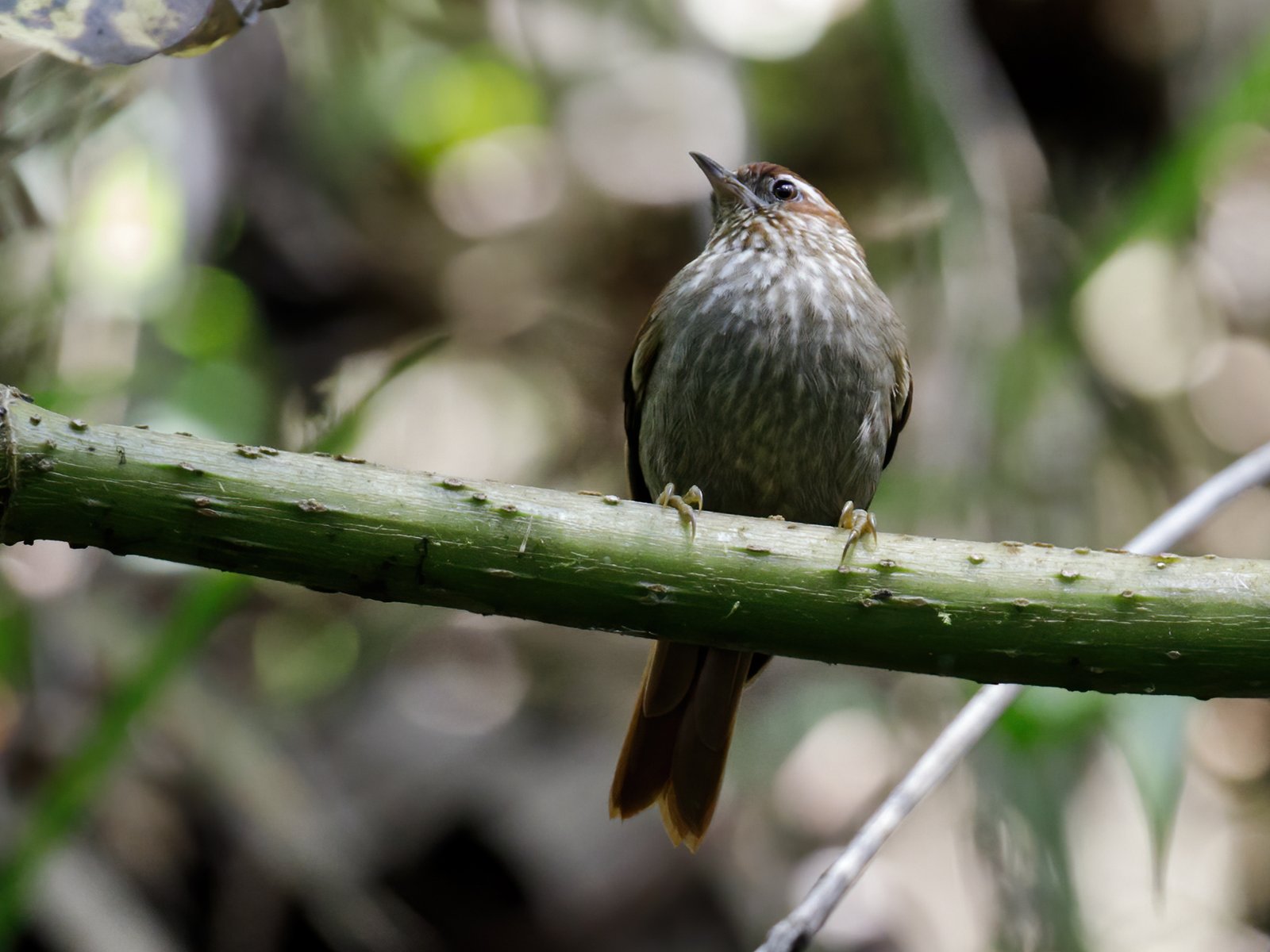
The Spectacled Prickletail is a small, dark brown ovenbird with white spectacles and a short tail with spiny tips, of the mossy cloud forests of the northern Andes. It climbs along mossy branches like a treerunner, usually in mixed flocks. The species is scarce and local.
Voice
High, thin, sharp calls, and a short, high, fast trill.
No recording with a suitable Creative Commons licence is available for this species yet.
Identification
11–12 cm, small and compact, with a short, straight bill and a short tail whose shafts project as spines. The crown is rufous, with a white, broken eye-ring and a short white streak behind the eye that together form spectacles. The upperparts are dark olive-brown, the wing coverts rufous. The throat and breast are dark with fine white streaks, the belly plain brown. The sexes are alike.
Confusion species
Pearled Treerunner Margarornis squamiger is larger, with a white throat, a white eyebrow and large, white, black-edged drops on the underparts. Spotted Barbtail Premnoplex brunnescens has buff spots on dark underparts and a buff throat, and forages low near the ground. Rusty-winged Barbtail Premnornis guttuliger has a buff eyebrow, a buff-scaled breast and a rufous tail.
Habitat
Mossy cloud forest and upper montane forest, roughly between 1500 and 2500 m. It climbs in mixed flocks along mossy branches and among epiphytes in the middle and upper levels, searching for insects. Little is known about the nest.
Where the bird is most at home, classified by the vegetation units of the Andes and the west coast.


Range and movements
Colombia: locally in the Central and Eastern Andes. Ecuador: on the east slope of the Andes almost throughout. Peru: in the north, in Cajamarca and Amazonas. Absent from the Galápagos. Isolated records from Bolivia do not fit the known range. Endemic to the guide area.
- Resident
- dark = core range, pale = thinly spread
How and when to look
Follow mixed flocks in mossy cloud forest on the east slope of the Andes in Ecuador, for example along the road over the Cordillera de Guacamayos; look for a small, dark bird with white spectacles climbing along branches like a treerunner.
Conservation status
Least Concern. The species is scarce and local; clearance of cloud forest is a threat locally.
Scientific name
Siptornis striaticollis | (de Lafresnaye, 1843)
De Lafresnaye described the species in 1843 as Synnalaxis striaticollis; because it was later moved to another genus, the author and year stand in brackets. The genus Siptornis was introduced in 1853 by Reichenbach. The genus name comes from Greek siptē, a bird allied to the woodpeckers mentioned by Aristotle, Callimachus and Hesychius and later associated with the nuthatch (Sitta), and ornis, 'bird'. The species name striaticollis combines Latin striatus, 'striped', and collum, 'neck'. The specimen the first description was based on came from Bogotá, Colombia.