All species › Passerines › Ovenbirds and woodcreepers › Tawny Tit-Spinetail
Tawny Tit-Spinetail | Sylviorthorhynchus yanacensis
Taankleurige meesstekelstaart | Tijeral leonado | Grimpeirinho-fulvo
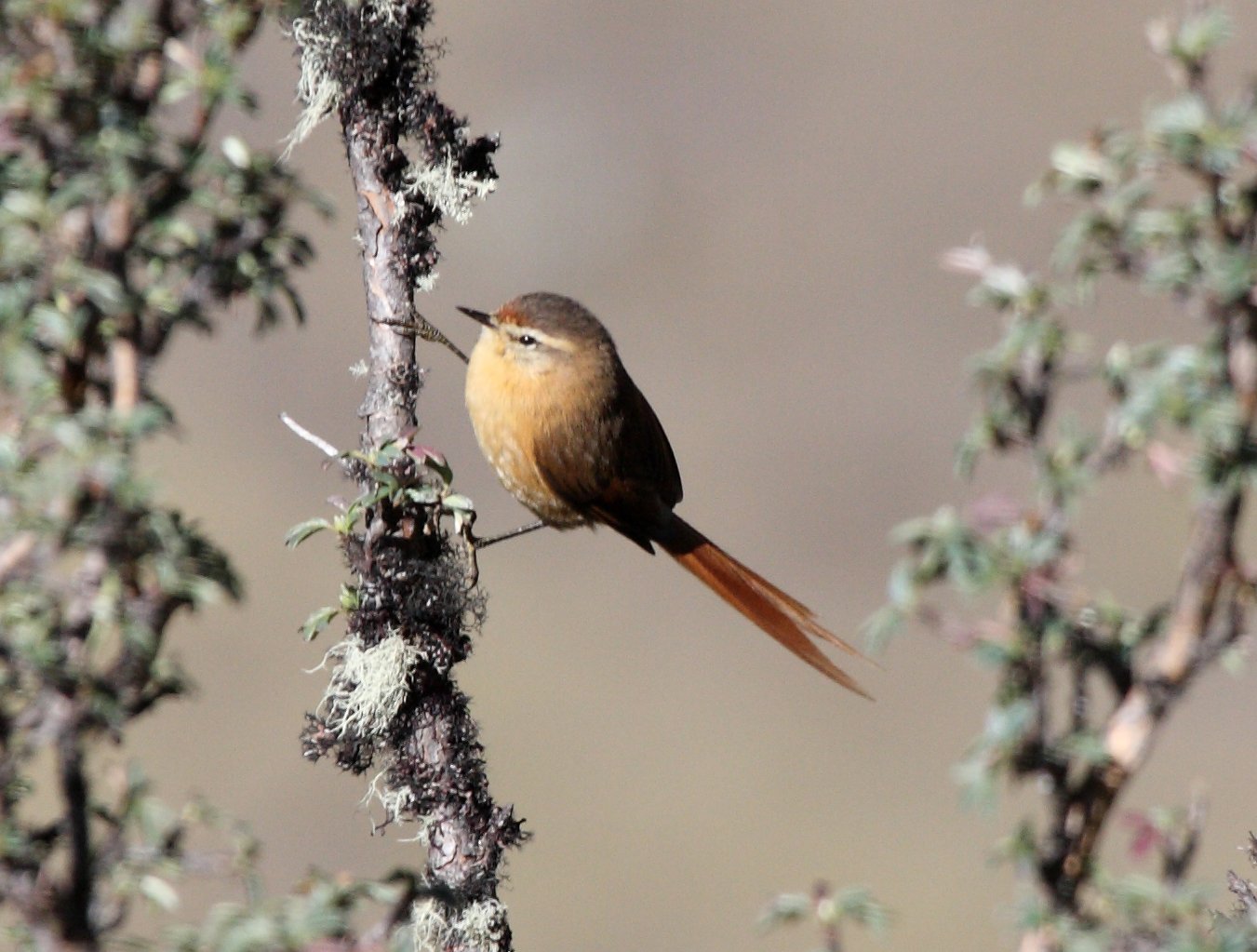
The Tawny Tit-Spinetail is a small, warm cinnamon ovenbird with a long, graduated tail that lives almost exclusively in Polylepis woodland. It was long placed among the tit-spinetails (Leptasthenura), but genetic studies showed that its closest relative is Des Murs's Wiretail Sylviorthorhynchus desmurii of Chile and Argentina. Peruvian and Bolivian birds differ slightly in colour.
Voice
The song is a rapid series of sharp chips that speeds up into a chatter. Also chattering runs, short notes and a brief snarling call.
Recording: Sjoerd Mayer — CC BY-NC-SA 3.0 · xeno-canto
Identification
16–17 cm, a small, slender bird with a short bill and a long, strongly graduated tail. The crown and back are tawny, the rump and tail rufous. The face and underparts are cinnamon-buff, with a narrow pale eyebrow: buff in Peruvian birds, whitish in Bolivian birds, which also have paler underparts. The wings are dusky with rufous edges. The sexes are alike.
Confusion species
The other tit-spinetails are streaked or have grey underparts: Andean Tit-Spinetail Leptasthenura andicola is heavily streaked with white, and White-browed Tit-Spinetail Leptasthenura xenothorax has a white eyebrow and a mottled throat above a grey belly. Canasteros (Asthenes) are greyer brown, have a shorter tail and stay more on or near the ground.
Habitat
Mainly Polylepis woodland, also montane scrub and grassland with shrubs, in Peru between 3950 and 4600 m, in Bolivia between about 2800 and 4200 m. It forages in pairs or small groups, often in mixed flocks, for arthropods on leaves, twigs and bark, sometimes hanging upside down from a branch. The only nest described was a ball of grass in the fork of a Polylepis tree, built by both birds.
Where the bird is most at home, classified by the vegetation units of the Andes and the west coast.


Range and movements
Absent from Colombia, Ecuador and the Galápagos. Peru: in separate areas, in the Cordillera Blanca in Ancash and Lima, and in the south in Apurímac, Cusco and Puno. Bolivia: in the Andes from La Paz southwards. Outside the guide area in northwestern Argentina, in Jujuy and Salta.
- Resident
- dark = core range, pale = thinly spread
How and when to look
Search high-elevation Polylepis groves, such as those of the Cordillera Blanca, for mixed flocks; the birds move through the outer foliage of the trees.
Conservation status
Least Concern; until 2016 it was listed as Near Threatened. The population is estimated at at least 50,000 mature birds and is probably declining: heavy grazing by livestock and fire prevent the regeneration of Polylepis woodland.
Scientific name
Sylviorthorhynchus yanacensis | (Carriker, 1933) (GBIF: Leptasthenura yanacensis)
Carriker described the species in 1933 as Leptasthenura yanacensis; because it was later moved to another genus, the author and year stand in brackets. The genus Sylviorthorhynchus was introduced in 1845 by Gay. The genus name combines the genus Sylvia with Greek orthos, 'straight', and rhunkhos, 'bill'. The species name yanacensis refers to Yanac in Áncash, Peru. The specimen the first description was based on came from Yanac, Áncash, Peru.