All species › Passerines › Ovenbirds and woodcreepers › Cinnamon-throated Woodcreeper
Cinnamon-throated Woodcreeper | Dendrexetastes rufigula
Bruinkeelmuisspecht | Trepatroncos gorjicanelo | Arapaçu-galinha
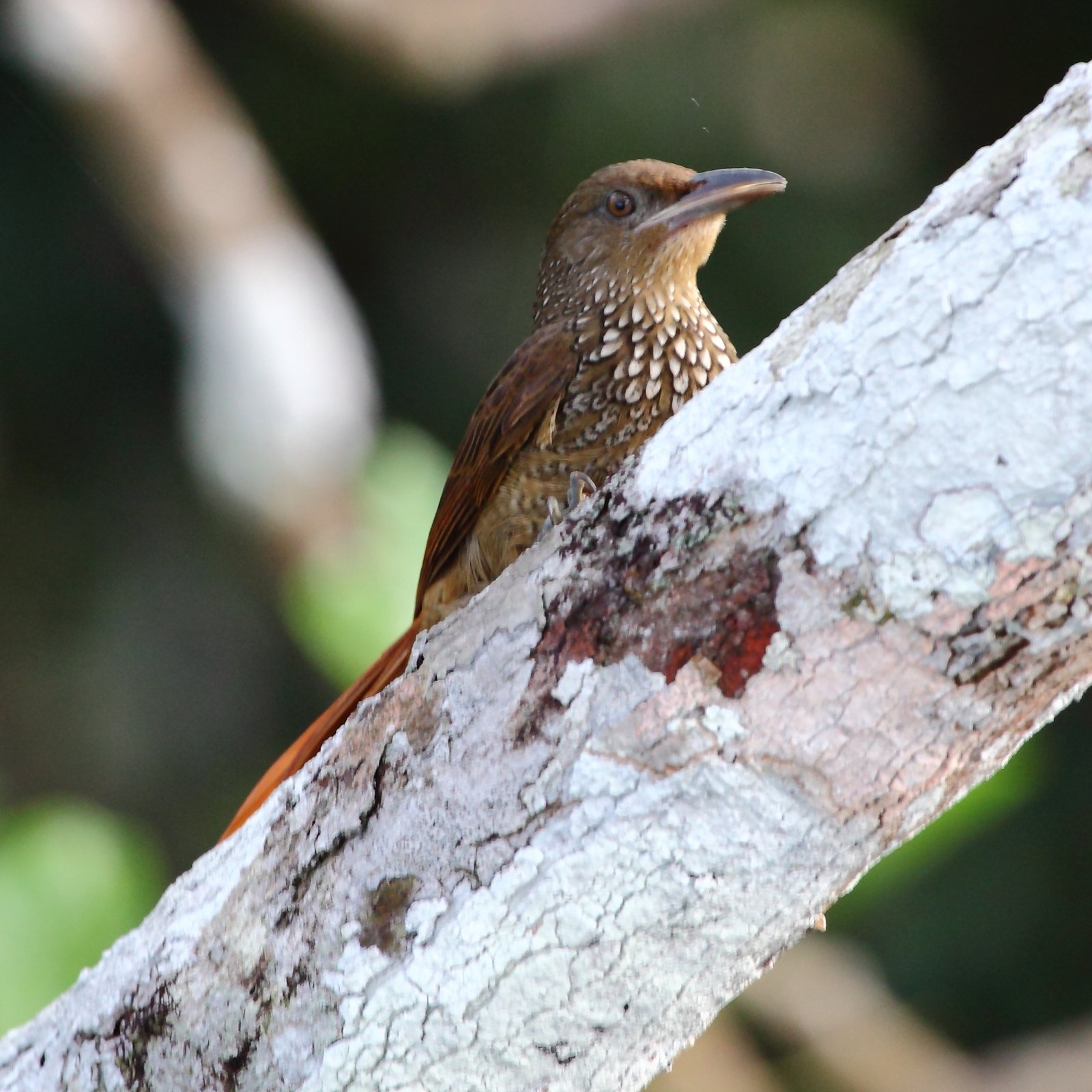
The Cinnamon-throated Woodcreeper is a stocky, rather plain woodcreeper of riverine forest and forest edges in the Amazonian lowlands, with a thick, straight, pale bill. It lives higher in the trees than most woodcreepers, often in the canopy, and also occurs at clearings and villages with tall trees. Its loud, accelerating series are heard mainly at dusk.
Voice
A loud, accelerating and descending series of sharp, slightly nasal notes, kew-kew-kew-kewkewkew. Heard mainly at dawn and at dusk, often as one of the last bird sounds of the day.
Recording: JAYRSON ARAUJO DE OLIVEIRA — CC BY-NC-SA 4.0 · xeno-canto
Identification
24–26 cm, with a thick, straight, pale greenish-ivory bill. The head, back and underparts are plain olive-brown; the wings, rump and tail are rufous. The throat is cinnamon to buff. Narrow, pale, dark-edged streaks run across the upper breast and upper back. The sexes are alike.
Confusion species
Buff-throated Woodcreeper Xiphorhynchus guttatus also has a pale throat, but a longer, thinner, slightly decurved bill and a heavily spotted breast. Amazonian Barred Woodcreeper Dendrocolaptes certhia is finely barred all over. Long-billed Woodcreeper Nasica longirostris is larger, with a very long bill and a streaked, blackish head. Plain-brown Woodcreeper Dendrocincla fuliginosa is smaller, with a dark bill and no streaks on the breast.
Habitat
Várzea, riverine forest and forest edges, clearings with scattered tall trees, also the edges of terra firme forest and trees around villages, up to about 500 m. It forages in the middle levels and the canopy, on trunks and thick branches and in bromeliads, for insects and other arthropods. It sometimes joins canopy mixed flocks. The nest is in a tree cavity.
Where the bird is most at home, classified by the vegetation units of the Andes and the west coast.


Range and movements
Colombia: in the Amazonian lowlands of the south-east. Ecuador: in the Amazonian lowlands. Peru: in the Amazonian lowlands. Bolivia: in the lowlands of the north. Absent from the Galápagos. Outside the guide area in Amazonian Brazil and in parts of Venezuela and the Guianas.
- Resident
- dark = core range, pale = thinly spread
How and when to look
Along rivers and at clearings with tall trees, watch for a stocky, plain woodcreeper with a pale bill high in the canopy. At dusk, listen for the accelerating series.
Conservation status
Least Concern. The species tolerates edges and semi-open land with tall trees, but depends on forest along rivers.
Scientific name
Dendrexetastes rufigula | (Lesson, 1844)
Lesson described the species in 1844 as Dendrocolaptes (orthocolaptes) rufigula; because it was later moved to another genus, the author and year stand in brackets. The genus Dendrexetastes was introduced in 1851 by Eyton. The genus name comes from Ancient Greek dendron, 'tree', and exetastēs, 'examiner, inspector'. The species name comes from Latin rufus, 'rufous', and gula, 'throat', for the cinnamon throat. The specimen the first description was based on came from Cayenne, French Guiana.